ClassNK Approves Liquefied CO2 Carrier Design For Socket SPAR Injection Facility



ClassNK has issued an Approval in Principle (AiP) for the designs of a liquefied CO2 carrier intended to Socket SPAR Unit for injection facility. The certification demonstrates its feasibility from regulatory and safety perspectives.
As CCS projects continue to advance worldwide, Japan faces unique challenges due to its deep and steep offshore waters, where subsea pipeline-based CO2 storage is not always feasible.
Under the Ministry of the Environment’s “Environmentally Friendly CCS Demonstration Project,” a floating offshore injection facility—the “Socket SPAR”—is being considered for installation above storage sites to enable CO2 injection from transport vessels even in such deep-water environments. In 2023, ClassNK issued AiP for the Socket SPAR.
At this time, for the liquefied CO2 carrier designed to accommodate the Socket SPAR, which has been under research and development by Shin Kurushima Sanoyas Shipbuilding Co., Ltd. under a commission from Uyeno Transtech Ltd., a member of the project consortium, ClassNK reviewed the design concept of the vessel based on its “Rules and Guidance for the Survey and Construction of Steel Ships”, including Part N, which incorporates the IGC Code, an international code for the construction and equipment of ships carrying liquefied gases such as LCO2 and LNG in bulk. Upon confirming compliance with the prescribed requirements, ClassNK issued an AiP.
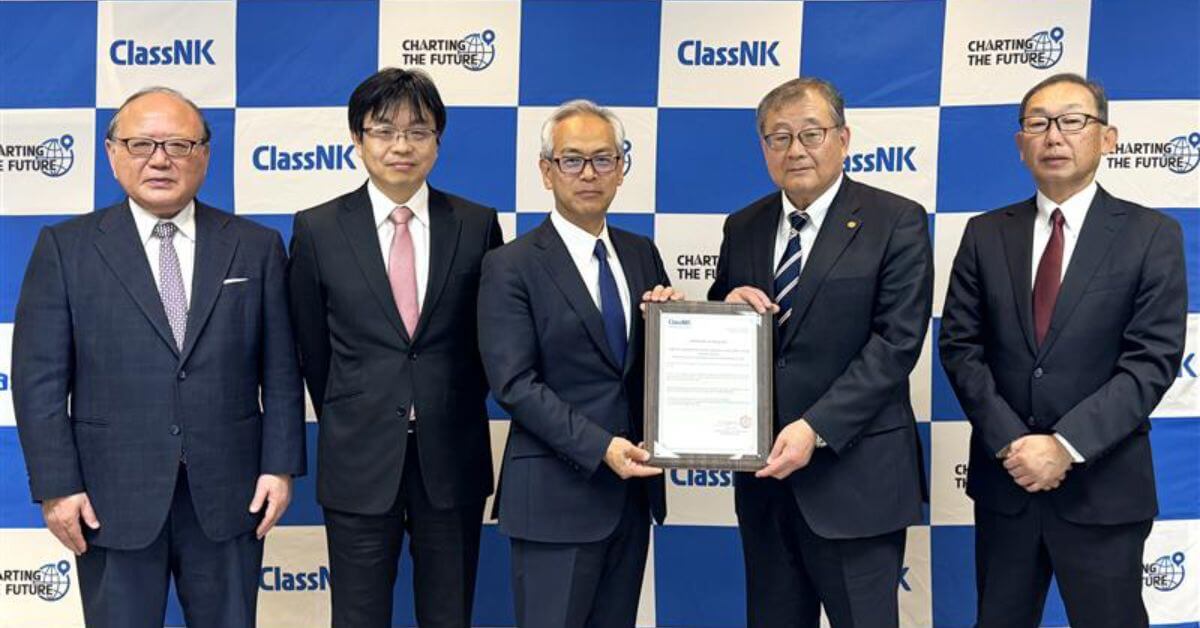
This AiP includes confirmation of the tests and verification results conducted using CO2 test facilities to investigate possibilities whether safety relief valves and piping could become clogged under various design conditions due to CO2, specifically when it turns into dry ice.
ClassNK will continually strive to contribute to advanced decarbonization initiatives through safety assessments and more.
Approval in Principle (AiP):
At the initial stage of designing or before the specific target ship to be implemented is decided, the design is examined based on the existing regulations such as international conventions and ship classification rules, and an Approval in Principle (AiP) is issued as proof of conformity with requirements. It also prevents rework of regulatory aspects in the post-process, shortens the examination time at the time of class registration, and can be used as a technical basis for external appeal of the design status.
Press Release
Want to read more?
Check out the full article on the original site