Massive 328-Foot Ancient Ship Graveyard Discovered Off Libya’s Greek Port City

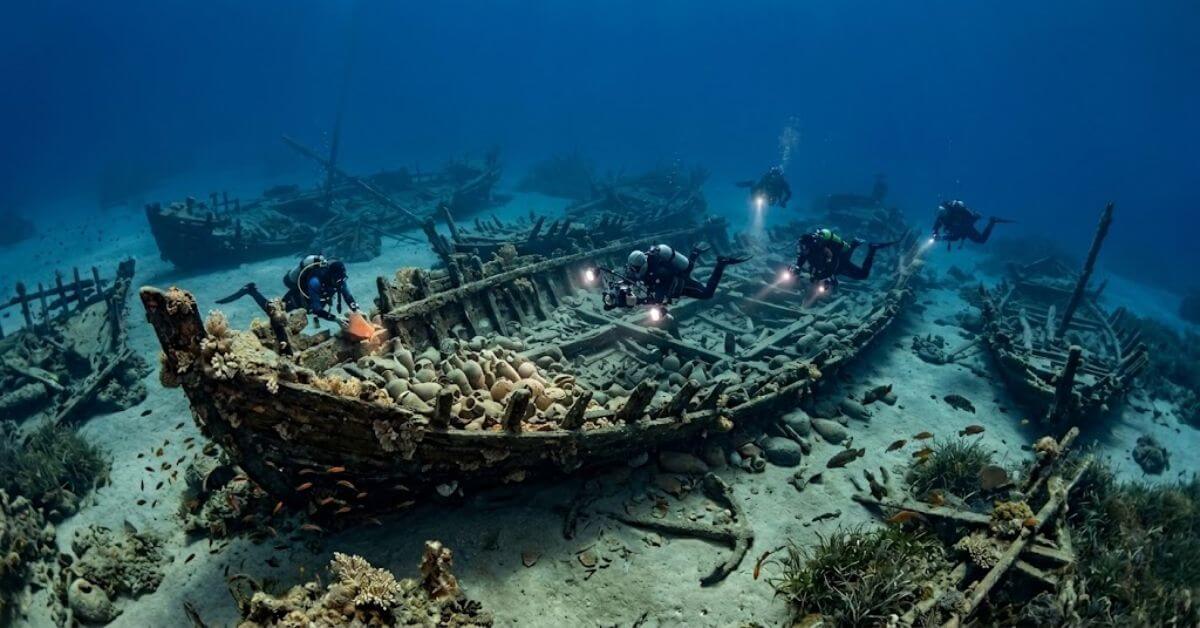
A team of Polish archaeologists has discovered a 328-foot-long stretch of ancient shipwreck remains off the coast of Ptolemais, an ancient Greek port city in present-day Libya.
The find was made during underwater surveys after researchers returned to the site in 2023, following a 13-year break caused by the Libyan civil war.
The discovery shows that several ships were lost in the same area over time while trying to reach the port. The wreckage lies across more than 100 metres of the seabed near a shallow rock formation.
According to the researchers, the length and spread of the debris confirm that it is not a single wreck but the remains of multiple vessels.
This suggests that ships approaching the port, especially from the east, repeatedly ran into the same hazard and sank in that zone.
The site has yielded several artefacts linked to ancient trade. Archaeologists recovered fragments of cargo, including amphorae that were commonly used to transport goods such as wine and oil.
One of the amphorae was found to contain what is believed to be crystallised wine. A bronze aequipodium, used as a weight in a Roman balance scale and shaped like a woman’s head, was also found. Researchers said these items are still being studied.
Alongside the shipwrecks, the team documented remains of ancient port infrastructure that are now underwater. These include columns, parts of submerged roads, dropped anchors, and tools that may have been used in ancient times to examine the seabed.
Experts said that over the centuries, slight sea-level rise in the Mediterranean and repeated earthquakes caused parts of the coastline and port to sink.
Excavations at Ptolemais restarted in 2023 as part of ongoing research led by the University of Warsaw. The project marks 25 years of Polish archaeological work in Libya. Both underwater and land-based studies are being carried out to understand the city and its surroundings.
On land, researchers identified a previously unknown road leading to the acropolis, which stands about 300 metres above sea level. They also found remains that may belong to observation towers, possibly part of the city’s defence system.
Near this road, a Roman milestone with a Greek inscription from the Severan dynasty, dating to the first half of the 3rd century CE, was also discovered.
Ptolemais was one of the largest cities in the Cyrenaica region. It was founded between the late 4th and 3rd centuries BCE during the rule of the Ptolemaic dynasty and remained in use until the Arab conquest in the 7th century CE. It served as an important coastal and defensive centre in ancient North Africa.
Conservation work is also being carried out at the site. Specialists are working to preserve wall paintings and restore artefacts that have already been moved to a local museum. Researchers said much of the city still remains unexplored and further work will continue in the coming years.
Reference: scienceinpoland
Want to read more?
Check out the full article on the original site