Floating Storage Regasification Unit (FSRU): How It Works,Types & Applications
In the winter of 2022, Germany experienced its worst energy supply crisis since the post-war era. The Russian pipeline gas, which supplied around 55% of Germany’s natural gas, was cut off, and the country needed LNG infrastructure to handle further imports.
To avoid building an LNG terminal, the country, within 18 months, commissioned 5 Floating Storage Regasification Units at Wilhelmshaven, Brunsbüttel, and Lubmin, and began receiving LNG.
The FSRU is not a new tech; however, the 2022 Energy shock highlighted how it can save millions of dollars by providing an option to store LNG without needing to build an elaborate facility, which would take years.
This article explains what an FSRU is, how the regasification process works, what its key components do, and how it compares to land-based alternatives, all with the technical detail that engineers, operators, and informed readers need.
What Is an FSRU?
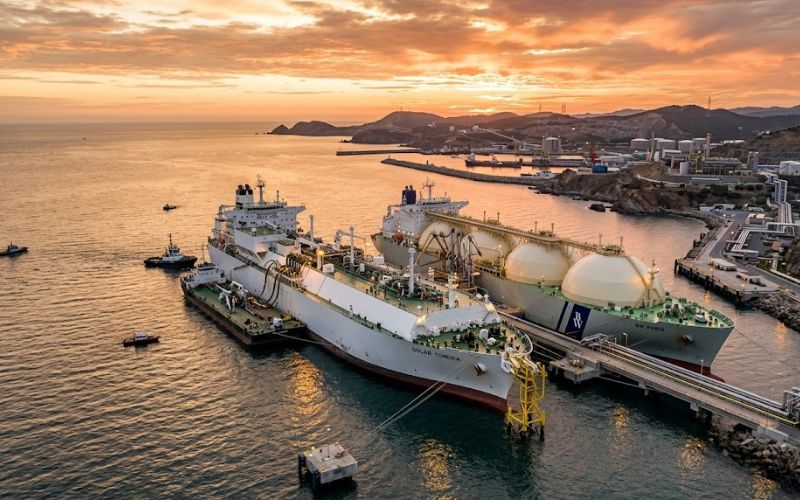
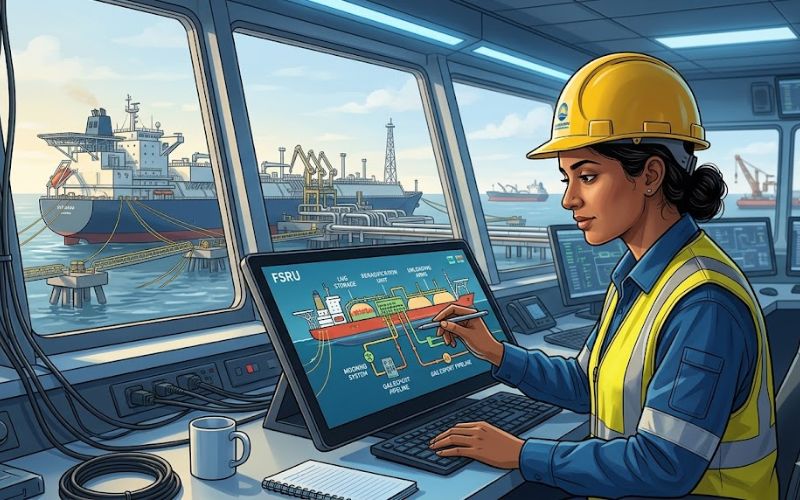
A Floating Storage Regasification Unit (FSRU) is a purpose-built or converted vessel that can receive LNG from supply tankers. It then stores it in cryogenic tanks and converts it back to a gaseous form for delivery to onshore pipeline networks.
An FSRU has the same function as an onshore LNG receiving terminal, with the only difference being that, in the case of an FSRU, the storage tanks, regasification train, and gas export systems are located on a floating hull rather than on land.
The FSRU is permanently or temporarily moored at a jetty or offshore buoy. It has a subsea or above-water pipeline which connects it to the national gas network.
By the end of 2023, 51 FSRUs were operating across the globe, up from 30 in 2020, a 70% increase in three years.
The global FSRU market was valued at $903 million in 2024 and is estimated to reach $1.78 billion by 2033, growing at a CAGR of 7.85%.
Before moving forward, it is important to understand a key distinction.
An LNG carrier transports LNG from a liquefaction plant to a receiving terminal. An FSRU receives, stores, and regasifies LNG. However, some vessels can work as an LNG Carrier and also as an FSRU when moored.
How the LNG Regasification Process Works
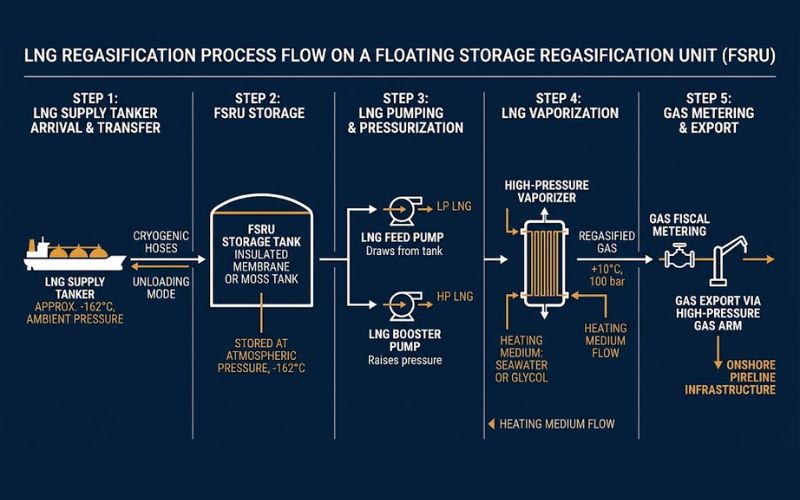
A supply tanker brings LNG, which is at −162°C (−260°F), the atmospheric pressure and temperature at which natural gas liquefies, reducing its volume to 1/600th of its gaseous state. The regasification process reverses this through pressurisation and heating.
The first step is the ship-to-ship transfer, where the supply tanker positions itself along the FSRU and transfers liquified natural gas or LNG either through unloading arms or cryogenic hoses from the tanker’s cargo tanks into the FSRU’s storage tanks.
Then LNG remains in the FSRU’s insulated cargo tanks at atmospheric pressure of −162°C, held in its liquid state by tank insulation and a continuous boil-off gas management system.
When LNG needs to be exported, a pump draws the liquid LNG from the tank, after which a booster pump raises the pressure to approximately 100 bar, which is the operating pressure of the high-pressure gas export system.
The next step is Vaporisation and heating. The high-pressure LNG passes through a vaporiser, which uses a heating medium to convert the liquid to gas. The temperature rises from −162°C to approximately +10°C at full export pressure.
Finally, regasified natural gas passes through a metering station and is supplied to an onshore pipeline through a high-pressure export arm or flexible hose.
The flow rates on FSRUs range from 400 to 750 million standard cubic feet per day (MMscfd), depending on the size of the vessel and configuration of the regasification train.
Key Components of an FSRU
Storage Tanks
FSRUs use one of the two tank designs described below.
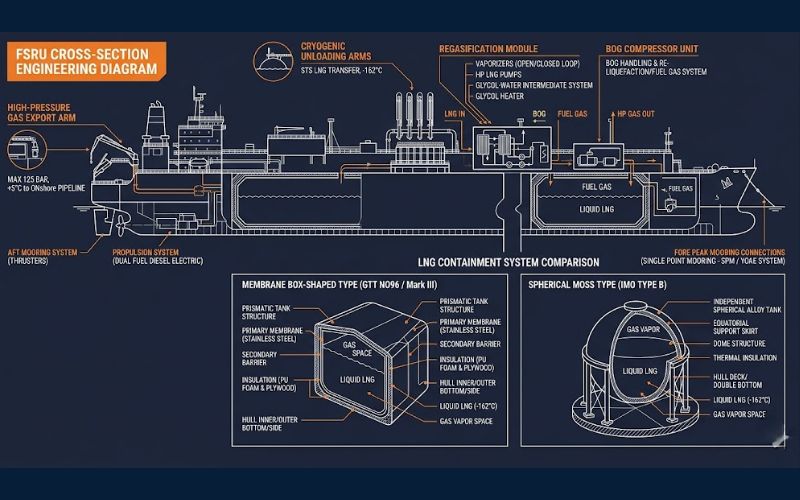
The first are membrane tanks that are shaped like a box and conform to the vessel’s hull form. They give a flat deck to mount regasification equipment. They also offer higher storage efficiency per unit of hull volume.
Moss tanks are made of aluminium and are spherical. They protrude above the deck and are robust, self-supporting infrastructure, but do not utilise the deck space judiciously.
Hence, most FSRUs use the membrane tank design.
Storage capacity on operational FSRUs ranges from approximately 125,000 m³ to 263,000 m³.
Regasification Train
The regasification train includes an LNG feed pump (drawing from the tank), a booster pump (raising pressure to export level), a vaporiser (converting liquid to gas using a heating medium), and a heater (bringing gas to the required delivery temperature of approximately +10°C). Some FSRUs carry two parallel trains to allow maintenance of one while the other continues operating.
LNG Unloading: Arms vs Cryogenic Hoses
| Feature | Unloading Arms | Cryogenic Hoses |
|---|---|---|
| Installation | Fixed — mounted on FSRU deck | Flexible — deployed as needed |
| Space requirement | Higher | Lower |
| Cost | Higher capex | Lower capex |
| Offloading speed | Faster — higher flow rates | Slower |
| BOG generation | Less | More |
| Ease of operation | Easier — articulated joints | Requires more handling |
| Best for | High-volume, frequent transfers | Lower-volume or temporary operations |
Heating Medium Systems
Open-loop system (seawater)
In this, seawater from below the vessel is drawn and passed through a heat exchanger to warm the LNG. The cold discharge water is subject to strict environmental regulations in many jurisdictions.
Closed loop (glycol/freshwater)
A mixture of freshwater and glycol is circulated through the heat exchanger, preheated by steam from the vessel’s boilers. This system is ideal for places where environmental discharge limits are strict, or in cold water regions where seawater temperature is insufficient.
Intermediate Fluid Vaporisation (IFV)
In this two-stage process, propane condenses against the LNG, and then propane is re-vaporised using seawater or another heating medium. The IFV system avoids direct LNG-seawater contact, reducing freezing risk in the heat exchanger and allowing a more compact unit.
Boil-Off Gas (BOG) Management
Even in a fully insulated tank, heat ingress causes a small proportion of the LNG to vaporise continuously.
On an FSRU, BOG generation runs at 0.10–0.15% of cargo volume per day, roughly 3–5 tonnes per hour depending on tank size and ambient conditions.
The BOG management system handles this by returning some vapour to the supply tanker using a vapour return line after reliquefying excess BOG with onboard compressors and returning it to the cargo tanks, or consuming it as fuel in the vessel’s boilers.
Gas Export Arms and Hoses
Regasified natural gas is delivered to the onshore pipeline through a high-pressure gas export arm, which can handle gas at operating pressures of up to 150 bar. In situations where a rigid arm cannot be used, high-pressure flexible hoses are the solution. Offshore FSRUs typically route gas to shore via a subsea pipeline connected at the mooring point.
Types of FSRUs
1. Purpose-built FSRU
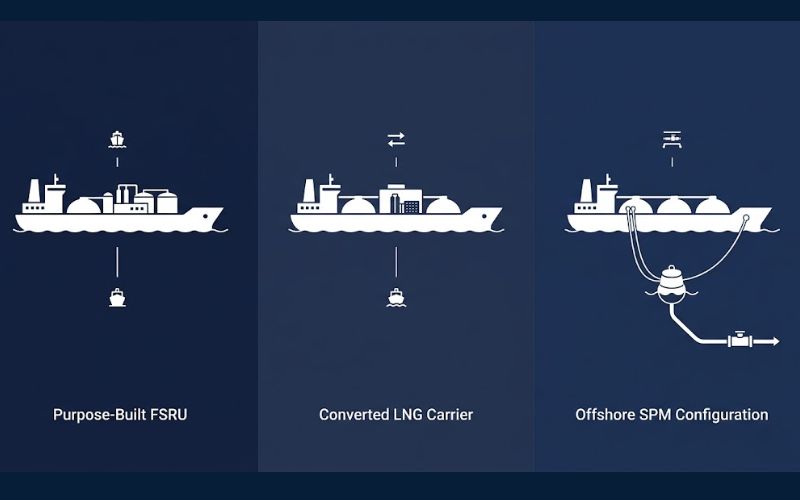
These vessels are especially constructed to function as floating regasification units. They feature membrane tanks, a flat deck for mounting regasification equipment and possess mooring systems. Compared to converted vessels, these are larger and more efficient.
2. Converted LNG carrier
When an LNG tanker is converted into an FSRU, a regasification module is installed on the deck. A converted FSRU is more cost-effective than new construction, but has a low regasification capacity and shorter operational lifespan.
3. Mobile (self-propelled) FSRU
As the name suggests, this unit retains the propulsion capacity, and so it moves to a new location or functions as a conventional LNG ship during periods when regasification demand is low.
4. Fixed offshore unit
In this FSRU, the propulsion system is removed or not installed in the first place. Hence, it is permanently moored at a specific location. This type of FSRU has a lower operating cost, but it cannot be relocated.
Mooring configurations
- Jetty-moored is the most common type of FSRU, which moors alongside a purpose-built jetty with a fixed gas export arm connection.
- Single Berth FSRU moors at a single berth structure, which allows the supply tanker to moor on the opposite side of the FSRU.
- Single Point Mooring (SPM): The FSRU is connected to a buoy at the bow, allowing it to weathervane, i.e., rotate with wind and current to reduce mooring loads. It is used in more exposed offshore locations; gas is exported via a subsea pipeline from the buoy.
FSRU vs Land-Based LNG Terminal
| Factor | FSRU | Land-Based LNG Terminal |
|---|---|---|
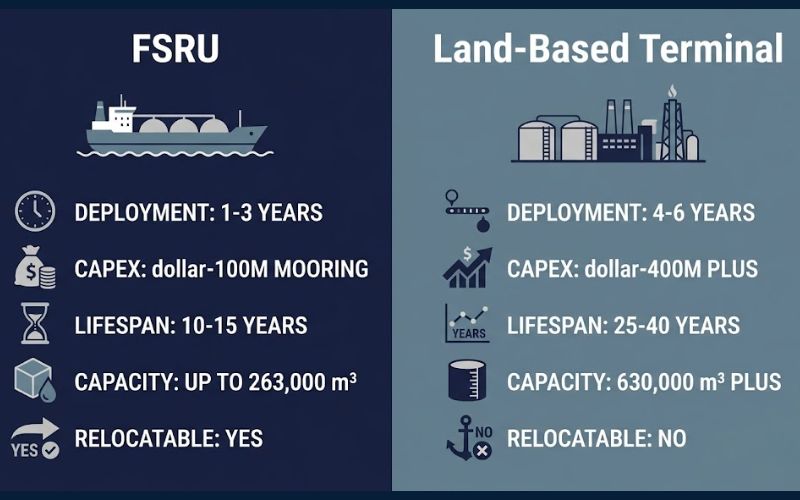
| Deployment time | 1–3 years | 4–6 years |
| Typical capex (mooring/infra) | ~$100 million | $400 million+ |
| Maximum storage capacity | Up to ~263,000 m³ | Up to 630,000 m³+ |
| Operational lifespan | 10–15 years | 25–40 years |
| Relocatable | Yes (if self-propelled) | No |
| Scalability | Limited | High — expansion possible |
| Weather sensitivity | Higher — STS limited in heavy seas | Lower — fully onshore |
| Land requirement | Minimal — jetty only | Significant |
| Ongoing cost | Charter rate $25,000–$40,000/day | Operating cost only |
| Best suited for | Fast deployment, emerging markets, emergency supply | Long-term baseload import capacity |
The FSRU cannot replace a permanent land-based LNG Terminal, but it is definitely a faster, cheaper entry point, and, for countries without the demand certainty to justify $400 million in fixed infrastructure, it is the ideal choice.
Advantages of FSRUs
Speed of deployment
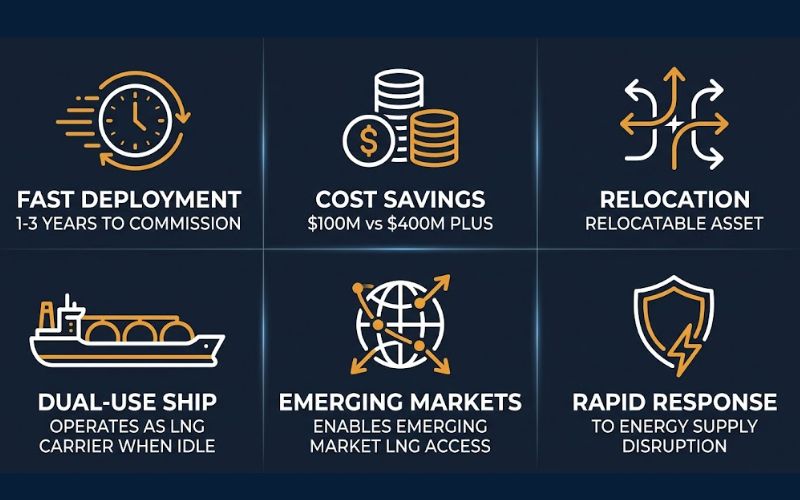
An FSRU can become operational in just 1-3 years compared to a land-based facility, which can take several years.
For instance, the ones commissioned in Germany between 2022 and 2024 show that the process, in fact, can be sped up if permission, procurement and construction run together.
Lower upfront capital
The infrastructure for mooring, jetty connection and the onshore receiving facilities for an FSRU project costs around a $100 million, which is a fraction of the $400 million or even more needed to operate a land-based terminal of the same capacity.
Relocatable asset
A self-propelled FSRU can be moved to a different market if demand at the original location falls. This is not possible with an onshore LNG facility.
Dual-use capability
FSRUs with propulsion systems can function as LNG carriers between FSRU contracts. Thus, owners and charterers can generate revenue in multiple configurations.
Accessible to emerging markets
Countries that cannot invest in a land-based terminal or those without sufficient port depth to accommodate massive LNG carriers can receive piped gas via an FSRU moored offshore with a subsea export line running to shore.
Limitations of FSRUs
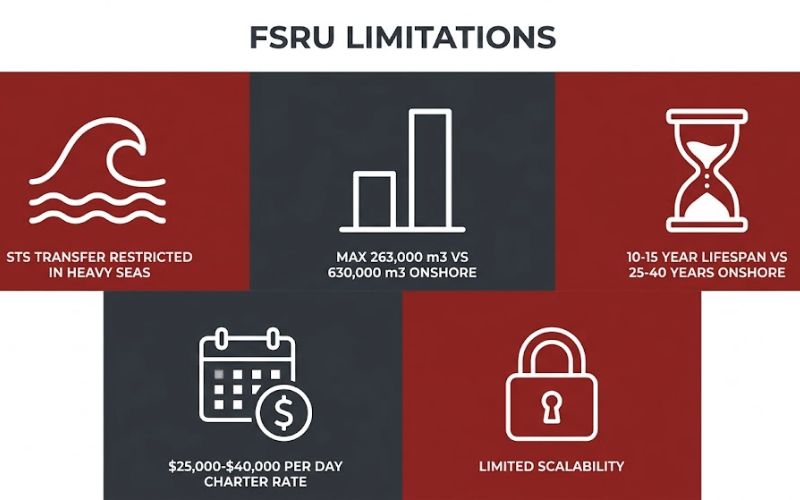
Weather sensitivity
Ship-to-ship LNG transfer between a supply tanker and an FSRU requires calm conditions with wave heights below 2.5–3.0 m. During rough weather or exposed locations, the number of operable transfer days per year is less.
Limited Storage Capacity
The largest FSRU in operation can accommodate 263,000 m³. Medium-sized onshore terminals commonly exceed 400,000 m³, and large baseload facilities reach 630,000 m³ or more. For high-volume markets, FSRU capacity can be a major constraint.
Shorter operational lifespan
FSRUs converted from existing LNG carriers have limited remaining hull life, often 10 to 15 years. Onshore terminals can operate for 25 to 40 years. The shorter lifespan means higher lifecycle costs when the asset must be replaced.
Ongoing charter costs
FSRU operators charter their vessels at $25,000–$40,000 per day and accumulate $135 to $220 million over a 15-year charter period, on top of the initial mooring investment, a recurring cost that an onshore terminal owner does not face after construction.
Limited expandability
Adding throughput capacity to an onshore terminal means adding tanks and regasification trains on available land, but for FSRU, it means bringing an additional vessel, which is complex and expensive.
Major FSRU Operators and Notable Deployments

1. Höegh LNG, Norway
One of the world’s largest FSRU operators, with a fleet of purpose-built FSRUs deployed in Colombia, Lithuania, Egypt, and Pakistan.
2. Golar LNG, Bermuda/Norway
Operates converted and purpose-built FSRUs across multiple continents; also active in floating LNG production (FLNG).
3. Excelerate Energy, USA
Pioneer of the FSRU concept; operates vessels in Brazil, Argentina, Bangladesh, Pakistan, and the UAE.
4. BW LNG, Singapore
Operates FSRUs under long-term charter in the Philippines and Croatia.
5. Exmar, Belgium
Specialises in smaller FSRUs and floating regasification units for emerging markets.
Asia’s growing FSRU market
Bangladesh, Pakistan, and India account for a significant portion of FSRU demand growth in Asia. Bangladesh operates FSRUs at Maheshkhali to offset domestic gas depletion, and Pakistan uses FSRUs at Port Qasim to supplement pipeline supply.
Frequently Asked Questions
1. What is the difference between an FSRU and an LNG carrier?
An LNG carrier transports liquefied natural gas between a liquefaction terminal and a receiving facility. An FSRU is permanently or semi-permanently moored. It stores LNG and regasifies it for onshore pipeline delivery. Some vessels are dual-purpose and can operate in both roles.
2. How long does it take to commission an FSRU?
A purpose-built FSRU takes approximately two to three years from contract to first gas. A converted LNG carrier can become active within 12 to 18 months.
3. What is boil-off gas (BOG) and how is it managed on an FSRU?
Boil-off gas is the natural gas that vaporises from the LNG cargo due to heat ingress through the tank insulation. FSRUs generate BOG at approximately 0.10–0.15% of cargo volume per day. The BOG management system handles this by returning vapour to the supply tanker during transfer, reliquefying excess BOG with onboard compressors, or consuming it as fuel in the vessel’s boilers.
4. Can an FSRU operate in all weather conditions?
The regasification process and gas export can continue in most sea states since the vessel is moored. The main weather constraint is the ship-to-ship LNG transfer from the supply tanker, which is limited to wave heights below 2.5 and 3.0 m.
5. How many FSRUs are currently operating worldwide?
As of the end of 2023, 51 FSRUs were in active operation globally. A further 13 floating and offshore regasification terminals were under construction at the close of 2024, with approximately 62% of that capacity expected to enter service during 2025, primarily in Europe and Asia.
Conclusion
The defining attribute of FSRU is speed. They can become operational in a shorter period compared to land-based elaborate LNG Terminals, which require more time and initial investments.
However, FSRUs also have constraints, such as limited capacity compared to an onshore LNG Terminal, weather-dependent transfer conditions, and charter costs which accumulate with time.
In markets where the demand is stable and long-term, an onshore terminal is the most economical.
However, in emerging markets where LNG demand fluctuates, those countries which are entering the trade for the first time, and nations facing urgent supply shortfalls, FSRU is the perfect choice.
You might also like to read-
- Understanding Design Of Liquefied Gas Carrier
- Properties of Membrane Tanks For Transportation of LNG Cargo
- Heat Exchangers On Ships Explained
- What is Boiling Liquid Expanding Vapour Explosion On Gas Carrier Ships?
Want to read more?
Check out the full article on the original site