Hyundai Glovis Introduces World’s First Car Carrier Capable Of Transporting Over 10,000 Vehicles
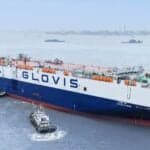


Hyundai Glovis has introduced the world’s largest Pure Car Carrier and Truck Carrier (PCTC). Through this, the company plans to support exports for the domestic finished vehicle industry and further strengthen its business competitiveness in the global finished vehicle maritime transport market.
Hyundai Glovis announced on the 29th that it will deploy the ‘Glovis Leader,’ a super-large PCTC with a capacity of 10,800 vehicles, for the maritime transport of finished vehicles.
Prior to this, officials including Hyundai Glovis CEO Lee Kyu-bok attended the ship naming ceremony held at the GSI shipyard in Guangzhou, China, on the 28th.
The vessel measures 230 meters in length and 40 meters in width, weighing 102,590 tons. It features a total of 14 cargo decks, the combined area of which is approximately the size of 28 football fields.
The ship can carry up to 10,800 vehicles based on compact car standards. Hyundai Glovis is the first global car carrier to introduce a PCTC with a capacity of over 10,000 vehicles, and as of now, this vessel is the world’s largest PCTC.
In addition, as the vessel is equipped with a liquefied natural gas (LNG) dual-fuel propulsion engine and capable of using shore power supply facilities (AMP), it is expected to respond seamlessly to strengthening eco-friendly regulations, such as the European Union (EU) carbon emissions trading scheme.
AMP refers to a facility that supplies onshore electricity to ships while they are docked. While berthed at a pier, ships emit sulfur oxides, nitrogen oxides, and particulate matter because they generate their own fuel using Bunker C oil to power onboard refrigeration and freezing facilities. If they receive electricity from onshore instead of generating their own fuel, pollutant emissions are significantly reduced.
Hyundai Glovis plans to deploy the PCTC on a rotational basis across global routes.
Hyundai Glovis plans to expand its operational PCTC fleet to 128 vessels by 2030, including the newly introduced ships.
Furthermore, based on this large-scale fleet, the company has set a goal to increase the volume of finished vehicles it transports by sea from 3.4 million to 5 million units annually by 2030.
If this goal is achieved, Hyundai Glovis is expected to handle more than 20% of the global maritime volume of finished vehicles.
To this end, Hyundai Glovis is actively engaging in sales activities to secure non-affiliated cargo alongside its affiliated volume. Last year, the company signed maritime transport contracts with numerous original equipment manufacturers (OEMs) in Europe, North America, and China.
In particular, as China’s finished vehicle export volumes have recently increased, the utilization of Hyundai Glovis’s fleet is rising. For reference, last year, the proportion of non-affiliated revenue in Hyundai Glovis’s finished vehicle maritime transport sector was approximately 53%, which was higher than the proportion of affiliated revenue.
The industry predicts that Hyundai Glovis’s continued introduction of PCTC will help alleviate the global shipping capacity shortage.
While the shortage of PCTC capacity has persisted over the past few years due to a surge in automobile exports from the Far East, the situation is intensifying as many PCTCs are taking alternative routes amidst continuing geopolitical risks surrounding the Middle East and the Red Sea, thereby extending transit times.
A Hyundai Glovis official stated, “We will continue to strengthen our competitiveness in finished vehicle maritime transportation and strive to provide stable supply chain services to global shippers.”
Want to read more?
Check out the full article on the original site