U.S. Navy’s 9,200-Ton Destroyer USS Patrick Gallagher Begins Sea Trials Ahead Of Delivery
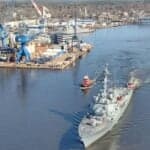


The future USS Patrick Gallagher (DDG-127), a 9,200-ton guided-missile destroyer built for the US Navy, has begun sea trials.
The vessel departed General Dynamics Bath Iron Works’ shipyard in Maine on April 27 and entered open waters for a series of performance tests.
According to the shipbuilder, the trials are part of the final steps before the Navy accepts the vessel.
Conducted under the control of Bath Iron Works rather than the Navy, this phase is aimed at confirming whether the destroyer meets all required operational and engineering standards.
DDG-127 is the last destroyer to be built in the Arleigh Burke Flight IIA Technology Insertion configuration.
The vessel represents the closing phase of this production line, as the US Navy shifts focus to newer Flight III ships equipped with upgraded radar and power systems.
Sea trials are designed to test the ship as a complete system rather than individual components.
Engineers are assessing propulsion, maneuverability, endurance, and overall system integration while the ship operates under real sea conditions.
The destroyer is powered by four General Electric LM2500 gas turbines, generating around 100,000 shaft horsepower. These engines are expected to push the vessel to speeds of approximately 30 to 31 knots.
During trials, engineers are conducting multiple speed runs at varying power levels to record performance data and compare it with Navy requirements.
Maneuverability tests are also underway to evaluate how the ship responds to turns and course changes, along with its stability in different conditions.
Emergency stopping trials are being conducted to measure how quickly the vessel can halt from full speed by reversing propulsion.
Endurance tests are monitoring fuel use, cooling systems, and exhaust performance during longer runs. To ensure accurate results, the ship is run in both directions to reduce the impact of wind and sea currents.
GPS and onboard systems are used to collect data for comparison with Navy requirements. Unlike isolated equipment testing, sea trials involve running multiple systems simultaneously.

Power distribution across the ship is closely observed while propulsion systems, auxiliary machinery, and onboard equipment operate together. This helps verify that the vessel can maintain stable performance under operational loads.
Mechanical systems, piping networks, and ventilation systems are activated in sequence and tested under increasing stress levels to determine their limits.
High-risk tests, including maximum-power runs, are conducted under controlled conditions with strict safety measures in place.
The trials are being carried out by a team from Bath Iron Works, including engineers, mechanics, and system operators. The crew follows established procedures that define testing sequences and safety protocols.
At this stage, combat systems are not fully exercised, as the focus remains on seaworthiness and engineering performance.
As part of the updated sea-trials programme, the ship also made a planned stop in Portland to rotate personnel.
Crew members who completed their assignments disembarked while new personnel joined to continue the testing phase.
Construction of DDG-127 began in 2018, with the keel laid in March 2022. The vessel was launched in October 2024.
Measuring around 509 to 513 feet in length with a beam of about 66 feet, the destroyer has a displacement of roughly 9,200 tons and can accommodate a crew of around 380 personnel.
The ship is equipped with the Aegis Baseline 9 Combat System, designed to enhance air and missile defence capabilities, including improved reaction times and electronic countermeasures.
It also features 96 vertical launch system cells, enabling a wide range of strike, anti-submarine, and air defence operations.
Additional armament includes a 5-inch naval gun, close-in defence systems, torpedo launchers, and facilities to operate two MH-60R helicopters, ensuring multi-mission capability within the fleet.
The destroyer is named after Marine Corps Corporal Patrick Gallagher, who was awarded the Navy Cross for his actions during the Vietnam War.
Born in Ireland in 1944, he moved to the United States in 1962 and joined the Marine Corps two years later.
During a battle near Cam Lo in July 1966, he intervened to protect fellow Marines from grenades, preventing casualties. He was later killed in action in March 1967 at the age of 23.
Reference: interestingengineering
Want to read more?
Check out the full article on the original site