Iran May Deploy Mine-Carrying Dolphins In Strait Of Hormuz To Target U.S. Warships
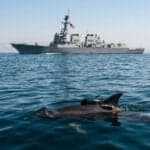


Iran is considering using trained dolphins equipped with mines to target US warships in the Strait of Hormuz, according to a report by The Wall Street Journal.
The idea is being discussed as the country faces growing pressure from a US-led blockade that has sharply reduced its oil exports.
Officials cited in the report said some groups within Iran now see the blockade as an act of war rather than just economic pressure.
This has led to discussions around taking stronger military action, including the use of unconventional methods.
The reported plan involves dolphins trained to carry explosives and strike enemy vessels. While unusual, the concept is linked to earlier military programs.
Iran had acquired trained dolphins from the former Soviet Union in 2000, according to a BBC report at the time.
These animals were said to be trained to carry out tasks such as attacking targets with harpoons and transporting explosives, including missions that could involve suicide-style strikes on ships.
The origins of such training go back to the Cold War. The Soviet navy had developed a dolphin program in Sevastopol, where animals were trained for missions ranging from detecting underwater threats to attacking enemy divers.
After the Soviet Union collapsed, the program was transferred to Ukraine, and some of the dolphins, along with equipment and trainers, were later moved to Iran. What happened to those animals after that has not been publicly confirmed.
The use of dolphins in military roles is not limited to Iran. The United States has also used trained marine mammals, but mainly for defensive purposes such as detecting naval mines and guarding ships.
During the Iran-Iraq War in the late 1980s, US Navy dolphins were deployed in the Persian Gulf to help protect vessels and locate underwater threats.
Shipping through the Strait of Hormuz has been heavily affected since late February 2026, when military action between the United States, Israel, and Iran escalated.
Iran responded with missile and drone strikes on US and allied targets, and since mid-April, US forces have enforced a blockade on Iranian ports. This has led to what analysts describe as a “dual blockade” in the region.
Hamidreza Azizi, a visiting fellow at a Berlin-based research institute, told The Wall Street Journal that many in Tehran now view the blockade as a different form of war.
He said Iranian decision-makers may begin to see renewed conflict as less costly than continuing under current economic pressure.
Along with the possible use of dolphins, Iran is also looking at other options. These include deploying submarines in the strait and targeting undersea communication cables.
The Islamic Revolutionary Guard Corps has already warned that it could cut key cables running through the waterway, which could disrupt global internet traffic.
The Strait of Hormuz remains one of the most important shipping routes in the world.
Around 20% of global oil and liquefied natural gas passes through it each year, and before the current crisis, about 3,000 ships moved through the strait every month.
Any disruption in this area has direct consequences for global trade and energy markets.
The United States has maintained strong mine-clearing capabilities in the region, including helicopters, specialised ships, unmanned systems, and trained dolphins used for detection.
At the same time, newer technologies such as sea drones are being deployed to help keep shipping lanes open, though many of these systems are still limited in real-world use.
US President Donald Trump has ordered the Navy to take action against any Iranian vessels attempting to lay mines in the strait, including using force if needed.
The blockade has already cost Iran billions of dollars in lost oil revenue, with estimates putting the figure at around $4.8 billion.
References: wionews, AOL
Want to read more?
Check out the full article on the original site