U.S.-Flagged Ship Alliance Fairfax Exits Strait Of Hormuz After Months Under Military Escort
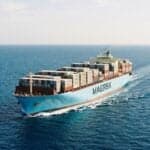


Danish shipping major A.P. Moller-Maersk has confirmed that its U.S.-flagged roll-on/roll-off vessel Alliance Fairfax safely exited the Persian Gulf on May 4 under U.S. military escort.
The vessel, operated by Farrell Lines, a subsidiary of Maersk Line Limited, completed the transit “without incident,” with all crew reported safe.
The ship had been unable to leave the Gulf since late February, when conflict between the United States and Iran sharply escalated, leading to a near-collapse in commercial traffic through the critical maritime chokepoint.
According to the company, the transit followed direct coordination with the U.S. military, which approached Maersk with an option to move the vessel under protection.
After developing a detailed security plan involving both shore-side and onboard teams, the operation was approved and executed with U.S. naval support.
This follows earlier statements from United States Central Command (CENTCOM), which said two U.S.-flagged merchant vessels had successfully passed through the Strait as part of a newly launched initiative called “Project Freedom.”
The identity of the second vessel has not yet been disclosed.
The U.S. government introduced Project Freedom to assist ships stranded in the region following months of heightened threats, including missile strikes, drone attacks, and naval mines.
The Strait of Hormuz remains one of the world’s most important shipping routes, previously handling around 20 percent of global oil flows.
Its disruption has had a direct impact on global energy markets and supply chains, increasing pressure on governments to restore safe passage.
The Alliance Fairfax is part of the U.S. Maritime Security Program, which ensures that a fleet of commercially operated, U.S.-flagged vessels remains available for military logistics during emergencies.
Several ships under this program were in the Gulf when hostilities intensified, leaving them effectively stranded as transit risks escalated.
U.S. forces have deployed guided-missile destroyers, aircraft, unmanned systems, and around 15,000 personnel for this mission.
Officials said they are working to protect shipping and have responded to threats including drones, missiles, and small boat attacks targeting vessels in the area.
Reports claiming that an Iranian strike hit a U.S. warship were denied by the U.S. military, which said all its ships remain intact.
U.S. officials also said they have contacted several shipping companies and that vessels from 87 countries are currently present in the Gulf.
They are encouraging more ships to use the protected route, though it is still unclear how widely the operation can be expanded.
Jakob Larsen, Chief Safety and Security Officer at BIMCO, said the overall risk environment has not improved. He added that without clear consent from Iran, the threat to vessels remains unresolved.
He also warned that Iran has issued threats against ships that try to pass without coordination, which could lead to further tensions.
Larsen said the current effort may only help a limited number of stranded vessels rather than fully reopening the route.
At the same time, a Panama-flagged cargo ship, HMM Namu, operated by a South Korean company, reported an explosion and fire while sailing through the Strait.
No injuries were reported, and authorities are still checking whether it was caused by an attack or an internal issue.
References: Reuters, Military.com
Want to read more?
Check out the full article on the original site