Iran Denies Attack On South Korean Cargo Ship HMM Namu In Strait Of Hormuz
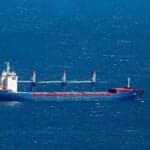


Iran denied on Thursday that it attacked a South Korean cargo ship in the Strait of Hormuz, while US President Donald Trump said a deal to end the ongoing conflict was “very possible” but warned that American bombing could resume if talks fail.
Iran’s embassy in Seoul rejected allegations that Iranian forces were behind a blast aboard the Panama-flagged cargo ship HMM Namu, which caught fire on May 4 while transiting the Strait of Hormuz with 24 crew members onboard.
The embassy said it “firmly rejects and categorically denies” the accusations.
Later, Trump claimed Iran had “taken some shots” at the vessel and called on South Korea to support US-led efforts to restore shipping movements through the strait.
The conflict, which started after the United States and Israel launched attacks in late February, has affected shipping traffic across the Middle East.
Iran responded with attacks across the region and tightened pressure around the Strait of Hormuz, one of the world’s busiest shipping routes for oil and gas trade.
The situation has continued to affect global energy markets, tanker operations and commercial shipping in the region.
Even though Trump spoke positively about possible progress in talks, Iran has not yet responded to a new US proposal.
Iranian officials said Washington was trying to force Tehran into surrender through military and economic pressure.
“We’ve had very good talks over the last 24 hours, and it’s very possible that we’ll make a deal,” Trump told reporters on Wednesday.
But he also warned earlier that if Iran failed to follow what had been agreed, bombing would resume “at a much higher level and intensity”.
Iranian Foreign Ministry spokesman Esmaeil Baqaei said the US proposal was still being reviewed and that Iran would share its response with mediator Pakistan after finalising its position.
Iranian parliament speaker Mohammad Bagher Ghalibaf, who has been leading negotiations for Tehran, accused Washington of using naval blockades, economic pressure and media campaigns to weaken the country and force it to surrender.
US news outlet Axios reported, citing two officials, that both sides were close to reaching a one-page memorandum of understanding that could end the war and create a framework for future nuclear negotiations.
Pakistani Prime Minister Shehbaz Sharif said he remained hopeful that the current talks could lead to long-term peace and stability in the region.
French President Emmanuel Macron also spoke with Iranian President Masoud Pezeshkian on Wednesday.
Macron said attacks on UAE civilian infrastructure and ships near the Strait of Hormuz were “unjustified” and urged all sides to remove blockades in the waterway without conditions or delay.
According to the Iranian presidency, Pezeshkian said the Strait of Hormuz could fully reopen only if the US naval blockade was lifted. He also said threatening statements and excessive demands from Washington had made diplomacy more difficult.
The talks came as the French aircraft carrier Charles de Gaulle passed through the Suez Canal on its way to the southern Red Sea, where it could support a multinational mission aimed at protecting shipping near the Strait of Hormuz.
France and Britain are leading planning efforts for the mission, with more than 40 countries reportedly involved in military discussions.
A French official said the deployment was meant to show that participating countries were ready and capable of securing navigation in the strait.
Financial markets reacted positively to reports of possible negotiations. The S&P 500 and Nasdaq closed at record highs, while Tokyo’s Nikkei index rose sharply on Thursday.
Oil prices also stayed lower during the week as hopes for a deal eased concerns over disruptions to shipping and energy exports.
However, not everyone in Iran supported the possibility of an agreement. A Tehran resident identified as Azadeh, a 43-year-old translator, told AFP that the idea of reaching a deal with the current Iranian government was “terrifying”.
She said people in Iran had suffered for years without seeing benefits and added that she hoped the current regime would end.
In Lebanon, Israel carried out strikes on Beirut’s southern suburbs on Wednesday, marking the first such attack in nearly a month.
A source close to Hezbollah told AFP that a senior commander from the group’s Radwan force was killed in the attack.
Lebanon’s health ministry said at least 11 other people were killed in strikes across southern and eastern parts of the country.
The Israeli military also said an explosive drone strike wounded four Israeli soldiers in southern Lebanon, including one who was seriously injured.
References: Thehindu, france24
Want to read more?
Check out the full article on the original site