France Deploys Aircraft Carrier Charles de Gaulle To Red Sea For Possible Hormuz Security Mission
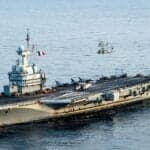


France has deployed its aircraft carrier strike group to the Red Sea as Paris and London prepare a possible multinational mission to secure shipping through the Strait of Hormuz.
The French military confirmed that the nuclear-powered aircraft carrier Charles de Gaulle, along with Italian and Dutch warships, is now heading toward the southern Red Sea after passing through the Suez Canal.
According to the French armed forces, the deployment is meant to assess the operational situation in the region, improve crisis-response options, support cooperation with partner countries and help reassure shipping companies and insurers.
French President Emmanuel Macron said the mission is linked to a French-British proposal aimed at restoring safe maritime transit through the strait once the security situation improves.
The proposed operation would be separate from the U.S.-led “Project Freedom” mission, which began earlier this week before being paused by U.S. President Donald Trump.
The Strait of Hormuz is now at the center of tensions involving the United States, Israel and Iran.
Iran has threatened and attacked ships moving through the area since the war began on Feb. 28 following U.S. and Israeli strikes.
The disruption has stranded hundreds of vessels and caused major problems for global oil supplies and maritime trade.
The International Energy Agency has described the situation as the biggest supply disruption in the history of the global oil market.
Oil prices have stayed around $100 per barrel, while war-risk insurance costs for ships entering the strait have increased four to five times compared to levels before the conflict.
French military spokesperson Col. Guillaume Vernet said insurance premiums remain so high that shipowners are still avoiding the route.
France and Britain have been working for weeks on a proposal that would allow safe passage for merchant vessels through the strait if the security situation stabilizes.
French officials said more than 50 countries have shown interest in joining the coalition, while military planners from over 30 nations have already discussed operational details.
Macron and British Prime Minister Keir Starmer hosted a summit in Paris on April 17 as part of those discussions.
French officials said the mission would only begin if two conditions are met: the threat to commercial shipping must reduce significantly, and the shipping industry must regain confidence to use the route again.
Any operation would also require support from neighboring countries, including Iran, which controls the northern side of the strait.
A senior French presidency official said Paris is proposing that Iran should be allowed safe passage for its own ships through Hormuz in exchange for negotiations with Washington over nuclear issues, missile programs and regional tensions.
In return, the United States would lift its blockade measures in the area.
French officials said a multinational naval force could then help secure convoys moving through the strait, provided Iranian forces stop targeting ships.
It remains unclear whether Iran would accept such a proposal because its control over the Strait of Hormuz has become one of its main points of leverage in talks with Washington.
Macron said he spoke with Iranian President Masoud Pezeshkian on Wednesday and plans to discuss the issue with Trump as well.
French officials said Europe wants to show it is capable of helping secure the strait and protect global shipping routes if diplomatic conditions allow.
The carrier deployment is part of a larger French military presence in the region since the conflict began.
France has also positioned eight frigates, two Mistral-class amphibious assault ships and Rafale fighter jets across the Middle East.
French Rafale jets based at the Al Dhafra airbase in the United Arab Emirates have been intercepting Iranian drones and missiles targeting the Gulf region under France’s defense agreement with Abu Dhabi.
European countries have mostly stayed out of direct military involvement in the conflict, but rising pressure on shipping routes and energy supplies has increased concerns across the region.
References: Reuters, AP News
Want to read more?
Check out the full article on the original site