Best Python Courses in 2026 — From Foundations to Career-Ready Skills
If you're researching Python courses, you may already feel stuck. There are hundreds of options, every "best of" list disagrees with the last one, and most people spend more time choosing a course than they ever spend learning Python. Choice paralysis is the single biggest reason beginners never start.
This guide compares 9 Python courses across cost, format, prerequisites, time commitment, and depth of coverage. We've organized them by goal and learning style rather than arbitrary rankings, with options for absolute beginners, hands-on learners, free university-backed picks, and career-changers. Each entry includes a quick-decision meta block with real costs, realistic timelines, what you'll learn, and whether the course is depth-first or breadth-first. By the end, you'll know which Python course is best for your exact situation.
Best Python Courses: Quick Picks
If you're skimming, here's the short answer:
- Best hands-on beginner course: Dataquest Learn Python
- Best video-led beginner course: Python for Everybody (University of Michigan, on Coursera)
- Best rigorous free course: Harvard CS50P
- Best long-form text-based course: Helsinki Python MOOC
- Best daily project course: 100 Days of Code (Angela Yu, on Udemy)
- Best backend-focused course: Boot.dev Python Track
| Course | Cost | Time | Format | Depth or Breadth | Best For |
|---|---|---|---|---|---|
| Dataquest Learn Python | Free intro + 3 projects; \$49/mo or \$399/yr for full path | 2 mo (24h + projects) | Interactive browser | Depth | Hands-on foundational learners |
| Python for Everybody (Michigan) | Free audit / \$49/mo | 2–4 mo | Video + assignments | Depth | Instructor-led learners |
| Codecademy Learn Python 3 | Free / \$40/mo Pro | 25–30 hr | Interactive | Breadth | Polished interactive UX |
| 100 Days of Code | \$15–60 (Udemy) | 100 hr | Video + project | Breadth | Daily project building |
| Boot.dev Python Track | \$49/mo (free content) | Self-paced | Gamified, code-first | Depth | Backend-curious |
| Harvard CS50P | Free (cert ~\$200) | 9–12 wk | Video + problem sets | Depth | Academic rigor |
| Helsinki Python MOOC | Free | ~280 hr | Text + exercises | Depth | Depth without video |
| freeCodeCamp Scientific Computing | Free | ~300 hr | Project-based | Breadth | Free with certificate |
| ZTM Complete Python Developer | \$39/mo or \$279/yr | 30+ hr | Video + projects | Breadth | Career changers |
For the full breakdown of cost, format, and what each course actually delivers, keep reading.
What to Look for in a Python Course
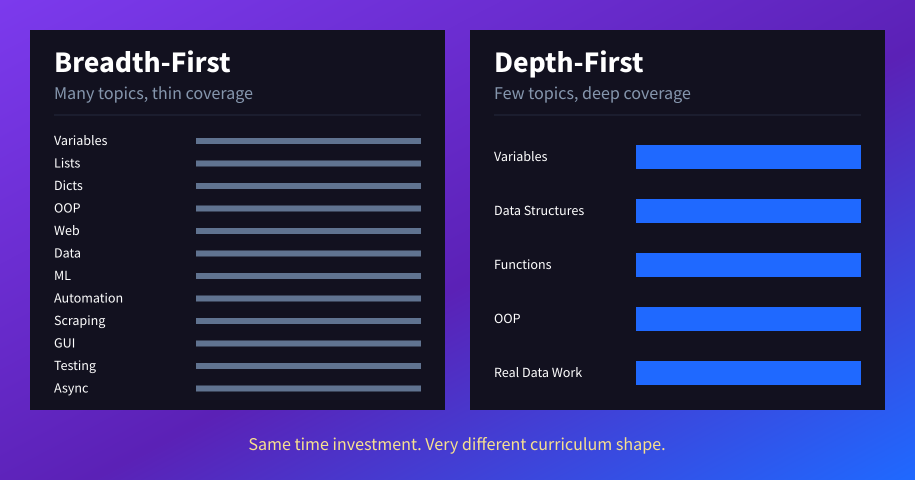
Many popular Python courses chase breadth. They pack 40 topics into 100 hours and leave learners with syntax memorized but a false sense of competence the moment they try to write code without the video playing. A focused, depth-first curriculum teaches fewer topics thoroughly and builds the foundations everything else rests on. That depth-first vs breadth-first distinction is the framework we use throughout this guide to evaluate each course.
Most experienced learners eventually settle on the same conclusion. Interactive courses beat passive video by a significant margin, focused curricula beat sprawling overviews, and no course replaces actually building things.
Without immediate practice on real projects, most of what you learn fades within a month. The right approach pairs a structured course with consistent project building from day one, not after the course ends. We expand on which courses fit which situations later in this guide, after you've seen the options.
What does depth-first look like in practice? It's smaller lesson boundaries with open-ended practice questions that force you to write code instead of copying it from a video, and projects pulled from real datasets so you're solving the kinds of problems you'd actually meet at work. Fewer topics, each one covered until it sticks. We evaluate every course in this guide against that standard.
Best Python Courses for Absolute Beginners
These courses provide entry points for complete newcomers building Python foundations. The category emphasizes depth: fundamentals taught thoroughly enough to stick.
1. Dataquest Learn Python (Skill Path)
- Cost: Free lessons available to try the platform (no credit card required). Full path access requires a paid plan: \$49/month
- Time to Complete: 2 months at 5 hours/week (24 hours of course content plus projects)
- Prerequisites: None. Designed for complete beginners.
- What You'll Learn:
- Python fundamentals across four progressive courses covering variables, data types, lists, loops, conditionals, dictionaries, functions, and OOP
- Working with text, date, and time data
- Cleaning and preparing real datasets in Python
- Object-oriented and functional programming basics
- Jupyter Notebook for code organization and analysis
- Course path: Four progressive courses covering fundamentals through intermediate data work. They are Introduction to Python Programming, Basic Operators and Data Structures, Python Functions and Jupyter Notebook, and Intermediate Python for Data Science.
- Industry Recognition: 4.8/5 ratings 337,473 learners enrolled. Favorably reviewed by LearnDataSci as a strong fit for hands-on, text-based interactive learning.
- Best For: Beginners who want depth-first foundations rather than breadth-first feature surveys, and anyone who wants to try the format before committing.
Why it works: Dataquest's Learn Python skill path is intentionally narrow. Four courses, 24 hours of content, projects integrated throughout. Each lesson breaks into small interactive steps with open-ended practice questions, which forces you to write code in the same window you're learning from rather than copy-paste from a video. Free lessons are available so you can try the format before paying.
One example of how the depth-first approach plays out: Kuan Rong Chan, PhD, used Dataquest to make the transition from molecular biology to data science. He's documented his journey on Medium, pointing to the structured progression and active practice as what helped fundamentals stick after passive video learning had failed him.
Worth knowing: This is a foundational skill path, not a full career-prep program. If you already know Python loops, OOP, and data structures, progress directly to Dataquest's Data Scientist, Data Engineer, or AI Engineer career paths instead. Plotly, Django, Flask, and web scraping aren't covered here. For those, take additional skill paths after building this foundation.
2. Python for Everybody (University of Michigan, on Coursera)

- Cost: Free audit / \$29/month for Coursera certificate
- Time to Complete: 2–4 months at 5 hours/week
- Prerequisites: None
- What You'll Learn:
- Python syntax, control flow, functions
- Data structures: lists, dictionaries, tuples
- Working with files and APIs
- Web scraping basics and database integration
- Capstone project synthesizing the curriculum
- Industry Recognition: 1.95M+ enrollments, 4.8/5 rating. University of Michigan credential.
- Best For: Learners who prefer instructor-led video lectures from a university professor.
Why it works: Dr. Charles Severance ("Dr. Chuck") teaches with patient, methodical pacing. The first week of course one is just installing Python. The 5-course specialization moves from absolute basics through web scraping and database work, with a capstone that synthesizes what you've learned. The brand carries weight on resumes, and the gentle pacing helps learners who've struggled with self-paced platforms.
One example of how the gentle pace works for non-programmers: a freelance journalist with no technical background described Dr. Severance's teaching as "splendid and simple" and used the course as his entry point into data journalism — a field he'd previously found impossible to comprehend or analyze.
Worth knowing: The pacing that helps absolute beginners can frustrate learners who already program. The video format is also more passive than browser-based practice, so learners who need immediate coding feedback may retain more from an interactive course. Andrea Knies, who switched from Coursera to Dataquest, describes the contrast in similar terms. If you bounce off video lectures, this isn't your course. If you thrive with structured video and want a recognized credential, it's still excellent.
3. Codecademy Learn Python 3
- Cost: Free / \$19.99 month for Pro
- Time to Complete: 24 hours
- Prerequisites: None
- What You'll Learn:
- Python syntax basics
- Control flow and functions
- Classes and basic OOP
- Small in-browser projects
- Industry Recognition: 4.6/5 ratings. 3,289,984 learners enrolled.
- Best For: Learners who want a polished interactive UI with frequent instant feedback.
Why it works: Clean UX, hand-holding through syntax, instant validation on every exercise. Recent updates added AI-assisted coding help, in-line quizzes to test recall, and projects to apply new skills.
One example of how the gentle pace plays out for beginners: Jana P., a Codecademy learner, called the course "very well made" with concepts "explained very clearly" and praised the examples and interactive elements. She noted the slower pace was ideal for getting started in programming.
Worth knowing: Codecademy is breadth-first by design. It covers many languages and topics across its catalog, which means the Python curriculum is shorter and shallower than dedicated platforms offer. Good for exposure and confidence-building, less suited for the "I want to actually use Python for something real" use case.
Best Python Courses for Hands-On, Project-Based Learning
These prioritize building over watching. The category leans depth-first because projects force you to use the fundamentals.
4. 100 Days of Code by Angela Yu (Udemy)
- Cost: \$15–60 on Udemy (frequently on sale)
- Time to Complete: ~100 hours across 100 days
- Prerequisites: None
- What You'll Learn:
- 100 Python projects covering automation, data, web, and ML
- Web development basics (Flask, Bootstrap)
- Data science basics (pandas, plotly)
- GUI applications and game development
- Daily building habit
- Expiration: Never (Udemy lifetime access)
- Industry Recognition: 1M+ enrollments, 4.7/5 rating
- Best For: Learners who want momentum through daily project building.
Why it works: Project per day for 100 days, covering web, data, and automation. The massive enrollment and high rating reflect strong instructor delivery from Angela Yu. The daily structure builds habit, which is the hardest part of self-paced learning.
Many learners praise Angela's project-first pedagogy specifically — the daily build cadence, her habit of teaching students to extend lessons into their own exercises once foundations are solid, and the way the course rewards consistency over deep theoretical study. For non-programmers especially, the structure helps move from "understanding concepts" to actually writing code with confidence.
Worth knowing: Heavy on breadth, by design. You touch many libraries and frameworks at a beginner level. Multiple learners on r/learnpython report that some projects in the back third (roughly day 60 onward) require community workarounds for outdated APIs and library version changes — one mid-course learner described needing to install earlier Python versions due to incompatible libraries in later sections. Best paired with deeper foundational work, not used as your only Python course.
5. Boot.dev Python Track
- Cost: \$49/month
- Time to Complete: 30 hours
- Prerequisites: None
- What You'll Learn:
- Python fundamentals and OOP
- Functional programming concepts
- Data structures and algorithms
- Backend engineering patterns
- AI-assisted code review
- Industry Recognition: 4.8/5 ratings. 721,887 learners enrolled.
- Best For: Backend-curious learners who want gamified, code-first progression.
Why it works: Gamified XP system, code-first lessons in a browser environment, and an AI mentor for help. The track ties Python to a backend engineering arc, which gives learners a clear "what comes next" path that most beginner courses lack.
Learners credit Boot.dev's gamification approach with what kept them coming back daily, calling the course "very accessible" whether you have prior programming experience or not. They flagged the steady stream of practice opportunities throughout each module as what made concepts stick.
Worth knowing: The backend engineering focus means it goes deep on topics tangential to data work and skips topics that matter for data tracks (pandas, NumPy, visualization). However some beginners may feel a sharp difficulty spike in the later modules, particularly the final seven, where guidance and prompting drop off significantly. Best for learners targeting backend or full-stack engineering specifically, and willing to push through harder problems on their own.
Best Free Python Courses
These courses prove that free doesn't mean lower quality. The category leans toward heavier time commitments and more self-direction in exchange for zero cost.
6. Harvard CS50P (Introduction to Programming with Python)
- Cost: Free to audit on Harvard OpenCourseWare, or \$299 for an edX verified certificate.
- Time to Complete: 10 weeks (3-9 hours a week)
- Prerequisites: None
- What You'll Learn:
- Functions, conditionals, loops, exceptions
- File I/O, regular expressions
- Object-oriented programming
- Unit testing and debugging
- SQL basics
- Expiration: Never
- Industry Recognition: 1.6M+ learners enrolled.
- Best For: Learners who want academic rigor and don't mind a steep curve.
Why it works: Harvard rigor at a \$0 entry price. Problem sets are demanding by design, and the production quality matches the rest of the CS50 series. Goes deep on fundamentals: functions, data structures, OOP, regex, and even basic SQL.
Many learners credit CS50P specifically for teaching proper coding habits and testing discipline alongside Python syntax, not just the syntax itself. A detailed review on edumats.dev describes the lectures as engaging and the problem sets as practical and hands-on, which is the combination beginners need to actually retain what they learn.
Worth knowing: The pace is academic, not vocational. If you want to ship a Python project for work next month, CS50P is overkill. Many learners also flag a sharp difficulty jump between the lectures and the problem sets, with the back end of the course feeling like a sink-or-swim experience. If you want a foundation that lasts decades and you're willing to wrestle with hard problems, it's exceptional.
7. Helsinki Python MOOC

- Cost: Free, including the certificate
- Time to Complete: 2-3 months (1.5-2h daily)
- Prerequisites: None
- What You'll Learn:
- Python fundamentals through advanced topics
- 250+ graded coding exercises
- Object-oriented programming in depth
- Modules and code organization
- Industry Recognition: University of Helsinki credential, used as their for-credit university course
- Best For: Learners who want depth without video and can commit serious time.
Why it works: Free, university-grade depth across 14 parts and 250+ exercises. The "Test My Code" system grades work instantly with an 80% passing threshold per section. Helsinki's curriculum continues into advanced OOP, modules, and a peer-reviewed final project, taking learners further in one course than most platforms cover across multiple. It's regularly ranked among the best free Python courses online, often above paid alternatives.
Worth knowing: The time commitment is real. Most learners take 6+ months, the format is text-heavy with no video, and the difficulty spikes around Part 4 or 5. The transition from browser-based coding to Visual Studio Code mid-course also catches some off guard. If you want a casual evening course, pick something shorter.
8. freeCodeCamp Scientific Computing with Python

- Cost: Free
- Time to Complete: ~300 hours
- Prerequisites: Basic Python helpful
- What You'll Learn:
- Python through 5 certification projects
- Data structures and algorithms basics
- Object-oriented programming
- Cryptography basics
- Mathematical computation
- Expiration: Never
- Industry Recognition: 40K+ developers report landing jobs after freeCodeCamp work
- Best For: Budget-conscious learners targeting a portfolio plus certificate combo.
Why it works: Free, project-based, certificate-bearing. Learners build 15 projects across 500+ coding challenges, covering string manipulation, lambda functions, recursion, data structures, classes, and tree traversal before tackling 5 capstone certification projects.
Many learners report that the projects, not the lectures, are where the real learning happens. One reviewer noted the projects forced them to think through problem-solving rather than follow along, with the Budget App in particular building solid intuition for classes despite its difficulty.
Worth knowing: The project format is great for retention but light on broader Python topics.The course covers Python fundamentals through OOP and standard library work, but doesn't include NumPy, SciPy, or pandas — the libraries most people associate with scientific Python. Some learners also report that several projects (the Budget App especially) have rigid output requirements that turn debugging into whitespace-counting exercises. Best treated as a foundational Python course with a portfolio outcome, not as preparation for data science or scientific work.
Best Python Course for Career-Changers
This course goes beyond Python syntax into the surrounding skills career-changers need. The category leans breadth-first by design, since exposure to many areas helps you find your direction.
9. Zero to Mastery Complete Python Developer
- Cost: \$49/month
- Time to Complete: 32 hours
- Prerequisites: None
- What You'll Learn:
- Python from beginner to job-ready
- Web scraping and automation
- Web app development with Flask
- Machine learning basics
- Interview preparation and career coaching
- Industry Recognition: : 4.9/5 ratings. 1M+ student community across the platform.
- Best For: Career changers willing to commit 3–6 months who want one all-in-one platform.
Why it works: Subscription model gives access to a comprehensive Python curriculum plus supporting courses (interview prep, web scraping, ML basics). Strong community via Discord. The platform is well-regarded for placement support.
Worth knowing: Breadth-heavy by design. You can sample many topics, which is great for career-changers exploring direction but can become "tutorial hell" if you don't commit to one focused track. Best paired with a clear career-direction goal so you know which ZTM modules matter for you.
Many learners credit Andrei Neagoie's teaching style as the key differentiator, calling the explanations clear and approachable for beginners with no programming background. The 12+ portfolio projects and active Discord community help career-changers stay engaged through the long arc of a self-paced course, which is where most career-change attempts stall.
Worth knowing: Breadth-heavy by design. You can sample many topics, which is great for career-changers exploring direction but can become "tutorial hell" if you don't commit to one focused track. Best paired with a clear career-direction goal so you know which ZTM modules matter for you.
When You Actually Need a Python Course
A Python course makes sense in these specific situations:
- You're new to programming entirely. Self-direction without scaffolding is difficult for many beginners. Structured learning beats it.
- You're switching careers into tech and need both skills and proof of serious effort to show hiring managers.
- You've tried self-study, but your momentum stalled out.
- You want to build deep foundations before specializing. This is where depth-first courses are essential.
- Your target employer values credentials from recognized institutions, especially when paired with project work.
When You Should Skip a Python Course
A course isn't always the right move. Skip it if:
- You already program in another language. Read the official Python tutorial, build a small project, and you'll be productive within weeks.
- You have a specific project in mind. Targeted tutorials and library docs will be faster than a general course.
- You need a specific library, not Python broadly. Go directly to the library's documentation.
- You learn better from books. Automate the Boring Stuff with Python by Al Sweigart is excellent and faster than some introductory Python courses.
- You already have Python fundamentals down and need depth in one specialization (data, web, ML). Pick a specialization track, not a general Python course.
Making Your Python Course Decision
If you've made it this far, you might still feel torn. That's the actual problem most Python-course researchers run into. They spend weeks comparing options and never start. The opportunity cost of paralysis is bigger than the cost of picking the "wrong" course. Pick one this week, pair it with consistent project building, and use AI tools to debug and explain code rather than to write it for you.
If you're a complete beginner who wants depth-first foundations, Dataquest's Learn Python skill path lets you try the platform with free lessons before committing to a paid plan. If you want academic rigor for free, choose Harvard CS50P. If you want video-led structure with a recognized credential, choose Python for Everybody.
Pick one. Block study time on your calendar. Finish it before enrolling in another.
Pick one. Block study time on your calendar. Finish it before enrolling in another.
The job market teaches you what skills actually matter. Start applying once you have a portfolio, even if you don't feel "ready."
# Your first portfolio project might be this small
import pandas as pd

df = pd.read_csv("hacker_news_posts.csv")
ask_posts = df[df["title"].str.startswith("Ask HN:")]
print(f"Total Ask HN posts: {len(ask_posts)}")
Frequently Asked Questions
Should I finish one Python course or sample multiple?
One focused course completed thoroughly beats three half-finished comprehensive ones. After your first foundation course, additional courses serve specialization (data, web, ML) rather than redundant beginner content.
The common failure pattern is collecting beginner courses without finishing any of them. Three half-completed Udemy courses plus one half-completed Coursera specialization equals zero portfolio projects and zero learning consolidation. The pattern has a name in developer communities: "tutorial hell." The way out is finishing what you start, even if the course turns out to be imperfect. Imperfect-and-finished beats perfect-and-abandoned every time.
Are Python courses worth it in 2026 with AI generating code?
Yes, more than ever. AI generates code. Humans review, debug, and architect. If you can't read and understand Python, you can't review what AI generates or debug what it gets wrong.
The TIOBE Index ranks Python the most popular programming language globally. Stack Overflow's Developer Survey consistently shows Python as the most-desired language among developers. Demand for Python skills isn't slowing because AI helps write code. It's accelerating because Python is the language that integrates with most AI workflows.
Modern learners use AI to explain unfamiliar code and accelerate boilerplate, not to replace learning. See our guide to learning Python for the AI-paired approach.
Can I learn Python without any programming experience?
Yes. Every course in the "Best Python Courses for Absolute Beginners" section above is designed for learners with zero programming background, and Python's syntax is closer to plain English than most languages, which lowers the barrier compared to starting with C++ or Java.
The bigger predictor of success isn't prior experience. It's whether you can commit to consistent practice. An hour a day for three months beats ten hours one weekend and nothing for a month. Pick a course that matches your learning style, block study time on your calendar, and start writing code in week one rather than waiting until you "understand" the material
How long does it take to get job-ready in Python?
Realistic timeline: 3 to 6 months at 10 to 15 hours per week of focused study, including portfolio project work. Faster if you already program in another language. Slower if you only have a few evening hours per week.
Job-ready means more than completing a course. It means a portfolio of 5+ projects on GitHub, comfort writing functions and using common libraries like pandas and requests, and the ability to debug unfamiliar code without panic. Apply for roles before you feel "ready." The market teaches you what skills actually matter, and waiting often means waiting too long. If your goal is data analytics specifically, see our guide to the best data analytics courses.
Do Python certificates matter to employers?
For entry-level roles, somewhat. Certificates from credible sources (Harvard, the University of Michigan, Google, or IBM) carry some weight. Certificates from unknown providers carry very little.
Hiring managers prioritize portfolio over certificates almost universally. A GitHub profile with 5 thoughtful projects beats 5 certificates with no demonstrated work. The exception is when a job posting specifically lists a certification (rare for Python entry-level roles, more common for cloud or specific platform credentials).
A useful way to think about certificates: they help your application get past initial screening, but they don't help you in the actual interview. Recruiters and hiring managers look at certificates as a signal of effort and structured learning. Engineers in technical interviews look at code samples, problem-solving ability, and how you talk about projects you've built. The interview is what gets you hired, and certificates don't help there. Build the portfolio. The certificate is a nice-to-have on top, not a substitute. For credential-focused guidance, see Dataquest's Python certifications guide.
Are paid Python courses worth it when so many free options exist?
Often, yes. Free options like Harvard CS50P and the Helsinki Python MOOC are excellent if you have the self-direction to push through long curricula without external accountability. Most learners don't, and that's why paid programs exist.
What you pay for is structure that holds you accountable: an interactive practice environment that catches errors immediately, graded projects that build a portfolio, and a community that keeps you moving when motivation dips. For learners who've stalled on free resources before, that structure pays for itself in completion rates alone.
If you've completed structured self-study before without prompting, free is probably enough. If you haven't, the cost of a paid program is small compared to another six months of starting and stopping.
How much should I expect to spend on a Python course?
Python courses range from \$0 to \$300+ depending on format and goal. Free university-backed options like CS50P and Helsinki cost nothing. Subscription platforms like Dataquest, Codecademy, Boot.dev, and Zero to Mastery run \$39 to \$49/month, with annual plans typically discounted. Udemy courses like 100 Days of Code go on sale frequently for \$15 to \$60. Coursera professional certificates run roughly \$49/month for 3 to 6 months.
The category to be cautious about is full Python bootcamps charging \$5,000+. Most don't outperform a \$400 annual subscription to a focused self-paced platform.
Want to read more?
Check out the full article on the original site