UW researchers launch ‘little free pantry’ mapping pilot, internet-connected pantries in Seattle
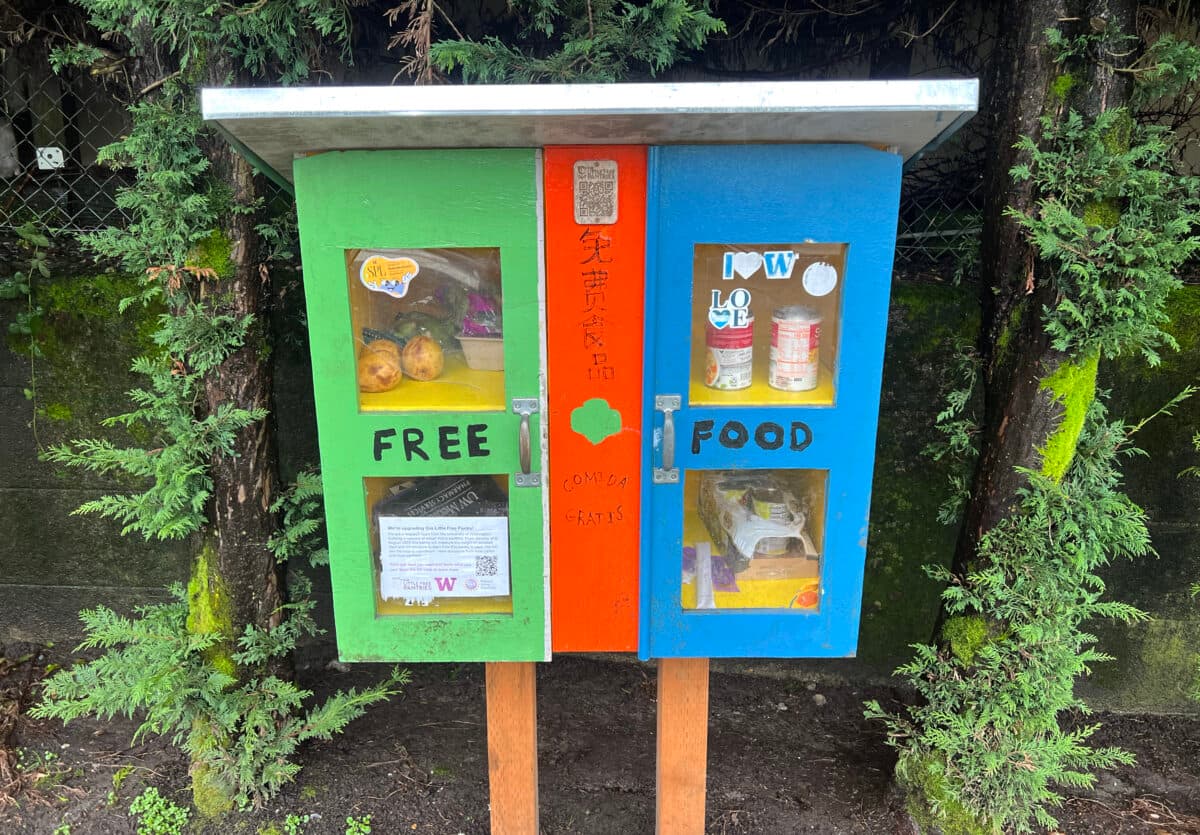

Micropantries — commonly called “little free pantries” — and community fridges are a frequent sight throughout Seattle and the greater Puget Sound region. One estimate suggests that they supply around 4 million pounds of food per year to neighbors in need in the Seattle area, more than the state’s largest food bank. The curbside cupboards are a decentralized, community-driven effort to fight food insecurity and reduce food waste at the neighborhood level, but their ad hoc nature limits their dependability — users don’t know when food is available without repeatedly checking, and donors don’t know what foods are needed most.
Now, anyone who interacts with micropantries or community fridges in the Seattle area can try out an experimental app, made by University of Washington researchers, that brings a suite of new features to the micropantry network. The app, called PantryMap.org, maps many local pantries across the region. The app also gives each pantry an activity feed where users can share food they’ve donated, report on stock levels, add requests to a wish list, post photos and leave other notes. The research team also retrofitted some pantries with sensors that anonymously auto-report their usage and stock levels to the app in real time.
“This is an effort to document and quantify the phenomenon of micropantries,” said Giacomo Dalla Chiara, a senior research scientist at the UW Urban Freight Lab. “Lots of micropantries and community fridges popped up around the time of the COVID-19 pandemic, and I was curious about who uses them and how they are used.”
Dalla Chiara’s curiosity grew into an interdisciplinary pilot program funded by the National Science Foundation that draws on UW expertise from the Urban Freight Lab, the School of Public Health, the Department of Civil & Environmental Engineering, the Global Innovation Exchange and the Paul G. Allen School of Computer Science & Engineering. Over the past seven months, the team has performed minor surgery on four micropantries around Seattle: They’ve added door open/closed sensors and digital scales to track the flow of food, as well as onboard microcomputers and Wi-Fi antennae to upload usage data to the app.
The team was cognizant of privacy concerns and designed the smart pantry tech accordingly.
“Putting cameras in the pantries could give us a lot of information about what specific foods are moving through the system, but that may also deter users who are concerned about privacy,” said Vicente Arroyos, a UW doctoral student in the Paul G. Allen School of Computer Science & Engineering who designed and built the sensor suite. “Instead, we settled on simpler sensors that measure weight and interactions like opening the door to measure stock levels while preserving everyone’s anonymity.”
The researchers hope that neighbors will find new ways to connect and help one another through these tools. A user might see that stock levels are low in a nearby pantry, for example, and decide to add some food. Another user might request certain foods to accommodate their dietary restrictions.
The sensor-equipped pantries are a small subset of the dozens of pantries throughout Seattle, but in addition to providing some neighborhoods with enhanced food tracking, they will generate aggregate data that will help Dalla Chiara’s team study donor and usage behavior. Dalla Chiara also plans to survey donors to learn more about what motivates people to provide food to pantries.
“We know that there is a lot of food insecurity in Seattle and in the United States in general,” Dalla Chiara said. “But we know that there is also a lot of food waste — lots of people have a surplus of food. And we want to see how grassroots efforts like micropantries can address both food insecurity and waste at the same time.”
Dalla Chiara and his team recently completed a refit on a cold, sleeting March day at a pantry owned by Saint Paul’s Episcopal Church near Seattle Center. The church keeps the pantry regularly stocked, and rector Stephen Crippen is curious about the data the new system will produce.
“It puts numbers on what we’re actually accomplishing,” Crippen said. “It helps us get in touch with what’s going on on this street.”
The research team is also working with local businesses and nonprofits to encourage and track food distribution throughout the pantry network. In April, recycling company Ridwell ran a nonperishable food drive across Seattle and delivered 25,000 pounds of food to the University District Food Bank; from there, volunteers from the Cascade Bicycle Club’s Pedaling Relief Project distributed the food to micropantries around the city by bike, giving the network an infusion of both food and usage data. The Washington State Department of Health and the nonprofit Sustainable Connections helped support the project’s community fridges effort.
Dalla Chiara recognizes that there are other grassroots micropantry mapping efforts online, and he doesn’t want his app to replace those services. Nor does he expect the smart pantry network to remain in service indefinitely — it costs about $150 to retrofit each pantry with sensors, and all that tech will be difficult to maintain after the study concludes in October of this year. At its core, the project is an effort to learn about micropantry usage and explore how technology might encourage sharing of resources and mutual aid systems.
“We’re trying to measure and quantify goodwill,” Dalla Chiara said. “Behind each little free pantry there is a whole system of behaviors — people trying to help one another. If we can understand that system better, we can support it better.”
Other UW collaborators include Anne Goodchild, professor of civil and environmental engineering and director of the Urban Freight Lab; Emily Hovis, assistant teaching professor of environmental and occupational health sciences; Marie Spiker, assistant professor of food systems, nutrition and health; and Vikram Iyer, assistant professor in the Allen School.
For more information, contact Dalla Chiara at giacomod@uw.edu.
Want to read more?
Check out the full article on the original site