Video: U.S. Navy Disables 2 More Iranian-flagged Oil Tankers In Gulf Of Oman
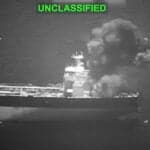


The United States Central Command (CENTCOM) said US naval forces disabled two more Iranian-flagged oil tankers in the Gulf of Oman on May 8 as part of the ongoing blockade against Iran.
According to CENTCOM, the vessels, M/T Sea Star III and M/T Sevda, were trying to enter an Iranian port in the Gulf of Oman before US forces intervened. Both vessels were unladen at the time of the operation.
CENTCOM said a US Navy F/A-18 Super Hornet launched from the aircraft carrier USS George H.W. Bush (CVN 77) fired precision munitions into the smokestacks of both tankers, disabling the ships before they could reach Iranian territory.
In an official statement, CENTCOM said the action formed part of ongoing blockade enforcement measures targeting vessels entering or leaving Iranian ports.
U.S. Navy F/A-18s disabled three Iranian-flagged tankers attempting to breach the blockade on the Gulf of Oman.
M/T Sea Star III and M/T Sevda were hit with precision munitions to their smokestacks on May 8. M/T Hasna had its rudder taken out by 20mm cannon fire on May 6. None… pic.twitter.com/b3tCLHKDEL
— Open Source Intel (@Osint613) May 8, 2026
The latest operation follows another incident on May 6 involving the Iranian-flagged tanker M/T Hasna.
According to CENTCOM, an F/A-18 Super Hornet operating from USS Abraham Lincoln (CVN 72) disabled the vessel after firing several 20mm cannon rounds at its rudder while it attempted to sail towards an Iranian port in the Gulf of Oman.
CENTCOM confirmed that all three vessels were no longer transiting to Iran following the operations.
Admiral Brad Cooper, commander of CENTCOM, said US forces in the Middle East remained committed to fully enforcing the blockade against vessels entering or leaving Iran.
He stated that American military personnel were continuing blockade enforcement operations across the region.
CENTCOM commander Admiral Brad Cooper said US forces in the Middle East remained committed to enforcing the blockade against vessels entering or leaving Iran.
He said American military personnel were continuing operations across the region.
The command also said multiple commercial vessels had been disabled during the blockade, while 57 ships had been redirected to ensure compliance.
In a post on X, CENTCOM shared photographs of USS Truxtun (DDG 103), USS Rafael Peralta (DDG 115) and USS Mason (DDG 87) operating in the Arabian Sea in support of blockade operations.
Photos of USS Truxtun (DDG 103), USS Rafael Peralta (DDG 115), and USS Mason (DDG 87) operating in the Middle East. The three destroyers are currently sailing in the Arabian Sea supporting the blockade against Iran. As of today, CENTCOM forces have redirected 57 commercial… pic.twitter.com/iFHp1HHMac
— U.S. Central Command (@CENTCOM) May 8, 2026
According to CENTCOM, four vessels have been disabled since the blockade began on April 13.
The command also said more than 70 tankers were currently being prevented from entering or leaving Iranian ports.
CENTCOM stated that these vessels have the capacity to transport more than 166 million barrels of Iranian oil worth over USD 13 billion.
Tensions continue in regional waters despite a fragile ceasefire between the United States and Iran. Iranian media also reported occasional clashes involving US forces in the Strait of Hormuz.
CENTCOM had earlier announced that US forces intercepted and seized the Iranian-flagged vessel M/V Touska on April 19 after the ship allegedly violated the blockade and ignored repeated warnings from a US destroyer.
Shipping activity in the region remains under pressure as both Washington and Tehran continue enforcing their respective blockade measures.
Iran’s restrictions in the Strait of Hormuz have affected one of the world’s busiest oil shipping routes, while diplomatic talks between the two sides remain stalled.
Operation Details
The Gulf of Oman and the Strait of Hormuz remain among the world’s most strategically important maritime corridors, handling a major share of global crude oil exports and tanker traffic.
CENTCOM said the disabled vessels were Iranian-flagged unladen oil tankers. In maritime operations, “unladen” refers to tankers sailing without cargo onboard.
The US Navy used F/A-18 Super Hornet carrier-based fighter aircraft during the operations.
Want to read more?
Check out the full article on the original site