Two Guardia Civil Officers Killed During High-Speed Drug Boat Pursuit Off Spain’s Huelva Coast
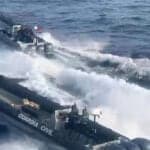


Two officers from the Guardia Civil have died and two others were seriously injured after two patrol vessels collided during a maritime anti-drug operation off the coast of Huelva in southern Spain.
The collision happened on Friday morning during the pursuit of a suspected “narcolancha,” a high-speed boat commonly used by drug trafficking networks operating along Spain’s southern coastline.
The operation took place around 70 to 74 nautical miles south of Huelva on the Atlantic side of the Strait of Gibraltar.
Spanish authorities confirmed that the officers were engaged in an active chase when the two patrol vessels collided at speed.
Emergency teams were sent to the area immediately to recover the crew from the water and provide medical help.
The two officers who died were identified in Spanish reports as Germán Pérez, aged 55, and Jerónimo J.M., aged 56.
Both had long careers in maritime operations within the Guardia Civil. One of them died at the scene, while the other later died from injuries after being evacuated.
Two other officers were seriously injured and remain under medical care, while another sustained less severe wounds.
Per reports, nine officers were on board the two patrol vessels at the time. The boats involved included the Río Antas, a rigid patrol vessel, and a semi-rigid inflatable boat used in the operation.
The Portuguese Navy also joined the emergency response. The patrol vessel NRP Setúbal diverted from a routine mission after coordination between maritime rescue centres in Madrid and Lisbon.
Portuguese naval personnel treated several casualties onboard and assisted with the evacuation of injured officers.
One injured officer was airlifted by helicopter from the Portuguese patrol ship to ensure faster medical treatment, according to the Portuguese Navy.
Spain’s Interior Ministry expressed condolences to the families of the deceased officers and confirmed that an investigation has been launched into the circumstances surrounding the collision.
Regional authorities in Andalucía declared an official day of mourning following the incident, while political parties cancelled campaign events scheduled for the weekend.
The Guardia Civil Maritime Service carries out regular operations in waters off southern Spain to stop drug trafficking routes between North Africa and Europe. Narcolanchas are commonly used in these routes because they are fast and difficult to intercept.
Officers’ union AUGC said the incident was “foreseeable” and claimed that concerns had already been raised about the risks involved in these operations.
The union stated that it had repeatedly requested updated risk assessments for maritime interdiction operations, minimum four-officer boarding teams, restrictions on the use of rigid inflatable boats during active interceptions, and revised deployment procedures for high-speed pursuit vessels.
AUGC also claimed that the Huelva command is operating with around 300 fewer officers than required, leaving a gap of nearly 20 percent in staffing.
The coastline around Huelva has become one of the main entry points for drugs into Europe.
Large quantities of cocaine are moved from South America towards the Canary Islands and then transferred at sea onto fast boats, which take them to coastal and river areas in southern Spain.
This region has seen a sharp rise in drug-related activity, with reports showing a 76.9 percent increase in trafficking cases in Huelva in early 2025 compared to the previous year.
In 2024, Spanish customs carried out around 12,000 anti-drug operations in the Strait of Gibraltar area, a 40 percent rise from the year before.
Major seizures have also been recorded. Spanish authorities recently seized around 30 tonnes of cocaine near the Canary Islands, which is believed to be one of the largest seizures of its kind.
The latest incident come more than two years after a similar case in Barbate, Cádiz, where two Guardia Civil officers were killed after being struck by a high-speed trafficking boat during an operation inside a harbour.
That incident had already raised concerns about safety conditions for maritime units involved in drug enforcement.
Narcolanchas
Narcolanchas are high-speed rigid or semi-rigid boats widely used by drug trafficking groups operating between North Africa and southern Europe.
Their speed allows traffickers to conduct rapid ship-to-shore transfers and evade maritime patrol units during interception attempts.
The waters around the Strait of Gibraltar and Gulf of Cádiz remain one of Europe’s most active maritime trafficking corridors because of their proximity to Atlantic shipping routes, North Africa and major European distribution networks.
Operations in the area often involve rigid inflatable boats (RIBs), high-speed interceptor craft, maritime surveillance patrols and coordinated rescue support between Spanish and Portuguese authorities under existing bilateral maritime security agreements.
References: Euroweeklynews, theolivepress
Want to read more?
Check out the full article on the original site