Japanese Anti-Ship Missiles Destroy Ex-US Navy Vessel In First-Ever Balikatan Live-Fire Drill
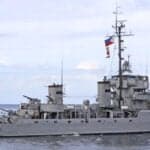


Japanese troops fired two Type 88 anti-ship missiles that sank a decommissioned Philippine Navy vessel during a maritime strike exercise held as part of Exercise Balikatan 2026 in the Philippines.
The live-fire drill took place on 6 May off the coast of Ilocos Norte in northwestern Luzon, marking the first time Japan participated in Balikatan live-fire exercises.
The missiles were launched from Culili Point near Laoag City and struck the target vessel, the former BRP Quezon (PS-70), around 75 kilometres away in the South China Sea, also referred to locally as the West Philippine Sea.
Philippine Balikatan spokesperson Marine Col. Dennis Hernandez said the maritime strike exercise began around 10 a.m. near the Paoay Sand Dunes.
According to Hernandez, a US Guided Multiple Launch Rocket System (GMLRS) round with a range of about 70 kilometres was first fired at around 10:15 a.m. as a probing shot to help determine the target vessel’s position.
This was followed by a constructive simulation involving the US Navy/Marine Expeditionary Ship Interdiction System (NMESIS) and the Philippine Navy’s C-Star sea-skimming anti-ship cruise missile system, which conducted simulated missile launches through computer-based operations.
Japan’s Ground Self-Defense Force then launched two Type 88 surface-to-ship missiles at around 10:30 a.m. The missiles struck the hull of the BRP Quezon directly and the vessel sank about 17 minutes later.
Hernandez said the quick sinking prevented Philippine Air Force aircraft from carrying out their planned live-fire attacks.
He stated that the FA-50 fighter aircraft and A-29 Super Tucano attack aircraft were unable to release their munitions because the vessel had already sunk.
Following the sinking, a US High Mobility Artillery Rocket System (HIMARS) reportedly fired at the location where the ship went down.
Officials said another live-fire exercise was scheduled for the following day to allow military aircraft and participating forces to fire at a standby target vessel.
The BRP Quezon was formerly a US Navy Auk-class minesweeper built during World War II before serving with the Philippine Navy.
The missile launch involved a single 6×6 launcher vehicle belonging to the Japan Ground Self-Defense Force.
Around 70 Japanese personnel participated in the firing activity, while Japan deployed approximately 1,400 troops to Exercise Balikatan 2026 overall.
Exercise Balikatan 2026 was conducted from 20 April to 8 May and involved about 17,000 military personnel from seven countries.
Alongside the Philippines, the United States, and Australia, this year’s exercise also included Canada, France, Japan, and New Zealand.
The drills marked Japan’s first deployment of combat troops to Philippine territory since the end of World War II.
Japanese participation was enabled after the ratification of a reciprocal access agreement on 11 September 2025.
Officials from both Japan and the Philippines attended the live-fire event, including Philippine Defence Secretary Gilberto Teodoro Jr. and Japanese Defence Minister Shinjiro Koizumi.
After observing the missile launches, Teodoro said the systems demonstrated future interoperability potential between the two countries.
He added that coordination involving planning, force formation, and resource management would improve further in future exercises.
The maritime strike drill formed part of a series of military operations conducted during Balikatan 2026.
Earlier in the exercise, American, Canadian, and Philippine forces carried out a counter-landing live-fire operation against a simulated amphibious invasion force.
The exercises also included maritime key terrain seizure operations in the Luzon Strait.
Equipment such as HIMARS and NMESIS systems were transported to remote islands using landing craft and C-130J Hercules aircraft for short-duration missions.
Military planners used the exercises to rehearse operations around the Luzon Strait, a strategic maritime chokepoint between Taiwan and the Philippines. The route is considered important for naval access into the Pacific Ocean.
Japan has also recently eased restrictions on overseas defence exports under revised guidelines linked to its Three Principles on the Transfer of Defense Equipment and Technology.
The matter was reportedly discussed during meetings between Japanese and Philippine defence officials in Manila before the exercise.
Missile System & Weapons Overview
The Japanese Type 88 surface-to-ship missile system is manufactured by Mitsubishi Heavy Industries and has been in service for more than 35 years.
The coastal defence system carries six launch tubes mounted on a 6×6 vehicle platform.
The missile has a reported range of 180 kilometres and carries a 225-kilogram high-explosive warhead.
The 5.08-metre-long missile travels at high subsonic speed and is designed for anti-ship operations from coastal launch positions.
Japan plans to gradually replace the Type 88 with the newer Type 12 anti-ship missile system.
The US NMESIS platform present during the exercise carries Kongsberg’s Naval Strike Missile mounted on an unmanned JLTV 4×4 vehicle. Officials said the NMESIS system has not yet conducted a live firing from the Philippines.
References: PNA, navalnews
Want to read more?
Check out the full article on the original site