Three Oil Tankers Carrying 6 Million Barrels Exit Strait Of Hormuz With Trackers Switched Off
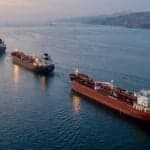


Three crude oil tankers carrying a combined 6 million barrels of Gulf crude exited the Strait of Hormuz with their tracking systems switched off, according to shipping data from Kpler and LSEG released on Monday.
The vessels reportedly disabled their trackers to avoid possible Iranian attacks as companies continue moving crude exports out of the Gulf despite ongoing tensions in the region.
Two very large crude carriers (VLCCs), Agios Fanourios I and Kiara M, passed through the strait on Sunday carrying 2 million barrels of Iraqi crude each, the data showed.
The Agios Fanourios I is heading to the Nghi Son Refinery and Petrochemical Facility, where it is expected to discharge its cargo on May 26.
Shipping data showed the tanker had failed to transit the strait during at least two earlier attempts after loading Basrah Medium crude on April 17.
Eastern Mediterranean Maritime, which manages the vessel, and the Nghi Son Refinery and Petrochemical Facility did not immediately respond to requests for comment.
Separately, the Kiara M also exited Gulf waters on Sunday with its transponder switched off, according to Kpler data.
It remains unclear where the San Marino-flagged tanker will discharge its 2 million barrels of Basrah crude.
The vessel is managed by a Shanghai-based company and owned by an entity registered in the Marshall Islands. The companies could not immediately be reached as their contact details were not publicly available.
Earlier this month, the VLCC Basrah Energy loaded 2 million barrels of Upper Zakum crude from ADNOC’s Zirku terminal on May 1 before exiting the Strait of Hormuz on May 6, according to Kpler data.
The Panama-flagged tanker later discharged its cargo at the Fujairah Oil Tanker Terminals on May 8.
It was not immediately clear which company chartered the vessel, which is owned and managed by Sinokor Merchant Marine. The company did not immediately respond to requests for comment outside office hours.
According to the data, ADNOC and several buyers have recently continued moving crude cargoes through the Strait of Hormuz in an effort to clear oil shipments stranded in the Gulf due to the ongoing Middle East conflict.
Technical Breakdown
A VLCC, or Very Large Crude Carrier, is among the world’s biggest tanker classes and is commonly used for long-haul crude oil transport. These vessels can typically carry around 2 million barrels of crude oil in a single voyage.
The Strait of Hormuz remains one of the most important maritime oil chokepoints globally, linking Gulf oil producers with international markets in Asia and beyond.
Tankers normally operate with AIS transponders switched on to broadcast their position and identity for navigational safety and tracking purposes.
Disabling AIS signals or transponders can make vessel movements harder to monitor publicly during periods of elevated regional security risks.
References: Reuters, Deccan Herald
Want to read more?
Check out the full article on the original site