Bulk Carrier Struck By Unidentified Projectile Catches Fire Off Qatar
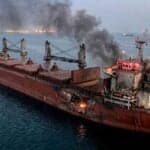


A bulk carrier was struck by an unidentified projectile northeast of Doha, Qatar, early on 10 May 2026, as tensions in the Gulf continue to rise amid the ongoing stand-off between Iran and the United States.
According to the United Kingdom Maritime Trade Operations (UKMTO), the incident occurred at approximately 03:01 UTC around 23 nautical miles northeast of Doha.
The vessel’s master reported that the ship had been struck by an unknown projectile, causing a small fire onboard.
The fire was later extinguished and no casualties or environmental damage were reported.
Qatar’s defence ministry stated that the vessel had entered Qatari waters from Abu Dhabi when it was reportedly struck by a drone northeast of the port of Mesaieed.
The ship later continued towards Mesaieed Port after the fire was brought under control.
Authorities in Qatar said investigations were underway to identify who was behind the attack. No group immediately claimed responsibility.
UKMTO advised vessels operating in the area to transit with caution, maintain high levels of vigilance and follow BMP-MS maritime security guidance.
Ships were also asked to report suspicious activity to UKMTO and MSCIO.
Iran’s semi-official Fars news agency reported that the targeted vessel was sailing under the US flag and belonged to the United States, although this was not independently confirmed by Qatari authorities or UKMTO.
The latest attack followed reports that US forces had disabled two Iranian-flagged tankers in the Gulf of Oman on Friday to stop them from continuing towards Iranian ports.
After that operation, Iran’s Islamic Revolutionary Guard Corps (IRGC) warned that any attack on Iranian tankers or commercial vessels would lead to retaliatory action against American ships and interests in the region.
Kuwait also reported security concerns on Sunday. The country’s armed forces said hostile drones had entered Kuwaiti airspace and were intercepted according to military procedures.
Shipping activity through the Strait of Hormuz remains heavily disrupted as tensions continue in the region.
Iran has restricted movement through the strategic waterway, while the US Navy has reportedly been diverting and disabling vessels linked to Iranian ports.
The situation has increased pressure on global energy markets because around one-fifth of the world’s oil and liquefied natural gas exports normally pass through the Strait of Hormuz.
Saudi Aramco warned on Sunday that global energy supply disruptions could continue into 2027 if shipping restrictions remain in place for several more weeks.
The company said the market would require significant time to stabilise even if the strait reopened immediately.
Amid the disruption, ship-tracking data cited by Bloomberg showed that the LNG carrier Al Kharaitiyat successfully transited the Strait of Hormuz over the weekend after departing Qatar’s Ras Laffan facility.
Iranian media reported that the vessel received permission to use a northern route close to the Iranian coastline while sailing towards Pakistan.
Meanwhile, Saudi Aramco and Abu Dhabi National Oil Company (ADNOC) were also reported to have continued moving crude cargoes through the strait despite the ongoing security situation.
US President Donald Trump said Washington was waiting for Iran’s response to a proposal aimed at extending the ceasefire and reopening negotiations.
Iranian Foreign Minister Abbas Araghchi reportedly stated that recent actions by US forces in the Gulf had increased doubts over Washington’s commitment to diplomacy.
Qatar has continued mediation efforts between both sides. Qatar’s Prime Minister Sheikh Mohammed bin Abdulrahman Al Thani met US officials over the weekend to discuss attempts to secure a longer-term agreement.
Tensions also remained high in Lebanon, where exchanges of fire continued between Israel and Hezbollah despite a separate ceasefire arrangement.
Lebanese authorities reported casualties after Israeli strikes in southern Lebanon, while Hezbollah said it launched drones towards northern Israel in response.
Technical Breakdown
The Strait of Hormuz is one of the world’s most critical maritime chokepoints, linking the Persian Gulf to the Gulf of Oman and the Arabian Sea. Roughly 20% of global oil and LNG exports pass through the route.
BMP-MS, referenced in the UKMTO advisory, refers to Best Management Practices for Maritime Security.
The guidance is used by commercial vessels operating in high-risk regions and includes measures such as enhanced bridge watchkeeping, reporting suspicious activity, route monitoring and increased onboard security readiness.
UKMTO and MSCIO act as key maritime security coordination centres for merchant shipping transiting conflict-prone waters in the Middle East.
References: MSCIO, UKMTO
Want to read more?
Check out the full article on the original site