U.S. Files Criminal Charges Against MV Dali Operators Over Deadly Baltimore Bridge Collapse That Killed 6
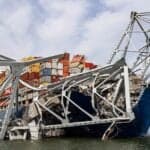


The U.S. Justice Department has indicted two foreign ship management companies and an Indian technical superintendent over the March 2024 collision involving the containership Dali that destroyed Baltimore’s Francis Scott Key Bridge and killed six construction workers.
A federal grand jury charged Singapore-based Synergy Marine Pte Ltd, Chennai-based Synergy Maritime Pte Ltd, and Indian national Radhakrishnan Karthik Nair with conspiracy, obstruction of an agency proceeding, false statements, and failing to immediately inform the U.S. Coast Guard about a known hazardous condition aboard the vessel.
According to the indictment, the 984-foot Singapore-flagged containership Dali lost power twice within four minutes while departing the Port of Baltimore on 26 March 2024 before crashing into the Francis Scott Key Bridge.
The bridge collapse killed six construction workers and caused extensive economic and environmental damage.
The Justice Department said the total losses from the incident reached at least $5 billion.
Separately, Maryland State Attorney General Anthony Brown announced that the state reached a final $2.25 billion settlement with Grace Ocean Private Limited and Synergy Marine ahead of a scheduled 1 June trial.
However, Maryland’s claims against shipbuilder Hyundai Heavy Industries remain unresolved.
Federal prosecutors said a loose wire in a high-voltage switchboard likely caused the first blackout on the vessel.
The indictment alleged that the defendants relied on a flushing pump to supply fuel to two of the Dali’s four generators.
However, investigators said the flushing pump was not designed to automatically restart after a blackout.
According to prosecutors, the generators could not continue operating without fuel supply, leading to a second blackout and loss of propulsion and steering.
The indictment further alleged that if the vessel had been using proper fuel supply pumps, the Dali would have regained power in time to safely pass beneath the bridge.
The indictment also accused Synergy and Nair of obstructing the National Transportation Safety Board investigation by providing false statements and documents.
Video Credits: First Coast News/YouTube
Prosecutors alleged that Nair falsely claimed he was unaware the vessel was using the flushing pump arrangement to fuel the generators.
The two Synergy companies were also charged with violations of the Clean Water Act, Oil Pollution Act, and Refuse Act over the discharge of pollutants into the Patapsco River, including oil, cargo containers, and bridge debris.
Acting U.S. Attorney General Todd Blanche described the bridge collapse as a “preventable tragedy” and said the case involved reckless disregard for maritime safety regulations.
U.S. Attorney for Maryland Kelly O. Hayes said prosecutors would continue pursuing those responsible for jeopardising the safety of ports, infrastructure, and local communities.
The Justice Department also cited major regional economic disruption caused by the collapse, while environmental authorities pointed to pollution released into the Patapsco River and Chesapeake Bay following the crash.
In response, Synergy Marine said it would defend itself against the criminal charges.
The company stated that the NTSB had already determined the initial cause of the blackout was a defect outside Synergy Marine’s control.
The company also said evidence collected during the investigation contradicted allegations of wrongdoing by the Dali crew.
Synergy Marine further criticised U.S. authorities for keeping crew members in the United States for more than two years despite what it described as timely and reasonable actions taken during the emergency.
Francis Scott Key Bridge
The Francis Scott Key Bridge was a major highway bridge that crossed the lower Patapsco River and outer Baltimore Harbor as part of Interstate 695, linking Dundalk and Hawkins Point.
Opened in March 1977, the bridge was originally called the Outer Harbor Crossing before being renamed after Francis Scott Key, who wrote the lyrics of the U.S. national anthem, “The Star-Spangled Banner.”
Stretching 8,636 feet, it was the second-longest bridge in the Baltimore metropolitan area and carried around 11.5 million vehicles every year, including trucks transporting hazardous materials that were not allowed through Baltimore’s harbour tunnels.
Operated by the Maryland Transportation Authority, the bridge completed the final link in Baltimore’s beltway system and served as one of the city’s three major harbour crossings.
On 26 March 2024, the bridge’s main span collapsed after the containership MV Dali struck one of its support piers, killing six maintenance workers.
Demolition of the remaining structure and construction of a replacement bridge are currently underway, with completion expected by late 2030.
Reference: US Government
Want to read more?
Check out the full article on the original site