Sunken Russian Freighter May Have Been Transporting Nuclear Reactor Parts To North Korea: Report
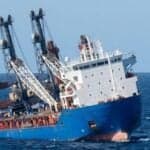


The Russian cargo ship Ursa Major sank in the Mediterranean Sea after suffering a series of explosions near the coast of Spain, with investigators now examining claims that the vessel may have been carrying submarine nuclear reactor components possibly meant for North Korea.
The Russian-flagged vessel went down on December 23, 2024, around 60 nautical miles off Spain’s south-eastern coast.
Two crew members were reported missing after the incident, while 14 others were rescued by Spanish authorities.
According to a statement later released by the Spanish government, the ship’s captain told investigators that the vessel was carrying “components for two nuclear reactors similar to those used in submarines.”
He reportedly said he could not confirm whether the reactor components contained nuclear fuel.
The Ursa Major, also known as Sparta III, was owned by Oboronlogistics, a company linked to the Russian state.
The ship had left St. Petersburg on December 11 and was officially headed for Vladivostok in Russia’s Far East.
Its public cargo manifest listed 129 empty shipping containers, two Liebherr cranes and two large “manhole covers.”
However, investigators reportedly questioned why such cargo would be transported by sea between two Russian ports despite Russia’s large rail network.
Sources familiar with the Spanish investigation told CNN that the vessel’s captain believed the ship would later be diverted to the North Korean port of Rason to deliver the reactor-related cargo.
The ship had earlier docked at Ust-Luga in the Gulf of Finland before moving to container facilities in St. Petersburg.
Video footage reviewed during the investigation reportedly showed containers being loaded into the ship’s hull, leaving space below the large objects later described as “manhole covers.”
Video Credits: Times News/YouTube
As the vessel travelled south along the French coast, Portuguese naval aircraft and ships monitored its movement through Portuguese waters.
The Ursa Major was being escorted by two Russian military vessels, the Ivan Gren and the Aleksandr Otrakovsky.
According to the Portuguese Navy, monitoring of the vessel ended on the morning of December 22 after it left Portuguese waters.
About four hours later, Spanish rescue authorities noticed the vessel had slowed sharply while sailing in Spanish waters.
Officials contacted the crew to ask whether the ship was in distress, but the crew reportedly replied that everything was normal.
Roughly 24 hours later, the vessel suddenly changed course before issuing a distress signal at 11:53 a.m. UTC on December 23.
Spanish investigators said the ship had suffered three explosions on its starboard side near the engine room.
The blasts reportedly killed two crew members identified as Second Mechanic Nikitin and Mechanic Yakovlev. Their bodies were not recovered.
The surviving crew members evacuated using a lifeboat and were later rescued by the Spanish rescue vessel Salvamar Draco. A Spanish military vessel also arrived to assist with the operation.
However, later that evening, the Russian warship Ivan Gren reportedly instructed nearby vessels to remain at least two nautical miles away from the scene and requested the immediate return of the rescued crew members.
Spanish rescue teams still boarded the vessel to search for survivors.
According to video reviewed during the investigation, rescuers tried to enter the sealed engine room and checked several containers onboard. Some reportedly contained fishing nets, rubbish and other equipment.
Investigators familiar with the case reportedly believed the Ursa Major initially appeared stable and was not expected to sink quickly. But later that night, the Ivan Gren reportedly fired red flares over the area.
Shortly afterwards, Spain’s National Seismic Network detected four seismic signals in the same area that reportedly resembled underwater explosions or quarry blasts.
By around 11:10 p.m., the Ursa Major had sunk.
Four days later, Oboronlogistics described the incident as a “targeted terrorist attack.”
The company claimed investigators found a 50cm by 50cm hole in the vessel’s hull with the damaged metal bent inward. It also said shrapnel was found scattered across the deck.
According to reports, the Spanish investigation examined whether the damage could have been caused by a supercavitating torpedo, a high-speed underwater weapon used by only a small number of countries, including Russia, the United States, Iran and some NATO members.
The investigation reportedly suggested such a weapon could match the size of the hole found in the hull and may explain why the vessel slowed suddenly on December 22 before the later explosions occurred.
However, Mike Plunkett, a senior naval platforms analyst at Janes, reportedly said a limpet mine attached to the hull appeared to be a more likely explanation.
A week after the sinking, the Russian vessel Yantar, officially described as a research ship but often accused by Western governments of intelligence activities, reportedly returned to the wreck area and remained there for several days.
Further underwater explosions were later detected near the wreck site, according to reports linked to the investigation.
Public flight tracking data also showed that US WC-135R aircraft, commonly used for nuclear debris detection and atmospheric sampling missions, flew over the wreck site twice after the sinking.
A spokesperson from the aircraft’s base in Nebraska confirmed that the aircraft supports nuclear debris collection and analysis missions but declined to comment on specific operations.
Spanish authorities said the wreck lies at a depth of around 2,500 metres, making recovery operations difficult.
Opposition lawmakers in Spain questioned why the ship’s data recorder had not been recovered if no radioactive material was onboard.
The investigation gained further attention after North Korea released images in 2025 showing what it claimed was its first nuclear submarine.
The images only showed the submarine’s outer hull and did not confirm whether it had a working nuclear reactor.
Reports linked to the investigation suggested the cargo onboard the Ursa Major may have included VM-4SG reactor systems used in Russia’s Delta IV-class nuclear submarines, although limited evidence has been publicly released to support the claim.
Satellite imagery and loading footage reviewed during the investigation reportedly showed two large blue containers being loaded onto the vessel before it left Russia.
Russian newspaper Kommersant later reported that the vessel had been carrying equipment linked to an icebreaker project in Vladivostok, including reactor hatch covers, but did not mention the large unidentified containers.
Russian, Spanish and British military authorities did not publicly comment on the investigation. The Pentagon also declined to comment.
Several Western intelligence and security officials quoted in reports described the case as unusual, while some questioned parts of the Spanish investigation’s conclusions.
However, no official explanation has been provided for the explosions that damaged the vessel before it sank.
References: CNN, theguardian
Want to read more?
Check out the full article on the original site