China Installs World’s Largest Single-Unit Floating Offshore Wind Power Platform
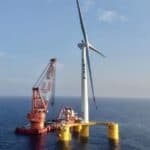


China has installed the world’s largest single-unit floating offshore wind power platform in deep-sea waters off Guangdong Province.
The state-owned Three Gorges Group announced on May 3 that the 16-megawatt floating offshore wind platform, named “Three Gorges Navigator”, was successfully installed in waters off Yangjiang in Guangdong Province on the evening of May 2.
The platform is located more than 70 kilometres offshore in waters deeper than 50 metres. It consists of a 16 MW wind turbine, a semi-submersible floating platform and a new mooring system.
Chinese officials described the project as a breakthrough in the country’s floating offshore wind power technology.
The wind turbine has a rotor diameter of 252 metres and a swept area equal to around seven standard football fields. The maximum blade tip height exceeds 270 metres.
According to Chinese officials, the installation site faces difficult sea conditions, with waves exceeding 20 metres and wind speeds reaching 73 metres per second.
The system was designed to withstand super typhoons and continue operating safely in rough weather.
Pan Hongguan, an offshore wind power engineer at the Guangdong branch of Three Gorges Group, said the project introduced several technologies and materials for the first time in China’s offshore wind sector.
These include a new mooring system, an active ballast system, an intelligent monitoring system and a domestically produced 66 kV dynamic submarine cable.
The semi-submersible floating platform measures about 80 metres in length and 90 metres in width, with a displacement of around 24,000 tonnes.
It is secured to the seabed using nine suction anchors together with domestically produced polyester fibre cables and anchor chains.
The polyester fibre cables are being used for the first time in China’s offshore wind industry.
The cables were designed with high elasticity and strength to absorb wave energy through elastic deformation, helping reduce the impact of waves on the platform structure.
According to Three Gorges Group, each cable can withstand a maximum tensile force of 1,300 tonnes while resisting corrosion and fatigue in marine conditions for long periods.
The project is also the first in China’s offshore wind sector to use an active ballast system.
During operations, the system automatically adjusts water levels inside the platform’s three pillar tanks to control the platform’s movement and reduce sway caused by wind and waves.
Power generated by the turbine is transmitted ashore through a domestically produced 66 kV dynamic submarine cable.
The cable uses a waveform structure design and includes buoyancy blocks, gravity blocks and anti-bending protection devices to maintain operational safety under changing sea conditions.
Assembly of the floating platform was completed in late April at Tieshan Port in Beihai before it was towed to the installation site near Yangjiang. The anchoring work was completed on May 2.
Three Gorges Group said the “Three Gorges Navigator” is an upgraded version of the earlier “Three Gorges Leading Ship” floating wind project deployed in 2021.
The new platform has nearly three times the generation capacity of the previous system while reducing the cost per kilowatt by more than 50 per cent.
China currently has around 47 GW of installed offshore wind power capacity and plans to increase the figure to 100 GW by the end of 2030 as it continues expanding its offshore renewable energy sector.
References: China NEA
Want to read more?
Check out the full article on the original site