World-First Standard Modular Battery-Swapping Ship Enters Service In China
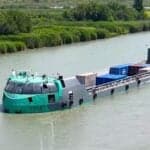


China has officially put the world’s first standard modular battery-swapping ship into operation after the vessel completed its first cargo voyage between Wuhu Port and Chaohu Port in Anhui Province.
The vessel, named Hefu Weilan 01, departed from Wuhu Port carrying 49 standard containers before successfully arriving at Chaohu Port and completing unloading operations.
Built jointly by Wuhu Shipyard Co., Ltd. and Sandianshui New Energy Technology Co., Ltd, the vessel has a deadweight tonnage of 3,000 tonnes and a top speed of 8 knots.
It was designed for inland waterway transport and uses a standard modular battery-swapping system instead of conventional marine fuel systems.
The ship is fitted with six modular batteries, each with a capacity of 430 kWh.
According to the developers, a single battery can be swapped in around five minutes, while all six batteries can be replaced within 30 minutes.
The vessel was launched in Wuhu on 28 April 2025. Over the past year, the ship and its related systems received battery-swapping system certification and ship inspection certificates from the China Classification Society. It also obtained Approval in Principle certificates from Bureau Veritas and DNV.
All three organisations are members of the International Association of Classification Societies.
Zheng Tianbao, Deputy General Manager of Wuhu Shipyard, said the vessel’s approvals from the three classification societies showed strong international recognition within the shipping industry.
World-first standard modular battery-swapping ship put into operation #CoolChina pic.twitter.com/bjYLjcIbxu
— CGTN (@CGTNOfficial) May 14, 2026
Following certification by the China Classification Society, the vessel was defined as the world’s first standard modular battery-swapping ship.
According to Liu Yang, executive vice president of Sandianshui New Energy Technology Co., Ltd, the core system behind the vessel is a shared “ship, vehicle and storage” modular battery-swapping platform.
Under the system, batteries used onboard ships can also be transferred ashore and used for port heavy trucks, forklifts and industrial energy storage operations.
The company said the aim is to build a shared energy system around ports using the same battery infrastructure across different transport and industrial sectors.
Liu Yang added that the battery-swapping system has applied for more than 370 patents covering multiple technical areas linked to the project.
The vessel also uses several technologies adapted from the automotive industry.
It is the first ship to use an automotive-grade motor sourced through a new energy vehicle supply chain, according to the developers.
The system was designed to improve driving efficiency while reducing weight, cost and energy consumption.
The ship also includes a unified electronic and engine management system based on intelligent cockpit concepts used in vehicles.
Other features include a 360-degree surround-view collision avoidance system, visual enhancement functions, and pre-installed hardware for future automatic berthing and unberthing operations.
Project developers said the vessel’s commercial operation would support deployment of the shared modular battery-swapping system across more inland shipping routes and port operations as China continues expanding low-emission inland waterway transport.
References: cgtn, sohu
Want to read more?
Check out the full article on the original site