U.S. Navy’s Fourth Gerald R. Ford-Class Aircraft Carrier Delayed By 2 Years Amid Supply Chain Shortages
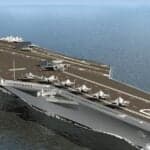


The construction timeline for the fourth Gerald R. Ford-class aircraft carrier being built for the US Navy has been delayed by at least two years, extending the delivery of the future USS Doris Miller (CVN-81) to February 2034.
According to the US Navy’s Fiscal Year 2027 budget documents cited by USNI News, the revised schedule means the carrier will take around 15 years to complete from the beginning of construction to delivery.
The US Navy said the delay was caused by construction space limitations at the shipyard, which affected the building of modules for the carrier.
The ship is being built by Huntington Ingalls Industries at Newport News Shipbuilding in Newport News.
The Navy stated that the delivery date shifted from February 2032 to February 2034 because “shipbuilder construction footprint constraints” limited the yard’s ability to build modules for CVN-81.
Todd Corillo, spokesperson for Newport News Shipbuilding, told USNI News that delays involving the future USS Enterprise (CVN-80) affected available capacity at the shipyard and slowed early construction work on Doris Miller inside the dry dock.
The shipyard still expects to hold the keel laying ceremony for Doris Miller later this year, while fabrication and outfitting work continues.
The future Enterprise has also been delayed. The carrier is now scheduled for delivery in March 2031 instead of July 2030.
According to the Navy’s budget documents, delays to Enterprise were caused by the late arrival of large equipment needed during key stages of construction.
Corillo said all delayed critical material for Enterprise has now arrived.
During Huntington Ingalls Industries’ earnings call, Newport News Shipbuilding president Kari Wilkinson said supply chain problems forced the yard to build some sections of Enterprise out of sequence, which increased costs and slowed work.
All ships in the Ford-class programme have faced delays at Newport News Shipbuilding.
The future USS John F. Kennedy (CVN-79) has also been delayed several times and is currently expected to be delivered in March 2027, around 16 years after construction began.
The Navy had earlier considered delivering JFK in two phases to reduce costs. However, the plan was dropped in 2020 after Congress required the carrier to support operations of the F-35C Lightning II before final delivery.
The delays affecting the Ford-class programme come as the US shipbuilding industry continues to face labour shortages and supply chain problems.
Shipbuilders are dealing with a shortage of skilled workers as many experienced employees retire and fewer people join the industry due to competition from the technology sector.
The situation has been worsened by long-term supply chain weaknesses that emerged after the Cold War, when the number of specialist subcontractors declined sharply.
Many critical components used in aircraft carriers and submarines are now produced by a limited number of manufacturers, increasing the risk that delays at a single supplier can disrupt entire naval construction programmes.
The Pentagon’s practice of adjusting technical requirements during active construction has also added more pressure on schedules and budgets by forcing redesign work on already completed sections of vessels.
Corillo said Newport News Shipbuilding and its Navy and industry partners were continuing efforts to speed up delivery schedules for submarines and aircraft carriers despite ongoing production and supply chain challenges.
Ford-class aircraft carriers
The Ford-class aircraft carriers are the US Navy’s newest generation of nuclear-powered carriers designed to replace the ageing Nimitz-class fleet.
The programme includes the future USS John F. Kennedy (CVN-79), USS Enterprise (CVN-80), and USS Doris Miller (CVN-81).
Doris Miller and Enterprise were procured together under a block-buy agreement announced in 2019 to reduce long-term construction costs and improve production efficiency.
However, continuing labour shortages, delayed equipment deliveries, and dry dock capacity constraints have slowed construction across the programme.
The carriers are important for the Navy’s long-range military operations and carrier strike group deployments.
References: USNI, militarnyi
Want to read more?
Check out the full article on the original site