Sub-JEPA: a simple fix to LeCun group's LeWorldModel that consistently improves performance [P]
World models learn compact latent representations for planning without pixel reconstruction. LeWorldModel (LeWM), from LeCun's group at NYU, achieves stable end-to-end JEPA training by enforcing an isotropic Gaussian prior over the full latent space.
The flaw: real environment dynamics live on low-dimensional manifolds, so a global high-dimensional Gaussian is an overly rigid prior — mismatched to the task geometry. LeWM itself struggles most on low-intrinsic-dimension tasks like Two-Room.
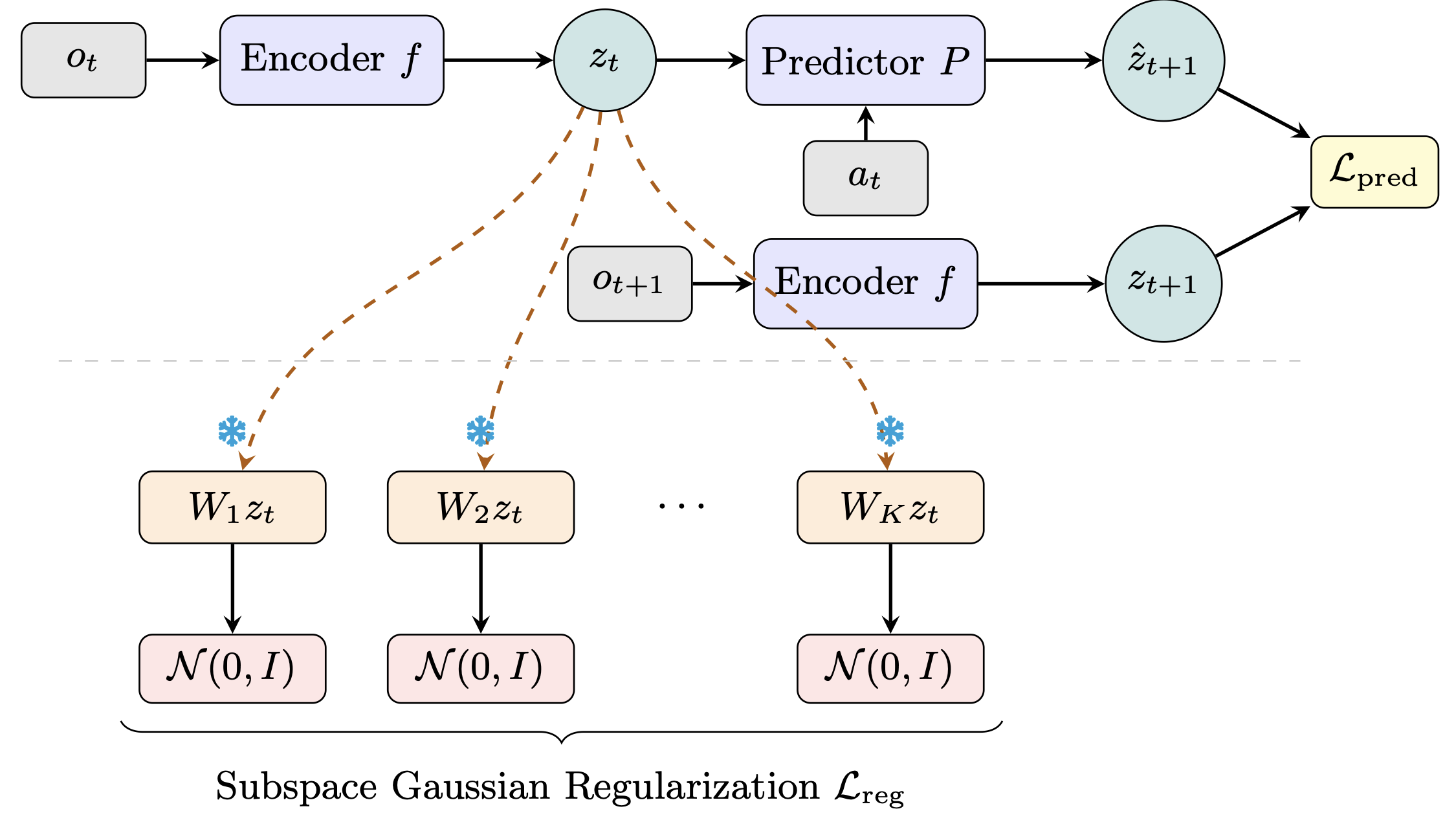
Our fix (Sub-JEPA): apply the Gaussian regularization inside multiple frozen random orthogonal subspaces instead. This relaxes the global constraint while keeping the anti-collapse benefit. No new hyperparameters, same two-term objective.
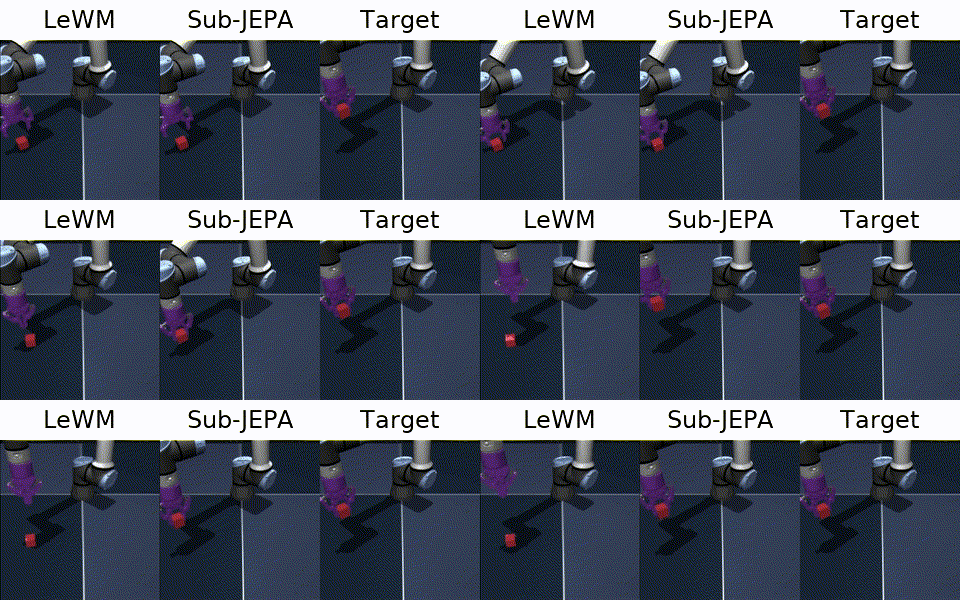
Sub-JEPA consistently outperforms LeWM across all four benchmarks, with up to +10.7 pp on Two-Room. We also observe straighter latent trajectories and better physical state decodability as emergent benefits.


🌐 Project: https://kaizhao.net/sub-jepa
💻 Code: https://github.com/intcomp/sub-jepa
📄 Paper: https://arxiv.org/pdf/2605.09241
[link] [comments]
Want to read more?
Check out the full article on the original site