Sunken Treasure Ship With 27 Cannons & 18 Silver Bars Discovered Off Spain
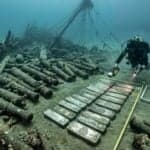


A 17th-century French treasure ship carrying 27 cannons and 18 silver bars has been discovered on the seabed of the Bay of Cadiz off Spain’s southern shores.
Provisionally named Delta I, it had silver cargo weighing half a ton and was found during dredging for a new container terminal at the Cadiz Port.
According to underwater archaeologists, this sunken treasure vessel is one of the most significant shipwrecks found in Andalusia.
Researchers Ernesto Toboso Suárez and Josefa Martí Solano, from the Andalusian Institute of Historical Heritage’s Centre for Underwater Archaeology and the firm Gerión Arqueología, mentioned that the vessel was constructed in the Ibero-Atlantic tradition.
It operated on behalf of France, and carried Swedish artillery purchased through Dutch middlemen, a common practice in the 17th-century arms trade in Europe.
The ship also had different cannon calibers, dating to the third quarter of the 1600s. A few components, like pins and muzzles used to mount the cannons, were missing.
These weapons may have been out of service before the ship sank and were carried as ballast.
A silver bar was engraved with the date 1667, which gives a reference point regarding the ship’s sinking.
According to experts, it is likely that the vessel was smuggling the silver and was attacked.
Spain’s Crown regulated precious metals arriving from the Americas, and Seville officially held the monopoly on overseas trade at the time.
Cadiz was a large maritime centre and was a busy port then as well, given its natural harbour, which made it attractive to merchants trying to avoid Spanish tax authorities.
Archaeologists say that the dredging work had disturbed the site before research began, and so the original position of the wreck and its contents on the seabed cannot be reconstructed accurately.
Divers worked in extremely low visibility, cleaning the hull to prepare it for extraction. Engineers also made a support frame to keep the ship stable during the lifting operation.
Every artefact recovered from the ship was scanned, photographed and carefully catalogued by the team. Wooden remains were stored in a place with controlled humidity before being returned to a protected area of the bay’s floor.
The ship’s exact identity cannot be ascertained, and future expeditions might provide some answers to its origin and why and how it sank.
Want to read more?
Check out the full article on the original site