China’s New Nuclear-Powered Carrier Could Challenge US Naval Reach Across Indo-Pacific
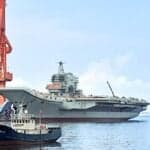


China is rapidly building what could become its first nuclear-powered aircraft carrier, according to new satellite images and analysis from the Center for Strategic and International Studies (CSIS).
The carrier, known as the Type 004, is under construction at the Dalian Shipyard in northern China.
Analysts say the project shows Beijing’s efforts to expand its naval reach beyond nearby waters and strengthen its presence across the Indo-Pacific.
CSIS said prefabricated hull sections first appeared at the shipyard in early 2025. Within months, the sections formed a clear aircraft carrier shape, showing the speed of China’s shipbuilding programme.
Satellite images from May 2026 showed the ship measuring about 286 metres (938 feet) long and 46 metres (151 feet) wide.
Analysts said it already appears larger than China’s Fujian carrier at the same stage of construction and could eventually match or exceed the size of the US Navy’s Gerald R. Ford-class carriers.
The report also said there are growing signs that the Type 004 could use nuclear propulsion. Analysts identified two large spaces inside the ship that may be designed for reactor systems.
Earlier research had also linked China’s 701st Research Institute to work on a land-based naval reactor prototype.
If the carrier is nuclear-powered, it would be able to operate farther from China without needing frequent refuelling.
The Type 004 is also expected to use electromagnetic catapults to launch aircraft. Analysts believe it could have four catapults, compared with three on the Fujian carrier.
The additional launch system could allow the ship to launch aircraft more quickly and support larger air operations farther into the Pacific.
China’s carrier programme has expanded steadily over the past decade. Beijing first converted the former Soviet Varyag into the Liaoning aircraft carrier before building the Shandong, which also uses a ski-jump launch system.
China later launched the Fujian, its first carrier with catapult launch technology.
Military analyst Eric Wertheim wrote in a March 2026 Proceedings article that the Fujian took six years from construction to launch. Based on that timeline, analysts believe the Type 004 could be launched around 2032.
China’s carrier groups are expected to operate with layered defence systems.
In a 2024 report for the China Maritime Studies Institute, analyst Daniel Rice said the outer defence zone around Chinese carriers relies on J-15 fighter aircraft and submarines for surveillance and attack missions.
The middle layer includes large warships such as the Type 052D destroyer and Type 054A frigate, equipped with anti-air, anti-ship and anti-submarine systems.
The inner layer uses close-range defensive systems on the carrier and nearby escort ships.
China could also support its carrier groups with anti-ship ballistic missiles such as the DF-21D and DF-26B.
According to Missile Threat, the DF-21D has a range of about 1,450 to 1,550 kilometres, while the DF-26 can reach around 4,000 kilometres and is capable of targeting Guam.
China is also increasing submarine production. In testimony to the US-China Economic and Security Review Commission in March 2026, Rear Admiral Mike Brookes said China is upgrading shipyards and speeding up the construction of nuclear submarines.
Analysts say China could use nuclear-powered aircraft carriers like the Type 004 for longer-range operations in the Pacific, while conventional carriers focus on areas closer to Taiwan and the South China Sea.
China is also expanding logistical support for distant naval operations. The South China Morning Post reported this month that Beijing may be building what could become the world’s largest naval supply ship.
According to the report, the vessel could carry fuel, food and ammunition for carrier strike groups operating far from China. It is estimated to measure about 271 metres long and 37 metres wide.
Reference: interestingengineering
Want to read more?
Check out the full article on the original site