Best Machine Learning Courses in 2026

Most "best machine learning courses" lists are either too theoretical (Andrew Ng's specialization with no real practice) or too tool-focused (Udemy bootcamps that skip the math entirely). The right course depends on whether you want to understand ML, apply ML, or engineer ML systems in production. Three very different goals, three very different paths.
We compared more than 15 machine learning courses across every major learning platform, drawing on what we've learned teaching Python and ML to over 100,000 Dataquest learners. The 10 below are the ones that actually deliver. They're the courses that take you from your first scikit-learn model to the patterns ML practitioners use daily: feature engineering, model evaluation, hyperparameter tuning, and the math that lets you debug when models fail. Every entry below includes honest limitations alongside strengths.
Top Picks by Goal
Want the short version? Here are the strongest picks for the most common goals:
- Best hands-on intro: Dataquest Machine Learning in Python
- Best comprehensive specialization: Machine Learning Specialization (Andrew Ng, Coursera)
- Best free Google-credentialed intro: Google Machine Learning Crash Course
- Best budget Udemy option: Machine Learning A-Z (Kirill Eremenko)
- Best free production and MLOps course: MLOps Zoomcamp (DataTalksClub)
For the full breakdown of all 10 courses across cost, format, framework, and what each one actually delivers, keep reading.
Machine Learning Courses Compared at a Glance
| Course | Track | Cost | Time | Format | Framework | Best For |
|---|---|---|---|---|---|---|
| Dataquest Machine Learning in Python | Foundations | Free intro / \$49 mo | ~25 hr | Interactive browser | scikit-learn + PyTorch | Hands-on path to job-ready skills |
| Andrew Ng's ML Specialization | Foundations | Free audit / \$49 mo | ~3 mo at 5 hr/wk | Video + labs | Python (NumPy + scikit-learn) | Theory-first intro |
| Google Machine Learning Crash Course | Foundations | Free | ~15 hr | Video + interactive | TensorFlow | Free Google-credentialed fast-start |
| StatQuest with Josh Starmer | Foundations | Free (YouTube) | ~20 hr | YouTube series | Concept-first (no framework) | Visual learners building intuition |
| fast.ai Practical Deep Learning | Applied | Free | ~7 wk (20+ hr) | Video + notebooks | PyTorch (fastai) | Top-down hands-on ML |
| Machine Learning A-Z (Eremenko) | Applied | \$15-60 (Udemy) | ~44 hr | Video + projects | Python + R | Budget breadth across algorithms |
| Complete ML & Data Science Bootcamp (ZTM) | Applied | \$39 mo / \$279 yr | ~44 hr | Video + community | Python (NumPy, scikit-learn, TF) | Structured path for career-changers |
| Caltech Learning From Data | Going Deeper | Free | ~10 wk | Video lectures | Concept-first (no framework) | Free academic theory rigor |
| Dataquest Data Scientist career path | Going Deeper | Free intro / \$49 mo | ~6-9 mo at 10 hr/wk | Interactive browser | scikit-learn + statsmodels + PyTorch | End-to-end data science career path |
| MLOps Zoomcamp (DataTalksClub) | Production | Free | ~10 wk | Video + cohort | Multi-framework + MLflow + Docker | ML engineers shipping to production |
For the full breakdown of cost, format, framework, and what each of the best online machine learning courses delivers, keep reading.
What Should You Look for in a Machine Learning Course?
The first few weeks of machine learning feel deceptively manageable. You import scikit-learn, fit a logistic regression to the iris dataset, and feel like you've cracked it. Then a real dataset arrives, your model accuracy collapses, and you realize the course didn't teach you why.
Four signals tell strong ML courses from weak ones:
- Hands-on practice with real datasets, not just toy examples like iris or MNIST. Real ML work is messy data work; the course should reflect that.
- Math depth that matches your goals, with explicit coverage of why gradient descent works, how regularization controls overfitting, and where models can fail silently.
- Production thinking that goes past
model.fit(). The best ML courses teach evaluation, drift detection, and the operational concerns that determine whether models survive contact with users. - A framework choice that matches industry reality: scikit-learn for traditional ML, PyTorch for deep learning, MLflow and Docker for deployment. Courses teaching only TensorFlow's older patterns are dating themselves.
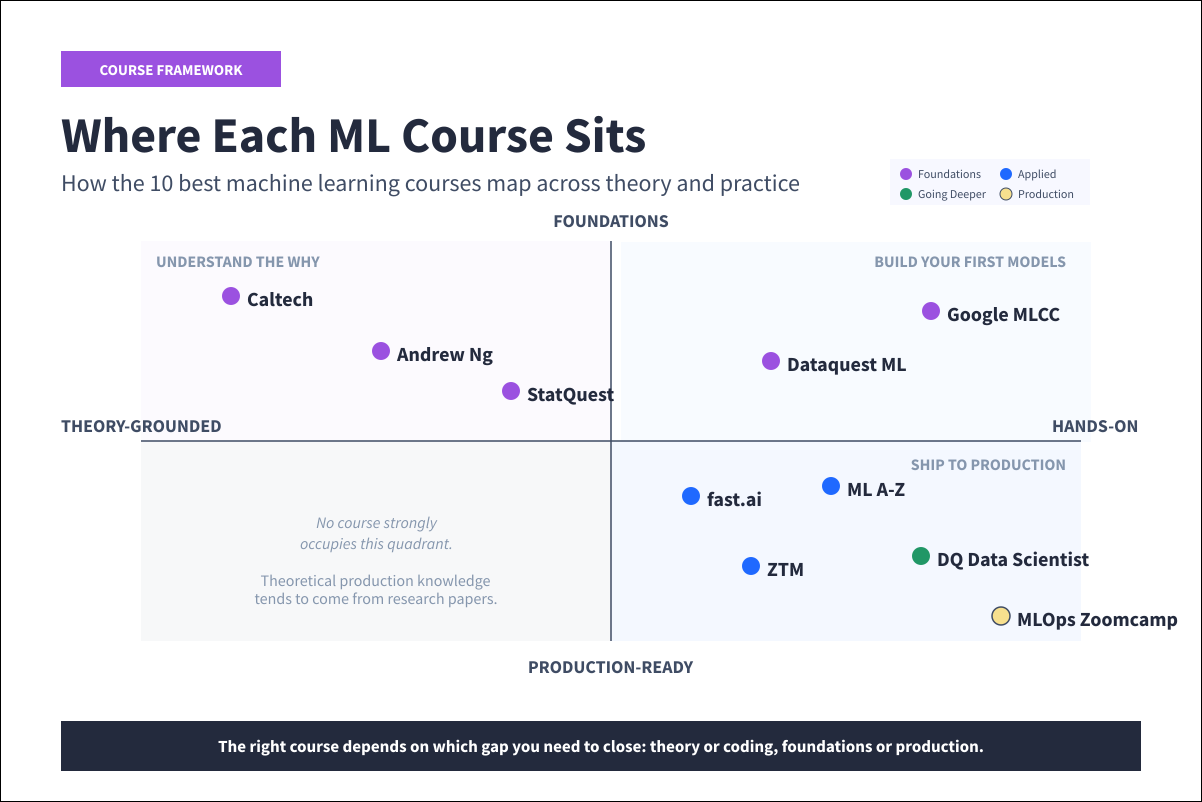
With those four signals in mind, the best place to start depends on whether you want to understand ML, apply ML, or engineer ML systems in production. Here are the 10 top picks for 2026, organized by track: foundations, applied ML, going deeper, and production. Within each track, courses are ordered from most-recommended down.
Best Machine Learning Courses for Learning the Foundations
These four courses teach machine learning fundamentals from the ground up. Expect coverage of regression, classification, model evaluation, and the math that underpins them. Each takes a different approach: hands-on, video lectures, free quick-start, or visual intuition. Start here if you've never trained a model.
1. Dataquest Machine Learning in Python

- Cost: Free intro lessons (no credit card required). Full path access requires a paid plan: \$49/month or \$399/year.
- Time to Complete: ~25 hours, self-paced.
- Prerequisites: Python fundamentals and basic statistics. Our Learn Python skill path covers the prerequisites if you need them.
- What You'll Learn:
- Linear and logistic regression from first principles
- Decision trees, random forests, and gradient boosting
- Feature engineering and selection for real datasets
- Model evaluation: cross-validation, ROC curves, precision/recall
- Hyperparameter tuning with grid search and random search
- Working with scikit-learn end to end, plus a PyTorch intro
- Guided projects analyzing real-world datasets
- Industry Recognition: 4.79/5 on CourseReport. [TO VERIFY: current learner enrollment count for ML in Python skill path]. Recommended on r/learnmachinelearning by working data professionals.
- Best For: Career-changers and data analysts who want hands-on ML training that goes past algorithm intros into real model evaluation and tuning.
Why it works: Dataquest's Machine Learning in Python path teaches ML the way working data scientists actually do the work: in a browser, against messy real datasets, with immediate code feedback.
Most beginner ML courses stop at fitting a model to toy data. This path keeps going into the harder parts of ML practice: feature engineering against missing values, evaluating models when class imbalance lies to you, and tuning hyperparameters in ways that don't overfit your validation set.
The scikit-learn coverage is comprehensive, and the guided projects build a portfolio that demonstrates working ML skills rather than just completed coursework.
Worth knowing: This is a skill path focused on traditional ML, not a full career path. Deep learning gets a PyTorch intro but isn't the focus. For broader career-change coverage including statistics, SQL, and end-to-end data science workflows, see entry #9 below. For deep learning specifically, our Best Deep Learning Courses guide is the better starting point.
2. Machine Learning Specialization (Andrew Ng, on Coursera)

- Cost: Free to audit individual courses. \$49/month for the specialization certificate, or \$59/month for Coursera Plus.
- Time to Complete: ~3 months at 5 hours/week (3 courses).
- Prerequisites: Basic Python and high-school math. The course teaches the rest as you go.
- What You'll Learn:
- Supervised learning: linear regression, logistic regression, and gradient descent
- Neural networks built from scratch and with TensorFlow
- Decision trees, ensemble methods, and recommender systems
- Unsupervised learning: clustering, anomaly detection, and dimensionality reduction
- Reinforcement learning fundamentals
- Best practices for ML project development
- Industry Recognition: 4.9/5 rating with 120,000+ reviews. Taught by Andrew Ng, co-founder of Coursera and founder of DeepLearning.AI. The most-cited ML course in r/learnmachinelearning recommendations across multiple years.
- Best For: Learners who want a comprehensive, theory-grounded ML education from the most recognized name in AI education.
Why it works: Andrew Ng's Machine Learning Specialization is the canonical ML course for a reason. Ng breaks complex math into intuitive explanations and walks you through implementing algorithms from scratch before using libraries.
The three-course structure builds methodically from regression through neural networks and unsupervised learning. The 2022 refresh moved everything from the older Octave/MATLAB to Python and added current best practices, modern frameworks, and reinforcement learning coverage.
If you can only take one ML course, this is the one most experienced practitioners would point you toward.
Worth knowing: The free audit gives full lecture access, but graded assignments and labs require payment. Reddit threads regularly flag this. Plan for \$147 (3 months at \$49) or Coursera Plus at \$59/month if you'll use other courses.
This is the Machine Learning Specialization, not the Deep Learning Specialization (also Ng, covered in our Best Deep Learning Courses guide). For the opposite, build-first approach, see fast.ai at entry #5.
3. Google Machine Learning Crash Course

- Cost: Free (no account required for most lessons).
- Time to Complete: ~15 hours, self-paced.
- Prerequisites: Basic Python and high-school algebra. The course teaches the rest.
- What You'll Learn:
- Core ML concepts: features, labels, training, inference, generalization
- Linear and logistic regression with TensorFlow
- Loss functions, gradient descent, and learning rate tuning
- Validation, test sets, and avoiding overfitting
- Feature engineering and feature crosses
- Neural networks and multi-class classification
- Embeddings and production ML considerations
- Industry Recognition: Built by Google's ML engineering and education teams. Used internally at Google for engineer onboarding and recommended consistently in r/learnmachinelearning discussions.
- Best For: Busy professionals and developers who want a fast, free, Google-credentialed introduction to ML before committing to a longer program.
Why it works: Google's Machine Learning Crash Course was built for Google engineers learning ML on the job, and it shows. The pacing assumes you're smart but time-constrained, and the explanations skip the hand-holding without becoming dense.
The interactive visualizations are the standout feature. TensorFlow Playground lets you watch a neural network learn in real time, which builds intuition that static textbook diagrams can't match.
At ~15 hours, this is the fastest free path to ML literacy that doesn't sacrifice rigor.
Worth knowing: The course uses TensorFlow, and some lab exercises use older TF patterns. The conceptual content (loss functions, regularization, validation) transfers cleanly to scikit-learn or PyTorch.
It's a foundations course, not a career path. After finishing, most learners either move to Andrew Ng's specialization (entry #2) for depth, or to a hands-on path like Dataquest's (entry #1) or fast.ai's (entry #5) to start building.
4. StatQuest with Josh Starmer (YouTube)
- Cost: Free (YouTube). Josh also sells a companion book and PDF guides.
- Time to Complete: ~20 hours for the core ML playlist; the full channel runs much longer.
- Prerequisites: None. The whole point is that Josh teaches concepts to absolute beginners.
- What You'll Learn:
- Linear and logistic regression explained visually
- Decision trees, random forests, and gradient boosting (XGBoost in particular)
- Support vector machines and clustering algorithms
- Neural network fundamentals and backpropagation
- Statistics for ML: p-values, hypothesis testing, distributions
- The math underneath each algorithm, drawn out step by step
- Industry Recognition: Frequently the top "this is how I finally understood it" recommendation on r/learnmachinelearning, r/statistics, and r/datascience.
- Best For: Visual learners who want intuition before formulas, or anyone who's tried a textbook and bounced off the math.
Why it works: Josh Starmer's StatQuest channel is the gold standard for visual ML explanations. Each video takes one concept (gradient boosting, ROC curves, regularization) and draws it out by hand, with colored markers and the kind of pacing that lets the math actually land.
The genius is in the sequencing. Most courses introduce a concept once and assume you got it. Josh teaches the same idea three different ways, each adding rigor, until you can hold the whole thing in your head.
For learners who've tried Andrew Ng or a textbook and stalled on the math, StatQuest is the bridge.
Worth knowing: This is a YouTube channel, not a structured course. No assignments, no progression, no certificate. Best used as a companion to another course on this list, not as a standalone curriculum.
The playlist organization is uneven. Josh's "Machine Learning" playlist is the right starting point, but expect to jump around the channel when specific concepts come up in your other coursework.
Best Machine Learning Courses for Applied ML
These three courses prioritize building working ML systems over deep theory. Expect Python projects, real datasets, and the kind of code-first pacing that gets you from your first model to a portfolio in weeks rather than months. Best after you have basic Python and at least some exposure to the fundamentals above.
5. fast.ai Practical Deep Learning for Coders

- Cost: Free (all materials, videos, and notebooks are open access).
- Time to Complete: ~7 weeks (20+ hours of video plus significant practice time).
- Prerequisites: At least one year of coding experience, ideally in Python. High-school math.
- What You'll Learn:
- Training neural networks for vision, NLP, tabular data, and collaborative filtering
- The fastai library on top of PyTorch
- Transfer learning and fine-tuning pre-trained models
- Setting up cloud GPU environments
- Deploying models with Gradio and Hugging Face Spaces
- The theory of how and why neural networks learn, taught after you've already trained one
- Industry Recognition: Studied by hundreds of thousands of learners worldwide. Multiple fast.ai alumni have won international ML competitions and published research after completing the course.
- Best For: Coders who want to build working models in week one and learn the theory by doing rather than studying math first.
Why it works: Jeremy Howard's fast.ai course is the opposite of Andrew Ng's approach, and that's the point. Where Ng starts with theory, fast.ai starts with complete working models and digs into why they work as you go.
In lesson one, you train a state-of-the-art image classifier. By the end of the course, you understand backpropagation, SGD, and the architecture decisions that made it work. The top-down approach has a track record: fast.ai students have won Kaggle competitions, landed top-company offers, and published research papers.
The active forum is one of the strongest in open ML education.
Worth knowing: The published course was last refreshed in 2022, which makes it more than three years old. Core concepts are still fully relevant, but the fastai library versions have evolved and some deployment patterns reflect a pre-LLM landscape.
The fastai library also adds abstraction on top of PyTorch. If you want pure PyTorch fluency, pair this with our Best Deep Learning Courses guide for vanilla PyTorch options.
6. Machine Learning A-Z (Kirill Eremenko & Hadelin de Ponteves, on Udemy)

- Cost: \$15-60 on Udemy (frequently on sale; lifetime access).
- Time to Complete: ~44 hours of video content.
- Prerequisites: High-school math. Some Python helps but isn't strictly required.
- What You'll Learn:
- Regression, classification, and clustering algorithms
- Decision trees, random forests, and SVMs
- Natural language processing fundamentals
- Dimensionality reduction (PCA, LDA, kernel PCA)
- Reinforcement learning basics
- Both Python and R implementations of every algorithm
- Expiration: Never (Udemy lifetime access).
- Industry Recognition: 1M+ students, 4.5/5 rating with 195,000+ reviews. One of the longest-running and most-enrolled ML courses on Udemy.
- Best For: Budget-conscious learners who want a broad survey of ML algorithms at an affordable one-time price.
Why it works: Machine Learning A-Z takes the "intuition first, then implementation" approach. Each section starts with a conceptual explanation, then walks through code in both Python and R. Eremenko and de Ponteves are well-regarded for making complex topics accessible.
At sale prices (\$15-20 is common), the cost-per-hour ratio is hard to beat for ML breadth. The dual-language coverage also gives R-shop learners (still common in academic and biostatistics settings) a path the other entries don't.
Worth knowing: This is breadth-first, not depth-first. You'll touch many algorithms without going deep on any.
Some sections reference older TensorFlow/Keras patterns. The R coverage is solid but lower-priority if you only need Python. Best treated as an affordable survey that helps you decide which area to specialize in next.
7. Complete Machine Learning & Data Science Bootcamp (Andrei Neagoie, Zero to Mastery)
- Cost: \$39/month or \$279/year on Zero to Mastery. Also available standalone on Udemy.
- Time to Complete: ~44 hours of video plus project work.
- Prerequisites: None for the bootcamp overall; it starts with Python and pandas fundamentals.
- What You'll Learn:
- Python data stack: NumPy, pandas, Matplotlib
- Machine learning with scikit-learn end to end
- Deep learning with TensorFlow and transfer learning
- Data exploration, feature engineering, and model evaluation
- End-to-end ML project workflow
- Career guidance and interview preparation
- Industry Recognition: Frequently cited in Reddit and Medium roundups as the top all-in-one Udemy ML bootcamp. Active ZTM Discord community.
- Best For: Career-changers who want a single structured path with community support and broader career guidance.
Why it works: Andrei Neagoie's Complete Machine Learning & Data Science Bootcamp bundles ML training into Zero to Mastery's broader career-change ecosystem. You get a 44-hour course progressing from Python basics through scikit-learn and TensorFlow, plus access to ZTM's Discord and the rest of the platform's courses.
Many learners credit the structured progression and active community for keeping them engaged through career-change, which is where most self-paced attempts stall. The end-to-end project work gives you something concrete to discuss in interviews.
Worth knowing: Breadth-heavy by design. ZTM's subscription gives access to many adjacent topics, which suits career-changers exploring direction but can become tutorial collecting without a focused track.
The ML course itself is solid, but the subscription pricing only makes sense if you're using the broader catalog for more than one skill. The Udemy standalone version is cheaper if you only want this single course.
Best Machine Learning Courses for Going Deeper
These two courses serve learners who have foundational knowledge and want more rigor or a more comprehensive end-to-end path. One is free academic content for theory depth; the other is Dataquest's full career-change curriculum.
8. Caltech Learning From Data (Yaser Abu-Mostafa)
- Cost: Free (lectures on YouTube and Caltech's own platform).
- Time to Complete: ~10 weeks of lectures plus problem sets.
- Prerequisites: Undergraduate-level linear algebra, calculus, and probability. Comfort with mathematical notation.
- What You'll Learn:
- The theory of learning: when learning is feasible and what it costs
- Linear models, neural networks, and support vector machines
- Bias-variance tradeoffs and generalization theory
- Regularization, validation, and the VC dimension
- Overfitting and how to control it mathematically
- The Three Learning Principles (Occam's Razor, sampling bias, data snooping)
- Industry Recognition: Taught by Yaser Abu-Mostafa, Caltech professor. One of the most-cited free academic ML courses, with materials used in graduate-level coursework worldwide.
- Best For: Learners with existing ML knowledge who want the deepest possible conceptual understanding of why learning algorithms work.
Why it works: Caltech's Learning From Data treats ML as a science rather than a toolbox. Abu-Mostafa builds the field from first principles, deriving why specific algorithms work and what their guarantees are, rather than just showing how to use them.
The Three Learning Principles framing is the standout. It gives you a mental model for evaluating any new algorithm or technique you encounter later in your career.
For learners who want to read research papers comfortably, this is the foundation that makes it possible.
Worth knowing: The prerequisites are real. Without solid linear algebra and probability, the pace will be overwhelming.
The course is from 2012, which sounds dated but matters less here than for other entries. The theoretical foundations of learning haven't changed; the specific tooling references are dated but the conceptual content is timeless. Pair it with a modern hands-on course like Dataquest's (entry #1) or fast.ai's (entry #5) to keep theory grounded in current practice.
9. Dataquest Data Scientist Career Path
- Cost: Free intro lessons (no credit card required). Full path access requires a paid plan: \$49/month or \$399/year.
- Time to Complete: ~6-9 months at 10 hours/week, self-paced.
- Prerequisites: None. The path starts with Python and statistics fundamentals.
- What You'll Learn:
- Python programming and data manipulation with pandas
- SQL for data analysis and database work
- Statistics and probability for data science
- Machine learning with scikit-learn (regression, classification, clustering)
- Deep learning fundamentals with PyTorch
- Data visualization with matplotlib and seaborn
- End-to-end portfolio projects across multiple domains
- Industry Recognition: 4.79/5 on CourseReport. Long-running Dataquest flagship career path. 446,232 learners enrolled in this path.
- Best For: Career-changers who want a single structured path from zero programming experience to job-ready data scientist with a portfolio.
Why it works: Where entry #1 focuses narrowly on ML, the Data Scientist Career Path covers everything around it: the Python and SQL that get you working with data, the statistics that let you know whether your ML results mean anything, and the portfolio projects that demonstrate end-to-end capability.
The curriculum is structured around how data scientists actually work day to day. Every lesson includes interactive coding in the browser, and the guided projects build a portfolio you can show employers.
For learners who know they want a data science career and want one platform to take them all the way there, this is the depth-first comprehensive option.
Worth knowing: This is a 6-9 month commitment at 10 hours per week. If you already have Python and statistics fundamentals, the ML in Python skill path (entry #1) is the more focused option.
If your goal is AI engineering specifically rather than traditional data science, our Best AI Courses guide covers the AI Engineer in Python career path, which sits alongside this one in the Dataquest catalog.
Best Machine Learning Courses for Production and MLOps
Most ML courses teach you how to start a project. The best MLOps courses teach you how to keep one alive after deployment. If your goal is shipping models to production rather than building portfolio projects, this is where you go.
10. MLOps Zoomcamp (DataTalksClub)
- Cost: Free.
- Time to Complete: ~10 weeks (cohort) or self-paced.
- Prerequisites: Python proficiency, command-line comfort, and familiarity with basic ML concepts (you've trained at least a few models).
- What You'll Learn:
- Experiment tracking with MLflow
- Workflow orchestration with Prefect or similar tools
- Model deployment patterns (batch, streaming, web service)
- Monitoring and observability for production ML
- Best practices for ML code: testing, CI/CD, model registries
- Capstone project deploying a real ML system end to end
- Industry Recognition: 50,000+ learners across cohorts. Regularly cited as the missing piece in most ML education. Strong Slack community of working practitioners.
- Best For: ML practitioners who can train models but need the operational skills to keep them running.
Why it works: MLOps Zoomcamp covers the unsexy work that determines whether your ML application delivers value over time: deployment, monitoring, testing, CI/CD, and the operational practices that separate a demo from a production system.
The cohort format with peer reviews keeps you accountable, and the Slack community is one of the strongest in open ML education. Former students stay involved to help newcomers, which is rare for free courses.
Worth knowing: This isn't an introduction to ML. The course assumes you can train models and want to learn what happens next. If you can't fit a logistic regression, start with entry #1 or #2 first.
The curriculum focuses on traditional ML deployment patterns. For LLM-specific operational concerns (cost management, prompt drift, evaluation pipelines), our Best AI Courses guide covers Full Stack Deep Learning's LLM Bootcamp.
When You Actually Need a Machine Learning Course
You'll get more from a structured ML course (paid or free) if:
- You're starting from zero with no programming background. Effective ML requires Python comfort plus statistics intuition plus the actual ML concepts. A course saves months of false starts compared to self-directed learning from blog posts.
- You're changing careers into data science, ML engineering, or AI engineering. Job-ready ML goes well past what you can pick up from tutorials. A structured path through feature engineering, model evaluation, and deployment builds the depth interviewers actually test for.
- You've tried free tutorials and stalled. If you've started a YouTube series or Kaggle notebook three times without finishing, the structure of a paid course with progress tracking and interactive exercises may be the missing piece.
- You want the credential. Andrew Ng's specialization, Google's certificate, and IBM's professional certificates all carry weight for entry-level roles. For the full breakdown of which ML and AI certifications matter, see our guide to the best AI certifications.
When You Should Skip the Course and Just Build
You can probably skip a paid ML course if:
- You already work with ML at your job. The scikit-learn documentation, PyTorch tutorials, and Kaggle Learn modules will move faster than any course for the specific patterns you need next.
- You have a narrow, specific goal. Fine-tuning one model? Building a recommendation system for a single feature? A targeted tutorial or paper-with-code beats a 40-hour course every time.
- You learn better from competition than instruction. Kaggle is the gold standard for learn-by-doing ML. Working through Featured competitions with public notebooks teaches what hiring managers actually test for.
- You learn better from primary sources. Sebastian Raschka's blog and books and Christopher Olah's deep learning essays explain concepts more clearly than most paid courses.
- You've already taken a few ML courses. If you've started two or three ML courses and finished none, a project might serve you better than another course. Pick something you actually care about (predicting your fantasy football lineup, classifying your photo library) and learn ML by solving a real problem you'd want solved anyway.
Making Your Machine Learning Course Decision
The "best machine learning courses" lists you've been reading aren't wrong, they're just trying to serve everyone at once. The right course for you depends on whether you're starting from zero, leveling up as a working analyst, or going deep on production ML.
The best way to learn machine learning is to pick one course this week, pair it with consistent practice on real datasets, and finish what you started. A quick shortcut by where you are:
- You're a complete beginner who wants to learn by building: Dataquest's Machine Learning in Python path lets you try the platform with free lessons before committing to a paid plan. The 25-hour curriculum goes through feature engineering, model evaluation, and hyperparameter tuning, the patterns hiring managers actually test for.
- You want theory rigor from the most recognized name: Andrew Ng's Machine Learning Specialization gives you university-grade depth at \$49/month for graded content, or free if you audit.
- You want a fast, free start: Google's Machine Learning Crash Course takes about 15 hours and is the fastest path to ML literacy without sacrificing rigor.
- You're already past basics and want to ship to production: MLOps Zoomcamp is free, cohort-based, and covers the deployment and monitoring work most courses skip.
Pick one. Block study time on your calendar. Finish it before enrolling in another. Then start applying for roles or take on a real project. The market teaches you which patterns matter, and you'll learn faster solving real problems than collecting more courses.
If your goal is AI engineering rather than traditional ML, our roundup of the best AI ML courses covering LLM application development and AI engineering sits at Best AI Courses in 2026.
Frequently Asked Questions
Should I learn classical ML or jump straight to deep learning?
Start with classical ML. Most working data scientists spend more time on regression, decision trees, and gradient boosting than on neural networks, especially for tabular business data where classical methods often outperform deep learning. The concepts (loss functions, validation, regularization) transfer directly when you do move to deep learning later.
If your goal is computer vision, NLP, or generative AI specifically, deep learning is the right starting point. Our Best Deep Learning Courses guide covers that path. For everyone else, get comfortable with scikit-learn first.
Are ML courses worth it in 2026 with all the AI hype?
Yes. AI applications still need humans who understand the ML underneath. When a model gives a wrong answer, when training data drifts, when a fine-tuned LLM produces hallucinations, the engineers who can diagnose and fix the underlying ML are the ones who keep production systems running.
The hype has shifted toward generative AI, but the durable skills of feature engineering, model evaluation, and production ML are more valuable than ever. ML is the foundation that LLM application work sits on, not a competing path. Modern ML learners use AI tools to accelerate learning, not replace it.
How much math do I really need?
You need comfort with three areas: linear algebra (matrix multiplication, vector operations), calculus (derivatives, gradients), and probability (distributions, Bayes' theorem). You don't need to have mastered these before starting. Andrew Ng's specialization and Dataquest's path both teach the math alongside the code, introducing each concept as it becomes relevant.
If you want to work in ML research or read papers comfortably, the math bar is higher: multivariate calculus, optimization theory, and graduate-level probability. For applying ML to practical problems, high-school-to-undergraduate math is genuinely sufficient to start and build from.
How long does it take to get job-ready in ML?
Realistic timeline: 6 to 12 months at 10-15 hours per week of focused study, including portfolio project work. Faster if you already program in Python and know statistics. Slower if you're starting from zero with no programming background.
Job-ready means more than completing a course. It means a portfolio of 3-5 ML projects on GitHub that demonstrate you can train, evaluate, and iterate on models on real datasets. A working classifier, a regression model with interpretable features, and a model with thoughtful evaluation tell hiring managers more than any certificate stack. Apply for roles before you feel fully prepared. The market teaches you what skills actually matter.
Do I need a certification to land an ML job?
No. Hiring managers care about whether you can solve real problems with ML, not whether you have a credential. Certifications can help in specific situations (career changes, cloud platform roles, ATS keyword filters), but they don't substitute for portfolio projects that demonstrate you've actually trained and evaluated models on real data. For the full breakdown of when ML and AI certifications make sense, see our guide to the best AI certifications.
Are paid ML courses worth it when so many free options exist?
Often, yes. Free options like Google's Crash Course, fast.ai, MLOps Zoomcamp, and Caltech's lectures are genuinely excellent if you have the self-direction to push through long curricula without external accountability. Most learners don't, and that's why paid programs exist.
What you pay for is structure that holds you accountable: an interactive practice environment, graded projects that build a portfolio, and a community that keeps you moving when motivation dips. For learners who've stalled on free resources before, that structure pays for itself in completion rates alone.
How much should I expect to spend on an ML course?
ML courses range from \$0 to \$500+ depending on format and goal. Free options like Google's Crash Course, Caltech's lectures, fast.ai, and MLOps Zoomcamp cost nothing. Subscription platforms like Dataquest and Zero to Mastery run \$39-49 per month, with annual plans typically discounted. Coursera Plus at \$59/month unlocks Andrew Ng's specialization plus thousands of other courses. Udemy courses like Machine Learning A-Z go on sale frequently for \$15-60.
The category to be cautious about is data bootcamps charging \$5,000+ that promise career outcomes. Most don't outperform a \$500 annual subscription to a focused self-paced platform paired with active practice on Kaggle.
Want to read more?
Check out the full article on the original site