China Deploys World’s Largest Offshore Wind Converter Station With Record 2-GW Capacity
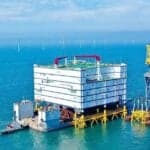


China has dispatched the world’s largest offshore wind converter station for installation off the coast of Guangdong Province, a project aimed at improving the transmission of electricity generated by deep-sea wind farms.
The platform, named Hai Feng Zhi Xin (“Heart of the Sea Wind”), departed Nantong in Jiangsu Province on May 27 aboard a semi-submersible vessel.
It is being transported about 1,090 nautical miles to offshore waters near Yangjiang, where it will be installed using a float-over method requiring millimetre-level precision.
Built by Shanghai Zhenhua Heavy Industries Co., Ltd. (ZPMC), the converter station will serve the Three Gorges Yangjiang Qingzhou V and Qingzhou VII offshore wind farms, which have a combined installed capacity of 2 gigawatts (GW).
Once operational, the facility is expected to deliver around 6 billion kilowatt-hours (kWh) of renewable electricity annually to China’s power grid.
The converter station measures 85.5 metres long, 82.5 metres wide and 44 metres high. Weighing about 25,000 tonnes, it is among the largest offshore energy structures built to date.
According to ZPMC, the project was constructed using a modular approach that allowed onshore assembly, equipment integration and installation work to be carried out simultaneously.
The company said this improved construction efficiency and coordination across the supply chain.
The platform will collect electricity generated by 163 offshore wind turbines and convert it for long-distance transmission.
Wind turbines produce alternating current (AC), but transmitting AC power through long subsea cables can lead to significant energy losses.
To address this, the converter station will convert the electricity into direct current (DC), allowing power to be transmitted over longer distances with lower losses.
ZPMC said the project has set six industry records, including becoming the world’s first offshore converter station with a single-unit transmission capacity of 2,000 megawatts (MW) and the world’s highest-voltage offshore wind flexible direct-current transmission system operating at ±500 kilovolts (kV).
The company also said it is the first offshore wind project to combine AC and DC transmission technologies within a single system and the first centralised offshore wind flexible DC transmission project of its kind.
In addition, the project will be the first offshore wind development to use ±525 kV DC subsea cables for long-distance transmission of renewable electricity generated at sea.
The converter station has been designed for unmanned operation and will rely on remote monitoring and intelligent maintenance systems.
It also contains electrical, ventilation and fire-control systems strengthened to withstand the high-salt and high-humidity conditions of the offshore environment.
China Media Group reported that the project marks China’s entry into the era of ultra-high-voltage direct-current transmission for offshore wind power.
China is increasingly developing offshore wind farms farther from shore, where wind resources are generally stronger and more stable.
The converter station is expected to help overcome transmission challenges that have previously limited the expansion of deep-sea wind projects.
Once installation and commissioning are completed, the facility will begin supplying electricity to Guangdong Province, supporting renewable energy generation while reducing transmission losses from offshore wind farms.
References: Xinhua, interestingengineering
Want to read more?
Check out the full article on the original site