7 Warning Signs That Your Mooring Line Is No Longer Safe To Use
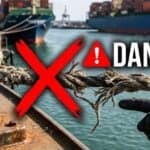

Every year, seafarers are killed or seriously injured during mooring operations. In most of those accidents, the line did not fail without warning. The signs were there, on the rope, on the equipment, sometimes on both. They were just not recognised in time.

A mooring line does not part silently. It gives you signals. Knowing what to look for and where to look is the difference between a controlled operation and a snap-back that crosses a deck in under a second.
Resource: Operating procedures for deck machinery
Here are seven warning signs that a mooring line is approaching failure, and what each one means for you.
1. Kinks and Hockles You Cannot Straighten Out
A kink is a sharp, permanent bend in a rope or wire that distorts the strand geometry.

A hockle is a back-turn, a twist against the lay that cannot be corrected once it has set.
Both look like localised deformations in the rope’s body.
These are not cosmetic defects. A kink can reduce a rope’s strength by up to 30%. A hockle can reduce it by up to 50%.

The problem with kinks and hockles is that even if you manage to visually straighten one out, the damage remains. The rope will be weaker at that point and is likely to kink again in the same location under load. Any line showing a kink or hockle should be removed from service and inspected by a qualified person before being used again.
Check: Run the entire length of the rope through your hands during inspection. Any area that resists straightening or springs back to an angled shape is suspect.
2. Glazed or Fused Patches on Synthetic Rope
Look for areas on a synthetic mooring rope that appear shiny, smooth, or slightly discoloured compared to the surrounding surface. This is heat damage, caused by the rope surging or slipping under load against a fixed surface, generating friction heat that melts and fuses fibres.

Polypropylene, the most common mooring rope material, has a melting point of around 165°C. Friction from surging can reach that temperature faster than most crew expect.
Heat-damaged ropes are significantly weaker than they appear. The strength loss is greater than what is visible on the surface, because internal fibres are also affected. A rope showing glazed patches should be taken out of service, not just flagged for monitoring.
Check: Any glossy, hardened, or discoloured area along the rope’s outer surface, particularly in sections that regularly contact bitts, drums, or fairlead surfaces during operations.
Resource: A Guide to Effective Communication for Deck Officers
3. Surface Abrasion at Contact Points
Mooring lines lose strength progressively through abrasion wherever they contact fixed equipment, fairleads, chocks, bitts, drum flanges. This shows up as a fuzzy, worn, or flattened area on the rope’s outer surface.

Abrasion damage is cumulative. A rope that looks only lightly worn today has likely lost more internal strength than the surface suggests. Areas subject to repeated chafing, especially over the lip of a Panama fairlead or across a rough chock edge, are the first to give way under load.
For wire rope, the discard criterion is clear: if more than 10% of the visible wires are broken in any length equal to eight times the wire’s diameter, the rope must be replaced. For synthetic rope, any pronounced surface abrasion in a localised section is a red flag.
Check: Inspect the full length of every line with attention to wherever the rope contacts any fixed structure during normal use — not just at the bitter end.
4. Seized or Frozen Fairlead Rollers
This is the warning sign most crews miss entirely, because they inspect the rope, but not the equipment the rope runs through.
Fairlead rollers that are not rotating freely cause the rope to drag across the same fixed surface contact point on every operation.

The rope is in constant contact with a hard, often corroded, non-moving surface. You get localised abrasion damage in the same spot on the rope every time, and you may not notice it building up because the worn section is often on the underside of the rope where it sits against the roller.
You can identify a frozen roller without waiting for a formal inspection. Run your hand along the contact surface of the fairlead. Any rust scale, grooving, or worn patches on the roller itself tell you the roller is not turning, and that the rope running through it has been paying the price.
Check: Before mooring stations, physically check that fairlead rollers and chock surfaces turn freely. Grease them regularly. If a roller is seized, it is causing hidden damage to every rope that passes through it.
5. UV Discolouration on Exposed Synthetic Lines
Synthetic mooring ropes stored or used permanently on an exposed deck are subject to UV degradation. You can identify this by comparing the colour of the outer surface fibres with the inner core: UV-affected outer fibres will appear faded, bleached, or slightly discoloured relative to the fibres beneath.

More telling than the colour change is the texture. UV-damaged surface fibres become brittle and break more easily when you flex them between your fingers. The inner fibres may still be intact, but the load-bearing capacity of the rope as a whole is reduced.
Ropes with UV jackets or protective covers fare better, but no synthetic rope is immune to prolonged open-deck exposure, particularly in tropical trading routes.
Check: Inspect lines that are kept rigged on deck or wound on exposed warp drums year-round. Any bleaching or brittleness on the outer surface layer warrants closer inspection.

6. Wire Rope Diameter Reduced by More Than 10%
A wire mooring rope that has lost more than 10% of its original diameter should be retired or referred to the manufacturer. Diameter reduction this pronounced indicates internal corrosion, internal abrasion between strands, or core breakdown, damage you cannot see from the surface.
The marine environment accelerates this process. Humidity, seawater, and salt-laden air begin attacking a galvanised wire rope from the moment it is put into service. When the lubricant inside the rope is exhausted or displaced by water, the corrosion process moves inward, and the rope deteriorates from the inside out.

Loose outer wires are an early indicator of the same problem. Wires that have lifted away from the strand body, or are no longer under tension as part of the rope’s structure, tell you that corrosion or abrasion has already separated them from the load path.
Check: Measure wire rope diameter periodically with a calliper and record it. Compare against the original diameter on the certificate. Also, check for loose or protruding individual wires along the strand surface.
7. Mooring Lines Crossing or Lying Against Each Other
When two mooring ropes of the same fibre type cross each other and are both under tension, they chafe against one another every time the vessel moves. The friction between the same fibre types generates heat, enough to cause fusion damage on both ropes simultaneously.
This is treated as a rigging or deck-tidiness issue by most crew. It is not. It is an abrasion and heat exposure problem for both lines, happening continuously and invisibly during the time the vessel is moored.

It also indicates that the mooring arrangement was not properly planned for the terminal layout, which may mean the line angles, breast/spring ratios, and load distribution are not optimal either.
Check: Before standing down from mooring stations, confirm that no mooring lines are crossing or in contact with each other. Correct the arrangement before the vessel settles onto the berth for a long stay.
Example
Mooring Tail Failure During an STS Operation
A Suezmax tanker completes an STS transfer in calm conditions. During the operation, the inner aft breast lines repeatedly exceed their Working Load Limit as small waves arrive on the beam. The mooring tails have been in service for 12 months with 798 recorded working hours and have passed the pre-operation visual check.
What the crew did not check: the inspection records, which would have shown the tails had not been break-tested against the retirement criteria. The tails part under a load spike.
No one is injured. But the post-incident investigation finds the tails had surface glazing from previous STS operations, worn sections at the fairlead contact points, and no recorded diameter measurements since installation.
This is the pattern behind most mooring failures: multiple signs present simultaneously, no single one treated as decisive.
What to Do With Any of These Signs
A mooring line showing one of these warning signs needs to be assessed before the next operation — not after. A line that is borderline acceptable in port may be below safe working load when vessel movement, current, and wind load are added during arrival or departure.
Document what you find. Record the location, the type of damage, and when it was observed. That record protects you, your crew, and your company.
The snap-back from a parting mooring line travels faster than you can react to it. The only reliable defence is taking the line out of service before the load test becomes involuntary.
Resource: Download A Guide To Mooring Operations On Ships
You might also like to read-
- Important Mooring Equipment On Ships
- Types Of Mooring Lines
- Important Mooring Decks On Ships
- 5 Important Types of Mooring Every Deck Officer Should Be Aware Of
Want to read more?
Check out the full article on the original site