Strait Of Hormuz Shipping Faces Months Of Disruption As 80 Mines Block Main Route
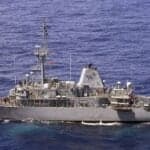


The Strait of Hormuz is expected to remain disrupted for months and possibly until the end of the year as around 80 mines blocking the main shipping route still need to be cleared, according to industry officials cited in a report by The Guardian.
The Strait, one of the world’s most important oil and cargo shipping routes, has its central passage effectively closed, forcing ships to use narrower coastal routes near Oman. This has increased safety risks for vessels passing through the area.
Phil Belcher, marine director at Intertanko, said the main route through the middle of the Strait is currently unsafe. He compared the situation to a highway where the central lanes are closed and traffic is forced onto the shoulder.
He added that ships now face a higher risk of running close to shallow areas along the alternative route.
Before the disruption, around 130 ships passed through the Strait every day, carrying oil, gas, and container cargo between the Gulf and global markets. The Strait of Hormuz connects the Persian Gulf with the Gulf of Oman and is a key route for global energy trade.
Industry officials say the mines were placed in the central traffic separation lane, which has been used for safe navigation since 1968. Because of this, ships are now avoiding the main corridor entirely.
There is also congestion in the region. Nearly 600 vessels are believed to be stuck in or around the Gulf after months of disruption, and clearing this backlog could take time even after conditions improve.
Richard Meade, editor-in-chief of Lloyd’s List, said he does not expect normal shipping to return through the Strait this year.
Freight analysts also say the disruption is affecting global shipping. Peter Sand of Xeneta estimated that about 10% of global container shipping capacity has been impacted, adding that freight rates are rising across major trade routes.
He said this level of disruption cannot be fixed quickly, even if tensions ease.
There are also concerns about navigation safety, including electronic interference that has affected ship tracking systems during the crisis. This increases the risk of collisions or grounding in narrow waters where many vessels are moving at the same time.
Some recent diplomatic steps, including a US-Iran memorandum, have offered limited relief. The agreement includes a period of toll-free passage for commercial ships, but shipping companies remain cautious.
German shipping company Hapag-Lloyd has said it is against charging vessels for passage through international waters, noting that toll systems are normally only used in canals like Suez or Panama, where infrastructure is maintained.
Iran has suggested it may introduce fees after the initial period, while US President Donald Trump has said no tolls will apply during the 60-day negotiation window, and any future charges would depend on broader agreements.
References: The Guardian, JPost
Want to read more?
Check out the full article on the original site