China’s Liaoning Carrier Returns Home After 40-Day Pacific Deployment, Reports Japanese ‘Harassment’
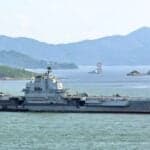


China’s aircraft carrier Liaoning has returned to its home port in Qingdao after spending more than 40 days conducting military exercises in the South China Sea and the western Pacific.
The deployment included live-fire drills, air defence exercises, anti-ship operations and joint training with an amphibious assault ship group.
During the mission, China also accused Japan of carrying out repeated close-range surveillance of the carrier strike group.
Chinese state broadcaster CCTV reported on Monday that the Liaoning carrier strike group had completed a series of combat-readiness drills aimed at improving its operational capabilities.
The exercises included ship-to-air offensive and defensive operations, long-range rescue missions and repeated take-offs and landings by carrier-based aircraft.
The People’s Liberation Army Navy (PLAN) also said the carrier group carried out joint exercises with an amphibious assault ship group in the western Pacific to improve coordination during long-range naval operations.
According to the PLA’s official China Military Bugle account, the carrier strike group returned to Qingdao on Monday after completing more than 40 days of open-sea training.
The Liaoning strike group sailed into the Philippine Sea on May 19 after operating in the South China Sea.
According to Japan’s Joint Staff Office, the group included aircraft carrier Liaoning, cruiser Wuxi, destroyer Kaifeng, frigate Luohe and fast combat support ship Hulunhu.
Japan’s Defence Ministry said it monitored the carrier group operating east of the Philippine island of Luzon in late May. It also reported that carrier aircraft conducted repeated take-offs and landings from May 26 to May 28 while the group was in the Philippine Sea.
Japanese destroyer JS Asahi and P-3C maritime patrol aircraft tracked the Chinese ships during parts of the deployment. On Friday, Luohe and Hulunhu sailed northwest through waters between Miyako Island and Okinawa into the East China Sea.
Liaoning, Wuxi and Kaifeng followed the same route on Saturday after being spotted about 130 kilometres east of Miyako Island.
Chinese state media said Japanese ships and aircraft repeatedly carried out close-range tracking and surveillance, describing the actions as “harassment and provocation.”
It said the Liaoning strike group remained on high alert throughout the deployment, continued flight operations and changed its formations while responding “professionally and prudently” to Japan’s activities.
Speaking at a defence ministry briefing on June 9, Chinese Defence Ministry spokesperson Senior Colonel Zhang Xiaogang said the deployment was part of a planned training exercise in the western Pacific. He accused Japan of trying to create tension by drawing attention to China’s military activities.
Chinese military videos released after the deployment showed day and night flight operations from Liaoning, including J-15 carrier-based fighter jets carrying out aerial refuelling with PLA Air Force YU-20 tanker aircraft.
The footage also showed amphibious assault ship Anhui conducting helicopter and landing craft operations.
Chinese state media said Liaoning and the amphibious assault ship group trained together to improve coordination during long-range missions.
Anhui and frigate Anyang had entered the Philippine Sea in May through waters between Miyako Island and Okinawa, according to Japanese authorities.
Japan regularly tracks Chinese naval ships operating near its southwestern islands and those passing through the Luzon Strait between Taiwan and the Philippines into the Philippine Sea.
Separately, China’s newest aircraft carrier, Fujian, has also completed another round of sea trials before returning to Qingdao.
Chinese state media and open-source analysts said the carrier conducted flight deck operations involving the J-15T fighter, the carrier-based J-35 stealth fighter and the KJ-600 airborne early warning aircraft as China continues testing the Type 003 carrier ahead of its planned entry into service.
References: USNI, Baird Maritime
Want to read more?
Check out the full article on the original site