US Navy Awards HII $418 Million Contract To Keep Aircraft Carriers And Amphibious Ships Mission-Ready
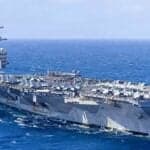


The U.S. Navy has awarded Huntington Ingalls Industries’ (HII) Mission Technologies division a contract worth up to $417.7 million to maintain and repair elevator systems on aircraft carriers and amphibious ships, helping keep its fleet ready for operations around the world.
The five-year indefinite-delivery/indefinite-quantity (IDIQ) contract was awarded by Naval Sea Systems Command (NAVSEA).
It covers engineering, maintenance, repairs and technical support for elevator systems, cargo-handling equipment and related shipboard systems.
The work will be carried out in the United States as well as at overseas and forward-deployed naval bases through June 2031.
Although they are not as visible as combat or propulsion systems, shipboard elevators are essential to daily naval operations. They move aircraft, weapons, maintenance equipment and supplies between different decks, helping carriers and amphibious ships continue flight operations and other missions.
A breakdown in these systems can delay aircraft launches, slow maintenance work and reduce a ship’s operational efficiency.
The contract was awarded through a competitive bidding process that received one bid. Since it is an IDIQ contract, the Navy is not providing the full funding upfront. Instead, it will issue task orders over the next five years as maintenance work is needed.
The cost-plus-fixed-fee contract allows the government to reimburse approved costs while paying the contractor a fixed fee, a structure commonly used when future repair needs cannot be predicted.
Under the agreement, HII will provide engineering and technical support, maintenance and repair services, operator and maintenance training, system testing, equipment overhauls, modernisation work, lifecycle support and maintenance of cargo-handling equipment.
The company will also send rapid-response teams anywhere in the world to carry out complex repairs and train sailors to perform routine maintenance on their own during long deployments.
“Ensuring that essential operational systems, including shipboard elevators, run reliably is central to meeting the readiness needs of our U.S. sailors and Marines,” Michael Lempke, president of Mission Technologies’ Global Security group, said.
He said HII would use more than 40 years of Elevator Support Unit experience to help keep these systems reliable throughout the fleet.
On aircraft carriers, weapons elevators move bombs, missiles and other munitions from secure magazines to flight deck preparation areas, allowing aircraft to be armed for missions.
Aircraft elevators move fighter jets, helicopters and support aircraft between the hangar and the flight deck for maintenance and flight operations.
On amphibious assault ships, elevators transport Marines, vehicles, cargo, aviation equipment, supplies and personnel between decks. Reliable operation of these systems is important for expeditionary missions, Marine Corps deployments, logistics operations and humanitarian assistance missions.
Mechanical problems with these elevators can disrupt the movement of personnel and equipment, reducing efficiency and affecting mission readiness.
The U.S. Navy continues to operate Carrier Strike Groups and Amphibious Ready Groups in regions including the Indo-Pacific, the Middle East and Europe.
Long deployments place additional strain on shipboard equipment, making regular maintenance and quick repairs important for keeping vessels available for operations.
The award also expands HII’s support business alongside its shipbuilding operations. The company, which became an independent business after separating from Northrop Grumman in 2011, maintains and modernises much of the U.S. Navy’s fleet, including submarines, surface warships, aircraft carriers and smaller vessels.
The contract follows recent progress in HII’s autonomous maritime programmes. Earlier this month, the company delivered the first REMUS 130 unmanned underwater vehicle, an updated version of a platform that has been used for undersea missions for more than 25 years.
The new model keeps the same basic design while adding upgraded internal technology to support future mission needs.
HII has also moved its ROMULUS unmanned surface vessel into the at-sea testing phase of the U.S. Navy’s Medium Unmanned Surface Vessel programme.
The vessel uses the company’s Odyssey Autonomous Control Solutions software, allowing operators to manage autonomous platforms through a single control system.
References: interestingengineering, HII
Want to read more?
Check out the full article on the original site