Oil Prices Jump Over 2% After Cargo Ship Hit By Unidentified Projectile Near Strait Of Hormuz
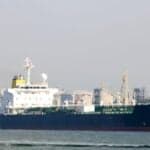


Oil prices climbed over 2% on Thursday after a cargo ship was struck by an unidentified projectile near Oman, increasing concerns over shipping safety in the Strait of Hormuz and possible disruptions to global oil supply chains.
The attack forced the International Maritime Organization (IMO) to suspend an operation that was helping ships and seafarers pass safely through the strategic waterway, raising fresh uncertainty over efforts to restore normal shipping after a preliminary U.S.-Iran agreement to end months of conflict.
Brent crude futures rose $1.52, or 2.1%, to settle at $75.26 a barrel, while U.S. West Texas Intermediate (WTI) crude gained $1.58, or 2.3%, to settle at $71.92 a barrel. U.S. gasoline futures jumped about 5%, while diesel futures gained around 4%.
According to the United Kingdom Maritime Trade Operations (UKMTO), the vessel was struck on its starboard side while sailing southeast of Oman by an unknown projectile.
After markets closed, two U.S. officials told Reuters that Iran had fired on the cargo ship as it tried to pass through the Strait of Hormuz.
Earlier in the day, a White House official said it was too early to say who was behind the attack. Iran has not publicly commented on the reports.
Iran’s Persian Gulf Strait Authority warned that ships using routes outside its designated Hormuz transit lanes would not receive safe-passage guarantees. It said shipowners, operators and captains choosing those routes would be responsible for any consequences.
The latest attack interrupted signs that shipping through the Strait of Hormuz was beginning to recover.
Earlier this week, crude shipments through the waterway reached their highest level since the conflict began, with about 70 vessels passing through on Wednesday, according to ship-tracking data.
The Strait of Hormuz normally carries around 20% of the world’s oil supplies, making it one of the most important shipping routes for global energy trade.
Both Brent and WTI had closed on Wednesday at their lowest levels since February 27, the day before the conflict began, as tanker traffic through the strait increased. Even after Thursday’s gains, analysts said both oil benchmarks remained in technically oversold territory.
Consultancy Gelber & Associates said technical buying and short-covering also helped push prices higher after the recent decline.
Analysts at Rystad Energy said storage tanks across the Gulf are about 50% to 60% full. They warned that if tanker traffic through the Strait of Hormuz does not improve soon, oil producers may have to cut output, delaying a full recovery in exports until next year.
Oil producers in the Gulf have continued increasing production but are struggling to find enough tankers to move additional cargoes. Goldman Sachs estimates that Gulf oil exports are currently running at almost two-thirds of normal levels.
Iraq has already stopped production at one of its key oilfields because of tanker shortages.
The United Arab Emirates, Kuwait and Qatar are continuing to raise production. Iraq is also seeking a higher OPEC production quota to recover oil sales lost during the conflict, although its oil ministry later said leaving OPEC is not being considered.
U.S. Secretary of State Marco Rubio told Gulf Cooperation Council (GCC) ministers that any future agreement with Iran would take the interests of Gulf countries into account.
The United States and the six-member GCC also backed free, unconditional and unrestricted navigation through the Strait of Hormuz without tolls, fees or attempts to control the waterway.
Rubio warned that any attempt by Iran to threaten or block shipping in the strait would create serious problems. He also said no country has the right to charge for the use of international waterways and that shipping fees would not be part of any agreement with Tehran.
However, the Wall Street Journal reported that Iran estimates charging for security, safety and environmental services in the Strait of Hormuz could generate about $40 billion a year for the countries involved.
Later on Thursday, U.S. President Donald Trump said the Strait of Hormuz remained open. He also claimed that Iran would buy U.S. farm products using money released under the agreement, although Tehran disputed that claim.
Japan’s Nikkei 225 and South Korea’s Kospi each fell more than 3% in early Friday trading, while Hong Kong’s Hang Seng Index and Taiwan’s Taiex also declined.
Separately, two powerful earthquakes struck Venezuela, causing widespread damage in and around Caracas. Thousands were feared dead.
Analysts said the disaster could slow the increase in Venezuelan oil exports that the Trump administration had expected after the United States captured Venezuelan President Nicolas Maduro in January.
References: Reuters, cnbctv18
Want to read more?
Check out the full article on the original site