Russia Arms One Of Its Most Strategic LNG Tankers In Baltic Sea With Heavy Machine Guns
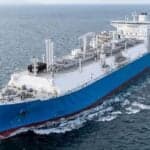


Russia has installed heavy machine guns on one of its most important commercial vessels operating in the Baltic Sea, according to reports and surveillance images released by Estonian authorities.
The move appears to be the first documented case of military-grade weapons being placed on a civilian Russian ship in the region.
Images taken by an Estonian Police and Border Guard Board surveillance aircraft in May reportedly show the Gazprom-operated liquefied natural gas (LNG) tanker Marshal Vasilevskiy carrying two sandbag-protected firing positions fitted with 12.7 mm Kord heavy machine guns.
The vessel was sailing past Estonia’s western islands toward the Russian port of Bolshoy Bor in the Gulf of Finland.
The installation follows heightened security concerns over possible Ukrainian drone attacks and closer European scrutiny of Russian vessels in the Baltic.
The images were first obtained by Estonian newspaper Eesti Ekspress and reported by investigative journalist Holger Roonemaa.
The 945-foot, 118,000-gross-ton vessel is owned by Gazprom and transports liquefied natural gas between mainland Russia and the Kaliningrad exclave. Since last August, it has completed four voyages between Bolshoy Bor and Kaliningrad.
Unlike Russia’s so-called shadow fleet, which is used to transport sanctioned Russian oil, the Marshal Vasilevskiy has a different role. It is Russia’s only Floating Storage and Regasification Unit (FSRU), capable of receiving liquefied natural gas, storing it, converting it back into gas, and feeding it into Kaliningrad’s gas network.
According to a Baltic Sea intelligence officer quoted in the reports, the machine guns were likely installed to protect the vessel from possible Ukrainian naval drone attacks and to show Russia’s willingness to defend the ship if it is stopped or inspected.
The officer said the weapons would be of limited use against aerial drones, which have recently targeted Russian infrastructure in the Baltic region, but could be effective against maritime drones.
However, Ukraine has not launched maritime drone attacks in the Baltic Sea, according to the reports.
Earlier this month, Ukraine carried out aerial drone strikes on the Russian Navy base at Kronstadt near St. Petersburg, in what was described as the first such attack on Russia’s Baltic Fleet.
Until now, Ukraine’s naval campaign had mainly focused on Russia’s Black Sea Fleet, where repeated attacks forced Russian naval assets to move from occupied Crimea to bases inside Russia. Ukrainian attacks linked to Russian shipping have also reached the Mediterranean on a more limited scale.
The reports said Ukraine has shown it can launch long-range drone attacks and carry out strikes from closer range using drones.
While there have been no reported Ukrainian attacks using uncrewed surface vessels (USVs) or uncrewed underwater vehicles (UUVs) in the Baltic Sea, the reports said Ukraine has that capability.
They also said Russia may be preparing for attacks similar to Operation Spiderweb, in which drones could be launched secretly from commercial platforms located close to their targets.
According to the reports, commercial vessels could potentially be used to launch aerial drones, USVs or UUVs.
The reports said the Marshal Vasilevskiy would be a valuable target because it is Russia’s only FSRU and plays an important role in supplying natural gas to Kaliningrad.
The Kord is a belt-fed heavy machine gun used by the Russian military on land vehicles and naval platforms. It fires 600 to 650 rounds per minute and has an effective range of about 2,000 yards.
Danish naval commander and independent analyst Jens Wenzel Khristoffersen said the weapons appear to serve mainly as a psychological deterrent, showing that Russia is prepared to use force if anyone tries to inspect or detain the vessel.
The reports also noted that the machine guns could be used to fire warning shots at boarding teams or helicopters. Earlier this month, a Russian warship fired warning shots near a British-flagged yacht in the English Channel. According to the reports, the Kord could also be used against helicopters supporting boarding operations.
Because commercial tanker crews are not normally trained to operate heavy machine guns, the reports said military personnel or members of Russia’s Federal Security Service (FSB) are likely travelling aboard the vessel.
They also said it was possible that man-portable air defence systems (MANPADS) could be stored on board, although there is no evidence that such weapons are being carried.
Journalists who reviewed passenger records since last August found that nearly half of the 50 people listed on board had previously served in the Russian military, the National Guard or the FSB.
One of them, Dmitry Artemenko, is registered at the address of an FSB special forces unit in Balashikha near Moscow, according to investigators. The reports said he travelled on every voyage the tanker made to Kaliningrad.
Estonian Navy Commander Commodore Ivo Värk said Estonia’s Defence Forces would intervene if the tanker used its weapons against any vessel inside Estonian territorial waters.
According to the reports, Russian Navy warships are increasingly escorting and monitoring shadow fleet tankers carrying sanctioned Russian oil through the Baltic Sea.
Over the past year, European authorities have intercepted several shadow fleet vessels over allegations of sailing under false flags or being suspected of damaging undersea cables.
Previous reports have also said some shadow fleet tankers have former soldiers and mercenaries among their crews. The Marshal Vasilevskiy is not part of the shadow fleet, although it has been sanctioned.
References: united24media, twz
Want to read more?
Check out the full article on the original site