US Navy Retires 7,640-Ton Nuclear Attack Submarine USS Alexandria After 35 Years Of Global Service
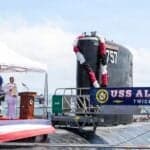


The U.S. Navy has formally ended the operational service of the nuclear-powered fast-attack submarine USS Alexandria (SSN-757), retiring one of its veteran Los Angeles-class submarines after 35 years.
The Navy held an inactivation ceremony for the submarine on June 29 at Naval Base Point Loma in San Diego.
USS Alexandria will now begin a multi-year inactivation and recycling process at Puget Sound Naval Shipyard and Intermediate Maintenance Facility before its scheduled decommissioning on Aug. 4, 2026.
The retirement is part of the Navy’s ongoing effort to replace older Los Angeles-class submarines with newer Virginia-class boats. USS Alexandria is the 46th submarine of its class to leave active service, leaving 23 Los Angeles-class submarines still in service.
Commissioned on June 29, 1991, the 7,640-ton (6,930-metric-ton submerged) submarine served through the post-Cold War period, the wars in Afghanistan and Iraq, and the Navy’s growing focus on the Indo-Pacific.
Over its career, it completed 14 overseas deployments and sailed more than one million nautical miles.
USS Alexandria operated in the Mediterranean Sea, Arctic Ocean, Persian Gulf and Indo-Pacific. It supported Operations Enduring Freedom and Iraqi Freedom, took part in Arctic Ice Exercises (ICEX), and carried out security missions in the Indo-Pacific. In 2004, it completed a round-the-world deployment through the Arctic.
The ceremony was attended by current and former crew members, retired naval leaders, family members and members of the submarine’s original commissioning crew.
Among those present were Rear Adm. Todd Weeks, director of In-Service Submarines and Industrial Base and a former commanding officer of Alexandria; Capt. Phillip Sylvia Jr., commander of Submarine Squadron 11 and another former commanding officer; Cmdr. Donald Coomes, the submarine’s final commanding officer; retired Capt. Paul Norman, its first commanding officer; retired Master Chief Machinist’s Mate Douglas Muller, its first Chief of the Boat; along with eight former commanding officers and several former Chiefs of the Boat.
Cmdr. Coomes said the crew had focused on training the next generation of submariners while taking the submarine through its final stage of service.
USS Alexandria was the third U.S. Navy ship named after the cities of Alexandria in Virginia and Louisiana. It belonged to the 23-boat Improved Los Angeles-class, or 688i, subclass, which featured quieter machinery, retractable bow planes and the ability to operate under Arctic ice.
During its service, the submarine took part in a wide range of operations. It deployed with the USS America battle group in 1993 and supported Operation Sharp Guard in the Adriatic Sea.
It later operated in the Mediterranean, North Atlantic, Persian Gulf and the U.S. 5th Fleet area, carrying out intelligence gathering, surveillance, carrier strike group support and other missions during Operations Enduring Freedom and Iraqi Freedom.
The submarine also participated in Arctic Ice Exercises, which tested under-ice navigation and operations.
In 2004, USS Alexandria completed a six-month deployment through the Arctic, Pacific, Central Command and European regions. During that mission, it became the first Improved Los Angeles-class submarine to circumnavigate the globe through the Arctic and the first U.S. nuclear-powered submarine to visit Goa, India.
After moving its homeport from Naval Submarine Base New London to Naval Base Point Loma in 2015, the submarine shifted its operations to the Pacific. It later deployed across the Western Pacific, operating around Japan, Guam, Okinawa, South Korea and the Philippine Sea.
Its later missions included operations with the USS Carl Vinson Carrier Strike Group, Foal Eagle exercises with South Korea, CHILEMAR submarine rescue exercises with Chile, ANNUALEX exercises with Japan and the U.S. Navy, and port visits to Sasebo, Yokosuka, White Beach, Busan and Apra Harbor.
USS Alexandria began its final deployment on Oct. 10, 2024, and returned on May 15, 2025, after about seven months in the Western Pacific.
Cmdr. Donald E. Coomes took command on June 2, 2025, and the submarine continued local operations off Southern California until entering the inactivation process in 2026.
During its 35 years of service, USS Alexandria received several awards, including the Navy Unit Commendation, the Meritorious Unit Commendation and multiple Battle Efficiency (“Battle E”) awards for operational readiness and mission performance.

Specifications
USS Alexandria measured 110.3 metres long, with a beam of 10 metres and a draft of 9.4 metres. It displaced about 6,082 tonnes on the surface and around 6,930 tonnes while submerged.
The submarine was powered by a General Electric S6G nuclear reactor driving two steam turbines that produced about 33,500 shaft horsepower. It could travel at speeds of more than 25 knots underwater and remain at sea for about 90 days.
Its weapons included four 533-mm torpedo tubes and 12 vertical launch tubes for Tomahawk cruise missiles. It could also carry Mk 48 ADCAP torpedoes, UGM-84 Harpoon anti-ship missiles, Mk 67 submarine-launched mobile mines and Mk 60 CAPTOR mines.
Following the inactivation ceremony, USS Alexandria will move to Puget Sound Naval Shipyard, where crews will remove or deactivate its weapons, classified electronics, sonar systems, communications equipment and combat systems before beginning work on its nuclear reactor.
The submarine’s S6G reactor will then be defueled, its propulsion system shut down and the reactor compartment separated from the pressure hull under Naval Reactors procedures.
Unlike conventionally powered ships, nuclear-powered submarines require years of specialised work before disposal.
The process includes removing nuclear fuel, managing radiological controls, separating the hull, demilitarising the vessel and recycling its remaining materials.
USS Alexandria now joins other retired Los Angeles-class submarines in the Navy’s recycling programme as the service continues modernising its undersea fleet with Virginia-class attack submarines.
References: interestingengineering, armyrecognition
Want to read more?
Check out the full article on the original site