Russian Tu-142 Aircraft Drops Sonobuoys Near UK Carrier Strike Group In Norwegian Sea
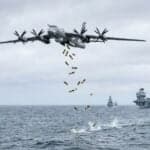


A Russian Tu-142 maritime patrol aircraft flew close to the British aircraft carrier HMS Prince of Wales in the Norwegian Sea before being intercepted by two UK F-35B fighter jets, the British Ministry of Defence (MoD) said on Monday.
The MoD said the Russian aircraft approached the carrier strike group several times on July 2, flying at low altitude and passing “unnecessarily close” to the carrier. It also dropped a large number of sonobuoys into the sea near the ship.
Britain described the flight as “unsafe and unprofessional.”
The incident took place while the UK’s Carrier Strike Group was operating under NATO command in the High North, an area that has become increasingly important as NATO steps up its presence in the North Atlantic and Arctic.
It also comes ahead of a NATO meeting in Ankara, where member countries are expected to pledge €70 billion in military aid to Ukraine for 2026.
According to the MoD, British forces tried to contact the Russian aircraft on international radio frequencies, but there was no response.
Two F-35B fighter jets were then launched from HMS Prince of Wales and escorted the aircraft away from the carrier strike group’s operating area.
The Russian aircraft involved was a Tu-142, known by NATO as the “Bear-F.” It is a long-range maritime patrol and anti-submarine warfare aircraft.
Sonobuoys used to monitor submarine activity
The MoD said the Russian aircraft dropped a large number of sonobuoys near the carrier. Sonobuoys are floating devices equipped with underwater sensors that are used to detect and track submarines.
The Tu-142 is designed mainly for maritime surveillance and anti-submarine warfare. Developed from Russia’s Tu-95 strategic bomber, it is fitted with long-range maritime search radar, electronic intelligence equipment, magnetic anomaly detection (MAD) systems, sonobuoy launch systems and communications equipment. It can also carry anti-submarine torpedoes and depth charges.
Newer Tu-142MZ/MR variants have upgraded navigation, communications and sensor systems, along with improved sonobuoys and anti-submarine weapons.
The UK Ministry of Defence did not say whether submarines were operating with the carrier strike group.
NATO increases operations in the High North
HMS Prince of Wales is leading the UK’s Carrier Strike Group during its current deployment under NATO command.
The group includes the Type 45 destroyer HMS Duncan, Royal Fleet Auxiliary tanker RFA Tidespring, F-35 fighter jets, and Merlin and Wildcat helicopters. Around 1,500 British personnel are taking part in the deployment.
Britain says the mission is part of NATO’s efforts to strengthen security in the North Atlantic and Arctic.
Earlier this year, the UK also deployed naval vessels to help protect undersea cables and pipelines after concerns over Russian submarine activity near British waters.
Defence Minister Dan Jarvis recently visited HMS Prince of Wales while it was operating near Iceland.
“We live in an increasingly dangerous and uncertain time, and it’s deployments like this, supported by allies and partners including Iceland, that improve our deterrence and defence as part of NATO,” Jarvis said.
He added that Russia poses challenges “under the water, on the water, on the land, in the sky, in space and in cyberspace.”
The latest encounter follows several recent interceptions involving Russian military aircraft in northern Europe.
On June 22, two Norwegian F-35A fighter jets intercepted two Russian Tu-160 strategic bombers escorted by MiG-31BM fighters over the Barents Sea.
In April, Norwegian F-35s intercepted a Russian Il-38 maritime patrol aircraft before later tracking Tu-95MS strategic bombers flying over international waters in the Barents and Norwegian Seas.
In early March, Norwegian F-35s also intercepted two Tu-95MS bombers escorted by Su-35 fighters over the Barents Sea.
HMS Prince of Wales
HMS Prince of Wales and its sister ship HMS Queen Elizabeth have previously faced technical and maintenance issues, including flooding incidents and periods of reduced operational readiness.
In 2023, HMS Prince of Wales was used for spare parts to help keep HMS Queen Elizabeth operational. Defence sources also said in late 2024 that war-game simulations had raised questions about the carriers’ survivability in a high-intensity conflict.
Despite those challenges, HMS Prince of Wales remains at the centre of the UK’s current carrier deployment. The Royal Navy says it is supporting what Britain describes as NATO’s first air policing mission from a European aircraft carrier.
The Ministry of Defence said the Russian aircraft left the area after being intercepted by the British F-35s. The UK’s Carrier Strike Group continues to operate under NATO command in the Norwegian Sea and surrounding North Atlantic waters.
References: militarywatchmagazine, deccanherald
Want to read more?
Check out the full article on the original site