Royal Navy Achieves World’s First Airborne Launch Of Uncrewed Boat For Maritime Missions
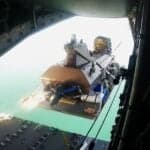


The Royal Navy has successfully carried out the world’s first airborne launch of an uncrewed surface vessel (USV) from a military transport aircraft.
During a six-day trial over the North Sea, engineers and defence partners completed four successful airdrops of a Kraken K3 SCOUT uncrewed surface vessel from an Airbus A400M aircraft flying at 1,300 feet.
Using a parachute-based delivery system, the vessel landed safely in the water, remained fully operational and was ready to begin its mission.
The trials were conducted as part of the Royal Navy’s Project Beehive, which is working to bring uncrewed and autonomous technologies into service as the Navy develops a future hybrid fleet of crewed and uncrewed vessels.
The new launch method allows an uncrewed boat to be deployed directly into an operating area without the need for a nearby port or support ship.
USV dropping in…
The Royal Navy is a step close to launching uncrewed surface vessels from the skies after a pioneering trial which saw the first airdrop of its kind from a military transport aircraft.
Read more: https://t.co/27q2A6bCxG pic.twitter.com/rb1s4g5Vbc
— Royal Navy (@RoyalNavy) July 8, 2026

According to the Royal Navy, this could help speed up missions such as surveillance, force protection and precision strike support, particularly in remote or difficult-to-access waters.
The trials combined Kraken Technology Group’s K3 SCOUT with Capewell’s Universal Maritime Craft Aerial Delivery System (UMCADS), a reusable platform designed to deliver small vessels from military aircraft.
Engineers also tested the IN-Release electro-mechanical release system, which controls the separation of the payload during deployment.
Captain Adam Ballard, who is involved in Project Beehive, said the programme was created to help the Royal Navy quickly learn how to operate uncrewed surface vessels more effectively.
“One of the limitations of small Uncrewed Surface Vehicles is their ability to self-deploy and so we are actively looking at concepts for deployment from motherships or ‘mother aircraft’,” Ballard said.
“The recent air dispatch trials that Kraken have conducted show the potential of this capability to rapidly deploy globally.”
He added that while naval aviation has traditionally projected air power from ships, future operations may increasingly see maritime capability launched from aircraft.

The K3 SCOUT was dropped into Sea State 4 conditions, where waves can reach about eight feet. The same vessel completed all four live airdrops during the trial, demonstrating that it could withstand the impact of the drop and continue operating afterward.
Mal Crease, Founder and CEO of Kraken Technology Group, said the trials showed that the K3 SCOUT could be deployed directly from a military transport aircraft into contested or hard-to-reach waters without requiring additional launch infrastructure.
He said Kraken would continue working with the Royal Navy and Capewell to develop new capabilities using its modular uncrewed platforms.
Mark Lavender, Director of Business Development and Training at Capewell, said the company successfully integrated the K3 SCOUT with the UMCADS platform and demonstrated that it can be quickly reconfigured for different maritime and land mission equipment.
Lavender said completing four live airdrops over six working days using the same vessel and delivery platform also demonstrated the reliability of the system.
References: royal navy, interestingengineering
Want to read more?
Check out the full article on the original site