First Images Reveal Ernest Shackleton’s Final Ship Quest Tangled In Fishing Nets On Labrador Seabed
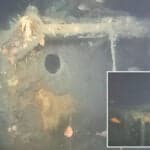


The first underwater images of Quest, the last ship used by Antarctic explorer Sir Ernest Shackleton, have revealed the historic vessel lying about 390 metres below the Labrador Sea, with parts of the wreck covered in abandoned fishing nets more than 60 years after it sank.
The images were captured during the Royal Canadian Geographical Society’s (RCGS) Heroic Age Expedition using the Woods Hole Oceanographic Institution’s remotely operated vehicle (ROV) Falcon and the crewed submersible Alvin. It is the first close inspection of the wreck since it was discovered in 2024 using side-scan sonar.
Researchers say the expedition is helping them understand the condition of the ship while also documenting how it has become home to a wide range of marine life despite damage caused by lost fishing gear.
“It doesn’t look good,” said David Mearns, co-chief scientist of the expedition and a professional shipwreck hunter who has found 29 wrecks.
He said the abandoned nets may have caused more damage to the wreck than if it had remained undisturbed on the seabed.
“We didn’t get any indication of nets in the original side-scan data, but it’s clear here. It is what it is, it’s disappointing,” Mearns said.
Images show the stern and much of the starboard side covered with fishing nets, floats and other trawling gear, which researchers believe became caught on the wreck and was later abandoned. A trawl door and chain were also found on the seabed nearby.
The bridge structure, where the ship’s name may once have been visible, is no longer there. Researchers said it was likely torn away either when the ship sank or during later trawling activity.
The wreck lies in the Hawke Channel, within an area known as the Hawke Box that has been closed to trawl fishing since 2002.
Mearns said the wreck shows that the effects of bottom trawling can remain long after fishing activity has stopped.
“It shows that even if trawling has been stopped for 25 years, the impact on the seabed is still there, and it will be there after 100 years,” he said.
Although the ship’s name and registration number cannot be seen, expedition research director Antoine Normandin said there is no doubt the wreck is Quest. He pointed to two distinctive portholes below the bridge that match historic photographs of the ship.
“It’s always disappointing to know that the wreck has been damaged by trawl fishing, but I’m just very happy to see that some of the more important sections from a historical perspective remain intact,” Normandin said.
RCGS Chief Executive Officer John Geiger was among the first people to visit the wreck aboard Alvin.
“Suddenly, you see the bow of the ship coming out of the darkness,” Geiger said. “You start to think about Shackleton. You think about where that ship has been. It’s very moving.”
He said seeing the deck where Shackleton died in January 1922 created a strong connection to the explorer and his story.
During the dive, Geiger also saw large holes in the deck and spotted a white enamel wash basin still inside the wreck. He said the fishing nets covering parts of the vessel were “surprising and disturbing.”
Shackleton’s last ship
Shackleton bought Quest in 1921 for a planned expedition to Canada’s High Arctic. When the Canadian government decided not to support the mission, he changed plans and sailed for Antarctica instead.
He died of a heart attack aboard the ship near South Georgia in January 1922 at the age of 47. His death is widely regarded as marking the end of the Heroic Age of Antarctic Exploration.
Shackleton is best known for leading the 1914 Endurance expedition after the ship became trapped and was crushed by Antarctic ice. He and his crew survived months on drifting ice before reaching safety.
After Shackleton’s death, Quest was sold to a Norwegian family. It later served as a minesweeper during the Second World War and spent much of its remaining working life as a sealing vessel operating off Labrador. It also supported Arctic expeditions, including British explorer Gino Watkins’ 1930 expedition to eastern Greenland.
On May 5, 1962, Quest was crushed by ice and sank off the southern coast of Labrador. All crew members escaped safely, but thousands of seal pelts carried on board were lost.
EXPEDITION ANNOUNCEMENT. @RCGS_SGRC @CanGeo CEO @JohnGGeiger and a team of international experts is in the Labrador Sea searching for the wreck of Sir Ernest Shackelton’s #QUEST. Tx to @MemorialU @marineinstitute @WeAreShackleton @FramMuseum @ExplorersClub https://t.co/AvieYihdcA pic.twitter.com/crpZjWRwJR
— Royal Canadian Geographical Society (@RCGS_SGRC) June 10, 2024
Wreck now supports marine life
Despite the damage, researchers found the wreck supporting a rich marine ecosystem.
The bow is covered with soft corals and sea anemones, while Atlantic cod, redfish and spotted wolffish have been seen around the ship.
WHOI biologist Kirstin Meyer-Kaiser said shipwrecks create new habitats by providing hard surfaces where marine life can grow. After more than 60 years on the seabed, Quest has become an important habitat for deep-sea species.
Normandin said the ship has also become valuable for scientific research.
Over its 45-year service life, Quest underwent several modifications, including changes to its cabins, conversion from steam to diesel power, and rebuilding of its bow and stern after the Second World War. These different materials now support different marine species.
3D model of the wreck
The expedition, the largest ever undertaken by the Royal Canadian Geographical Society, is using underwater photogrammetry technology from Voyis, part of Newfoundland-based Kraken Robotics, to create a detailed three-dimensional digital model of Quest.
Researchers say the model will help future scientific studies and allow people to explore the wreck virtually.
Fishing nets covering much of the starboard side have made the survey more difficult, but work is continuing.
After completing dives on Quest, the expedition will travel to the southern tip of Greenland to survey Terra Nova, the ship used by British explorer Robert Falcon Scott during his 1910 Antarctic expedition. The Terra Nova wreck was discovered in 2012 by the Schmidt Ocean Institute.
References: canadiangeographic, cbc
Want to read more?
Check out the full article on the original site