US Navy Supercarrier Abraham Lincoln Spends Over 210 Days At Sea Without Any Port Call Since Dec 2025
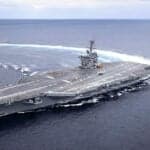


The U.S. Navy aircraft carrier USS Abraham Lincoln has spent more than 210 consecutive days at sea, setting a new record for a modern U.S. aircraft carrier as it continues operations in the Middle East.
The Nimitz-class carrier, the flagship of Carrier Strike Group 3 (CSG-3), has not made a port call since a brief stop in Guam on Dec. 11-12, 2025, after leaving Naval Base San Diego on Nov. 21, 2025.
It is now operating in the northern Arabian Sea after taking part in Operation Epic Fury and the U.S. naval blockade of Iran.
The deployment comes as U.S. naval forces continue operating around the Strait of Hormuz, one of the world’s busiest oil shipping routes.
More than 20 U.S. Navy surface combatants and over 50,000 American troops remain deployed across the Middle East as uncertainty continues over talks between Washington and Tehran following recent exchanges of strikes.
According to Stars and Stripes, Abraham Lincoln reached 207 consecutive days at sea on Monday, breaking the previous record held by USS Dwight D. Eisenhower in 2020. The carrier has since remained at sea, taking its total to more than 210 consecutive days.
“We’ve officially claimed the title for most consecutive days at sea for any modern aircraft carrier,” Lt. Cmdr. Alexis Travis, who serves aboard Lincoln, wrote on Instagram on June 16.
The U.S. Navy has not officially confirmed the record.
Lincoln and its strike group, made up of more than 5,000 sailors and Marines, left San Diego in November. At the time, the deployment was expected to focus on routine Pacific operations.
However, planning had also included a possible Middle East mission following Operation Midnight Hammer, when U.S. B-2 bombers struck nuclear targets inside Iran.
The group’s final pre-deployment exercise, known as COMPTUEX, included training for such operations.
After leaving Guam, the carrier operated in the South China Sea, crossed the Indian Ocean, and reached the northern Arabian Sea in late January.
Aircraft from Carrier Air Wing 9 (CVW-9) took part in the opening phase of Operation Epic Fury, while the strike group helped enforce the naval blockade that followed.
Since a Memorandum of Understanding (MOU) was signed between U.S. and Iranian officials on June 17, the carrier has remained in the northern Arabian Sea and has continued launching retaliatory strikes during recent military exchanges.
The deployment has now lasted more than seven months. If Washington and Tehran reach a final agreement before the mid-August deadline under the MOU, Lincoln could be among the first U.S. naval forces to leave the region. However, recent exchanges of strikes have raised uncertainty over the talks.
The long deployment has also raised concerns about crew welfare.
A message shared with Stars and Stripes by family members quoted one sailor as saying, “Our mental health and physical health is in danger.”
A family member, who asked not to be identified because of concerns about possible retaliation, said they were worried the sailor could be facing a mental health crisis.
Travis also acknowledged the demands of the deployment.
“We are tired,” she wrote in another Instagram post. “This crew has shown grit, grace, resilience, flexibility, kindness, and unmatched ability to do the darn thing.”
In another post, she wrote: “Actually literally no one signed up for this and yet here we are, still doing it safely and successfully.”
The Navy and U.S. Central Command did not immediately respond to questions about support measures for sailors during the deployment.
Carrier Strike Group 3 also includes destroyers from Destroyer Squadron 21, which launched Tomahawk Land Attack Missiles (TLAMs) against Iran and used Standard Missiles and other weapons to defend the carrier group.
The carrier’s air wing includes F-35C Joint Strike Fighters assigned to Marine Fighter Attack Squadron 314 (VMFA-314).
According to the operational account, the air wing flew thousands of sorties during the 40-day conflict, escorted dozens of commercial ships through the Strait of Hormuz, and supported operations against Iranian-affiliated vessels attempting to break the blockade.
Some of the carrier’s escorting destroyers made port visits before fighting intensified. USS Frank E. Petersen Jr. stopped at Duqm, Oman, in mid-February, while USS Michael Murphy visited Dubai from Feb. 25-27 before leaving shortly before Iran launched its first counterattacks.
USS Spruance, which deployed with Lincoln from San Diego, has also remained at sea for most of the deployment, with only one stop in Guam. It was seen launching a Tomahawk missile on the first day of Operation Epic Fury.
Lincoln has now surpassed the previous record of 206 consecutive days at sea set by USS Dwight D. Eisenhower in 2020, when COVID-19 restrictions limited port visits. Before that, USS Theodore Roosevelt spent 160 consecutive days at sea during operations after the Sept. 11 attacks.
Earlier this year, USS Gerald R. Ford completed the Navy’s longest overall deployment at 326 days, but that deployment included at least nine port calls in Europe and the Caribbean.
The U.S. Navy has not said when Abraham Lincoln will make its next port visit. Its deployment is expected to continue as U.S. forces remain in the region and negotiations between Washington and Tehran remain uncertain.
References: stripes, twz
Want to read more?
Check out the full article on the original site