Indian Navy Commissions Sixth Indigenous Project 17A Stealth-Guided Missile Frigate INS Mahendragiri
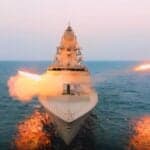


The Indian Navy on Saturday commissioned INS Mahendragiri, its sixth indigenous Project 17A (Nilgiri-class) stealth-guided missile frigate.
Defence Minister Rajnath Singh commissioned the warship at the Naval Dockyard in Visakhapatnam in the presence of senior naval officials, including Chief of the Naval Staff Admiral Krishna Swaminathan.
Built by Mazagon Dock Shipbuilders Limited (MDL) in Mumbai and designed by the Indian Navy’s Warship Design Bureau, the frigate has more than 75% indigenous content and is expected to join the Navy’s Eastern Fleet.
The commissioning marks another step in the Navy’s Project 17A programme, under which a new generation of stealth frigates is replacing older warships.
The programme is also part of the government’s Atmanirbhar Bharat initiative to strengthen India’s domestic defence manufacturing.
India continues to expand its naval capabilities amid increasing strategic competition in the Indo-Pacific and growing activity by extra-regional powers in the Indian Ocean.
The Navy says the new frigate will support a wide range of operations, including combat missions, maritime security, humanitarian assistance and disaster relief (HADR), and search and rescue operations.
INS Mahendragiri, named after the Mahendragiri mountain range in the Eastern Ghats, is the first Indian Navy warship to bear the name. The Navy said the name represents resilience, strength and determination.
Speaking at the commissioning ceremony, Defence Minister Rajnath Singh said the warship shows India’s progress in indigenous defence manufacturing.
“This indigenously designed and constructed state-of-the-art warship is a testament to our Aatmanirbhar Bharat vision and the incredible capabilities of our domestic defence industries and MSMEs,” he said.
He described INS Mahendragiri as a combat-ready warship that will help protect India’s maritime interests and contribute to security in the Indo-Pacific.
Singh also said India remains committed to maintaining peace and stability in the Indian Ocean Region and highlighted the Navy’s role in protecting maritime borders and securing important sea lanes.
“The region is our courtyard, and securing the courtyard is our responsibility,” he said.
Referring to changing security challenges, Singh said future conflicts may not resemble those of the past.
“There are conflicts that are fought without a formal declaration of war. The adversary of tomorrow may not look like the adversary of the past,” he said.
He added that the government would continue providing the armed forces with modern weapons and technology while stressing that trained personnel remain the key to military success.
Every warship has a journey.#Mahendragiri’s began with indigenous design and the craftsmanship that shaped her.
As the sixth Project 17A Nilgiri-class frigate prepares for commissioning, today #11Jul 26, witness the making of a frontline combatant built for the Navy of… pic.twitter.com/C4lFtCALAY
— SpokespersonNavy (@indiannavy) July 11, 2026
Captain Saikat Chatterjee, Commanding Officer (Designate) of INS Mahendragiri, said it was an honour to command the indigenous stealth frigate.
“Mahendragiri has no forerunner in the Navy. The ship therefore charts its own legacy with a fresh soul and character,” he said.
The ship’s motto, “Sthitpragyah, Raneshu, Aprajitah,” translates to “steadfast, wisdom and invincible in battle.”
“We pledge to serve resolutely as the founding custodians of this ship. We shall remain mission-ready and uphold the values of duty, honour and courage,” Chatterjee said.
INS Mahendragiri is designed to carry out anti-air, anti-surface and anti-submarine warfare. It can also undertake maritime security operations, humanitarian assistance and disaster relief missions, search and rescue operations, and long-duration deployments in the Indian Ocean Region and beyond.
The warship has advanced stealth features, reduced radar signature, enhanced survivability and a high level of automation. It is powered by a Combined Diesel or Gas (CODOG) propulsion system, allowing both high-speed operations and long-endurance deployments.
With a full-load displacement of about 6,670 tonnes and a top speed of 28 knots, INS Mahendragiri is equipped with BrahMos surface-to-surface missiles, the Barak-8 surface-to-air missile system, a multifunction radar, integrated combat management system, electronic warfare suite, anti-submarine warfare systems, torpedo launchers, an indigenous rocket launcher and a close-in weapon system.
According to the Ministry of Defence, more than 75% of the ship’s components are sourced domestically. Its construction involved a large number of Indian industries, including micro, small and medium enterprises (MSMEs), supporting India’s defence manufacturing sector and employment.
INS Mahendragiri was delivered to the Navy on April 30. It is the sixth warship under the Project 17A programme.
The earlier ships in the class are INS Nilgiri, INS Udaygiri, INS Himgiri, INS Taragiri and INS Dunagiri, while the seventh and final frigate, INS Vindhyagiri, is under construction at Garden Reach Shipbuilders and Engineers (GRSE) in Kolkata.
References: freepressjournal, economictimes
Want to read more?
Check out the full article on the original site