3 Thai Seafarers Attacked In Strait Of Hormuz Sue Shipping Firm Over Alleged Exposure To Security Risks


Three former crew members of a Thai cargo ship attacked in the Strait of Hormuz have filed a lawsuit against the vessel’s operator, alleging the company exposed them to known security risks by sending the ship through the waterway despite rising regional tensions.
The lawsuit was filed on Friday in Thailand’s Central Labor Court against Precious Shipping Co., two affiliated companies and the captain of the Mayuree Naree.
The three former seafarers have accused the company of labour rights violations and unfair dismissal following the March 11 attack, which killed three crew members and left the vessel inoperable.
Commercial ships passing through the Strait of Hormuz continue to face security risks amid the ongoing conflict between the United States and Iran. The waterway handles about one-fifth of global crude oil and liquefied natural gas (LNG) trade.
The former crew members, Panithi Tumkaew, Noppadon Wongsuvan and Surades Manpuen, claim the company put their lives at risk by allowing the ship to sail through the Strait of Hormuz despite the security situation, according to their lawyer, Kunpat Singhathong.
Kunpat said the three men were dismissed before completing their nine-month employment contracts after the attack left the ship unable to operate. They received compensation equal to two months’ salary.
He said the compensation was not enough because all three have since been diagnosed with post-traumatic stress disorder (PTSD), which has left them unable to return to work at sea for the foreseeable future.
“We tried to negotiate with the company, but it denied responsibility, so we believe the matter should be brought to the court,” Kunpat said before filing the case.
He did not disclose the total amount being sought, saying only that each plaintiff is seeking more than one million baht (about $30,000) in compensation.
Panithi, who worked for Precious Shipping for more than 10 years, said his wife encouraged him to seek medical treatment after noticing changes in his behaviour following the attack.
“When there are loud noises, I’ll get startled,” he said. “I can’t work now, and I have to take medication.”
Another plaintiff, Noppadon Wongsuvan, said the compensation they received was inadequate and below international standards.
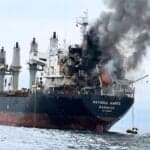
The Mayuree Naree was hit by two projectiles north of Oman on March 11 while transiting the Strait of Hormuz. Three crew members were killed and the remaining 20 were rescued before returning to Thailand about a week later.
According to the crew’s lawyer, the company knew the route carried security risks but still sent the vessel through the area.
Precious Shipping said it had not yet received the court documents but maintained that it had met all its legal and contractual obligations to the crew.
In a statement to the Stock Exchange of Thailand, the company said it had continued to support the affected crew members and their families after the incident.
It also said the Mayuree Naree had adopted enhanced security measures and remained in contact with maritime security coordination centres while transiting the Strait of Hormuz before the attack.
Earlier this month, the remains of the three crew members killed in the attack were returned to Thailand.
In a statement issued on July 3, Precious Shipping thanked everyone involved in the repatriation process and expressed its condolences to the victims’ families.
The company said it “remains committed to providing full assistance, care, and support to bereaved families throughout this difficult time.”
The attack took place during heightened regional tensions after U.S. and Israeli strikes on Iran began on Feb. 28. Before the incident, Iran’s Revolutionary Guards had warned that ships passing through the Strait of Hormuz could become targets, and several commercial vessels were attacked during the period of increased hostilities.
On Thursday, the United States launched new airstrikes against Iran, which responded by targeting American allies in the Middle East. The exchange of fire threatens an interim agreement aimed at ending the conflict.
The conflict has disrupted shipping through the Strait of Hormuz, one of the world’s most important maritime trade routes. Around one-fifth of global crude oil and LNG trade passes through the waterway, with much of it bound for Asia, where countries have faced an energy shock since the conflict began.
The safety of seafarers in the Persian Gulf has become a growing concern for countries including India, the Philippines and Thailand, whose nationals make up a large share of the global merchant shipping workforce.
“This is not simply a matter of shipping statistics,” International Maritime Organization Secretary-General Arsenio Dominguez said in a statement on Wednesday.
“Behind the figures are seafarers, and in some cases their families, who continue to bear the human cost of this conflict.”
The Labour Court will now hear the case and decide whether the employer met its legal duty of care towards the crew and whether the former seafarers are entitled to additional compensation.
References: thetimes-tribune, apnews
Want to read more?
Check out the full article on the original site