South Korea Dispatches Its Only Icebreaking Research Vessel On 83-Day Arctic Mission
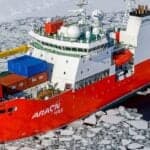


South Korea has launched its 17th Arctic research mission, sending its only icebreaking research vessel, Araon, on an 83-day expedition to collect data that could help support future commercial shipping through the Arctic as the country works towards opening a regular northern shipping route to Europe by 2030.
The mission is being carried out by the state-run Korea Polar Research Institute (KOPRI) and the Ministry of Oceans and Fisheries.
It is the first expedition under a joint project to develop forecasting technology using field observations to support future operations along Arctic shipping routes.
The 7,500-ton Araon departed this week for a three-month voyage. During the mission, it will travel through the Bering Sea, East Siberian Sea, Chukchi Sea and the Central Arctic Ocean, where researchers will study climate change, the seabed, marine ecosystems and sea ice conditions.
Scientists will also use autonomous observation equipment to collect data on sea ice and navigation conditions that could affect commercial shipping.
According to KOPRI, the information gathered will help improve forecasting systems and support future Arctic shipping operations.
KOPRI President Shin Hyeong-cheol said the expedition would help document changes in the Arctic, which is experiencing significant climate change, while also supporting preparations for future Arctic shipping routes.
He added that the data collected by Araon would strengthen South Korea’s Arctic research capabilities and their practical application.
The government is preparing to send its first trial container ship from South Korea to Europe through the Arctic later this summer to assess whether the Northern Sea Route could be used as a seasonal route between Northeast Asia and Europe.
South Korea has set a goal of opening a regular shipping route to Europe through the Arctic by 2030 as part of a plan to develop its southeastern region into a global maritime hub.
Although interest in Arctic shipping has grown as some parts of the region experience longer ice-free periods, the route still faces challenges, including unpredictable ice conditions, limited infrastructure, high insurance costs and geopolitical tensions.
South Korea is also expanding its polar shipbuilding capabilities. In April, HD Hyundai Heavy Industries won a $348.9 million contract to build Sweden’s next-generation icebreaker, the first overseas icebreaker order secured by a South Korean shipbuilder. The vessel is scheduled for delivery in 2029.
Hanwha Ocean was awarded a contract in 2025 to build South Korea’s next-generation heavy icebreaking research vessel.
The new ship is expected to enter service around 2030 and will strengthen the country’s polar research capabilities beyond those of Araon, which has been in service since 2009.
References: yna, oceancrew
Want to read more?
Check out the full article on the original site