U.S Navy Launches At-Sea 3D Printing In RIMPAC 2026 Exercise To Provide Spare Parts To Ships
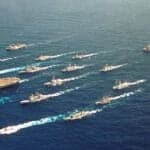


The U.S Naval Postgraduate School’s (NPS) Consortium for Advanced Manufacturing Research and Education (CAMRE) is preparing to use 3D printing technology in the world’s largest multinational military exercise, the Rim of the Pacific 2026 (RIMPAC).
According to reports, NPS will deploy 3D printers and other systems onboard ships which are taking part in the naval exercise to provide ship parts as required.
This would function as a distributed factory network across several domains and assets.
Usually, the crew analyses the fault, and then someone looks for the part and puts in an order for the replacement if the said part is not available on the ship.
Then, the order needs to be transported to the ship by a support vessel or an aircraft while the ship waits or operates with limited capability.
While this is not an issue during peacetime, it could lead to serious consequences in an active combat zone or in case there is an accident at the nearest port or if supply vessels are targeted, or aircraft cannot deliver it due to rough weather conditions.
By adapting this system, a part can be 3D printed at sea and delivered to the ship using a drone ship.
This method would come in handy during emergencies at sea, enabling ships to remain operational until replacements arrive. It will also be cheaper and faster than the traditional method.
A ship requiring a component could simply put in a digital request, and the special software would find the nearest supplier or 3D print the part needed, while also handling its safe and quick delivery.
This would also reduce the number of spare components every supply ship has to carry, and instead it could carry manufacturing equipment, raw material and approved digital designs.
RIMPAC has been chosen as a test ground to check whether this system can work in a real-world military environment.
Everything right from placing the digital order, to order tracking, manufacturing and the delivery will be tracked.
Chris Curran, program manager for CAMRE, said, “The objective is to demonstrate how advanced manufacturing complements an integrated logistics network in contested environments.”
Around 35 countries, 40 warships, 5 submarines, 140 aircraft and over 25,000 personnel are participating in the exercise close to the Hawaiian island chain.
Want to read more?
Check out the full article on the original site