China Builds Full-Scale Replica Of US Navy Destroyer For Missile Testing In Xinjiang Desert
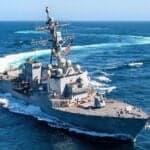


China has built a full-scale replica of a US Navy Arleigh Burke-class guided-missile destroyer at a remote missile testing range in the Taklamakan Desert, according to recent satellite imagery.
Analysts believe the mock-up is part of China’s ongoing efforts to improve its anti-ship missile capabilities as military competition with the United States continues.
The replica is located at the Ruoqiang Test Range in Xinjiang and is the latest in a series of mock US naval targets built by China for missile testing and military training.
Commercial satellite images also show a six-metre-wide rail system with a ship-sized target that analysts believe can simulate a moving vessel during weapons tests.
According to the US Naval Institute, the Ruoqiang facility has previously been used for ballistic missile testing.
An assessment by AllSource Analysis said the site contains mock-ups of several probable US warships, including mobile and rail-mounted targets.
The report added that the detailed design of the targets, along with multiple sensors placed on and around them, suggests the site is intended for repeated testing under different conditions.
The latest structure is far more detailed than earlier targets seen at the same location. Satellite images released in 2021 showed flat outlines of a US aircraft carrier and two Arleigh Burke-class destroyers.
The new replica is a three-dimensional structure built to match the approximate 155-metre size, superstructure and radar characteristics of an Arleigh Burke Flight IIA or Flight III destroyer.
Analysts say this allows China to carry out more realistic testing of missile guidance systems by recreating the radar profile of an operational warship.
The Arleigh Burke-class destroyer is one of the US Navy’s main surface combatants. It escorts aircraft carriers, provides air defence and carries out long-range strike missions.
According to Newsweek, ships from this class were also used during the recent conflict involving Iran.
Destroyer Squadron 15, based in Japan under the US Seventh Fleet, operates 10 Arleigh Burke-class destroyers, making it the largest destroyer squadron in the US Navy.
These ships regularly operate in the western Pacific, where they frequently encounter Chinese naval forces.
Military analysts say the replica fits into China’s anti-access and area-denial (A2/AD) strategy, which is aimed at improving its ability to target hostile naval forces during a potential regional conflict, including a Taiwan contingency.
US military planners have increasingly assessed that any Chinese move against Taiwan would likely involve attempts to delay or deter intervention by US carrier strike groups.
The Taklamakan Desert test range already contains several maritime targets, including mock-ups of Ford-class aircraft carriers, destroyer silhouettes and rail-mounted ship targets designed to simulate moving warships.
Analysts believe the new destroyer replica could be used to test anti-ship ballistic missiles such as the DF-21D and DF-26, along with hypersonic weapons and AI-assisted targeting systems.
Reproducing the radar profile of a warship allows missile developers to test whether weapon seekers can identify actual ships while distinguishing them from electronic decoys and other countermeasures.
Satellite imagery has also shown debris around earlier maritime targets at the range, suggesting previous live-fire testing involving precision-guided weapons.
The latest replica was first identified by Joseph Wu, co-founder of the Taiwan Defense Studies Initiative. Copernicus Sentinel-2 satellite imagery indicates construction began around October 2025.
According to US-based satellite operator Vantor, there were no similar structures at the site before then.
China has built similar military training targets before. It previously constructed replicas of central Taipei at military bases in Inner Mongolia, including buildings resembling Taiwan’s Presidential Office, Judicial Yuan and Foreign Ministry.
State broadcaster CCTV showed Chinese troops conducting a live-fire exercise against one of the structures in 2015. Another site included replicas of major roads in Taipei.
Military experts say it is not known whether the latest destroyer replica uses materials similar to those used in real warships.
However, they say China continues to invest in improving its ability to strike maritime targets with different types of missile systems.
China also displayed its latest anti-ship missiles during a military parade last August, held as tensions remained high with the United States and its Indo-Pacific allies.
A separate analysis of China’s state-owned and civilian missile industry found that missile production increased significantly in 2025, marking the largest annual increase since President Xi Jinping became president in 2013.
References: ndtv, express
Want to read more?
Check out the full article on the original site