US Launches Fresh Strikes On Iran After Container Ship Attack In Strait Of Hormuz
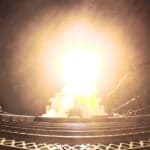


The United States launched fresh strikes on Iran early Sunday after Iranian forces attacked a Cyprus-flagged container ship in the Strait of Hormuz.
US Central Command (CENTCOM) said it struck about 140 targets across Iran, including missile and drone launch sites, air defence systems, coastal radar sites, ammunition depots, communication facilities and military boats.
The military said the operation was aimed at reducing Iran’s ability to attack commercial vessels sailing through the Strait of Hormuz.
The strikes followed an attack by Iran’s Islamic Revolutionary Guard Corps (IRGC) on the M/V GFS Galaxy, a Cyprus-flagged container ship transiting the strait.
According to CENTCOM, the vessel caught fire and suffered significant engine room damage, leaving it unable to continue its voyage. One civilian crew member remains missing.
The latest fighting has increased concerns over the security of shipping in the Strait of Hormuz, through which about one-fifth of the world’s traded oil and natural gas passed before the conflict began. It has also added pressure on negotiations aimed at reaching a lasting ceasefire.
“Iran made a poor choice. Now they pay,” US Defence Secretary Pete Hegseth said in a post on X.
CENTCOM said the latest operation was the third round of US strikes against Iran this week. It said fighter aircraft, naval vessels, one-way attack aerial drones and one-way attack sea drones were used to hit Iranian military targets.
The military said it targeted missile and drone capabilities, coastal radar systems, air defence sites and small military boats used to support attacks on international shipping.
“The Strait of Hormuz is a vital maritime corridor for global trade. Iran does not control it,” CENTCOM said, adding that US forces remain prepared to ensure freedom of navigation for commercial shipping.
CENTCOM also said Iran had been given another opportunity to comply with the Memorandum of Understanding after earlier attacks on commercial vessels but failed to do so.
The US said the strikes followed the attack on the M/V GFS Galaxy, which was sailing through the Strait of Hormuz.
According to CENTCOM, the ship suffered a fire and extensive engine room damage during the attack.
The United Kingdom Maritime Trade Operations (UKMTO), run by the British military, said the vessel had been sailing close to Oman’s coastline. Commercial ships have increasingly used that route to avoid Iranian territorial waters.
Oman’s maritime authority said it rescued 23 crew members from the vessel. One crew member is still missing.
India’s Ministry of External Affairs said the missing crew member is an Indian national and that it is working with Oman to locate him.
Hours before the US strikes, Iran said it considered the Strait of Hormuz closed once again after a vessel using what it called an “unauthorised route” was hit by a warning shot.
Iran’s Revolutionary Guards later said the strait would remain closed “until further notice.”
The Guards said several vessels had ignored warnings and instructions to use approved routes and that one vessel was stopped after being struck by a warning shot.
Iran has said it wants to control transit through the strait and has argued that ships using the waterway should pay transit charges.
The United States has encouraged commercial vessels to use a southern route through Oman’s territorial waters, while the international community continues to regard the Strait of Hormuz as an international waterway.
Iran launches attacks across the Gulf
Iran responded to the US strikes by launching missile and drone attacks at countries hosting US military forces, including Bahrain, Qatar, Kuwait, Oman and Jordan.
Missile alerts sounded across several Gulf countries early Sunday.
Qatar’s military said it intercepted incoming missiles. The country’s Interior Ministry said three people, including a child, were injured by falling debris from intercepted missiles.
Bahrain, home to the US Navy’s Fifth Fleet, also activated missile warnings, while Kuwait said it intercepted incoming attacks.
Oman’s state news agency reported drone strikes in areas overlooking the Strait of Hormuz and issued shelter-in-place warnings. Oman later summoned the Iranian ambassador to protest the attacks.
Jordan said three Iranian missiles landed in different parts of the country, causing minor damage but no injuries.
Sirens also sounded in the United Arab Emirates, although authorities said no missiles entered UAE airspace.
Explosions reported in Iran
Iranian media reported explosions in several parts of the country after the US strikes.
Press TV reported blasts in Bushehr and Asaluyeh, while state television reported explosions near Chabahar.
Mehr News Agency reported explosions on Qeshm Island.
State broadcaster IRIB reported explosions in Bandar Abbas and Sirik.
IRNA said more than 10 explosions were heard in the southern port city of Jask.
Iranian media also reported strikes near the Strait of Hormuz and in areas close to Tehran.
Iran’s semi-official news agencies said a navy officer was killed in the attacks.
Ceasefire talks remain uncertain
The latest escalation comes despite an interim ceasefire agreed on June 17, which was intended to create a 60-day period for negotiations to end the war that began on Feb. 28.
US President Donald Trump declared the war “over” three days ago and also said last week that the interim agreement was effectively over. However, mediators including Pakistan, Qatar and Egypt continue efforts to reach a permanent agreement.
Iranian Foreign Minister Abbas Araghchi said he met Oman’s foreign minister to discuss ways to ensure the safe passage of ships through the Strait of Hormuz.
He also accused the United States of violating the interim agreement after ending waivers that allowed Iran to sell crude oil on the open market in US dollars.
Oman said discussions with Iran on the future of the Strait of Hormuz would continue at both the technical and political levels.
The Strait of Hormuz remains at the centre of the dispute between the two countries. Before the conflict, about one-fifth of the world’s traded oil and natural gas moved through the waterway.
Iran has said it could target additional enemy bases in the region if more attacks take place.
In his first statement since the funeral of his father, Ayatollah Ali Khamenei, Iran’s Supreme Leader Ayatollah Mojtaba Khamenei said the country would avenge his killing.
References: freepressjournal, indiatoday
Want to read more?
Check out the full article on the original site