U.S Reveals Autonomous Vessel System Which Can Switch Between 5 Different Naval Operations
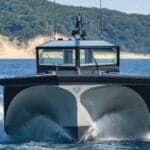


At the 2026 Pennsylvania Defense and Innovation Summit, Ghostworks unveiled MRLN, a groundbreaking remote-pilot autonomy system.
Rather than being a new physical boat, MRLN acts as a mission-management layer designed to let a single uncrewed surface vessel pivot between multiple naval missions without switching platforms.
It was developed in collaboration with General Atomics Aeronautical Systems Inc. (GA-ASI) and Mercury Marine; the system integrates seamlessly with Ghostworks’ proprietary M-Hull and powercat vessel designs.
Naval architecture usually forces a compromise between speed, operating range, and payload capacity.
According to Ghostworks CEO Brooke Kerschbaumer, MRLN was built to break these constraints, granting commanders field-flexible command without requiring an entire fleet of specialised, single-role boats.
While MRLN handles autonomous navigation, human operators maintain constant situational awareness and can assume direct, remote piloting control at any moment.
The software features a modular design that supports various onboard systems without locking customers into specific hardware.
Unlike rigid, fixed mission packages, operators can rewrite and adapt mission settings directly in the field.
MRLN boasts its own independent communications capability, allowing it to function reliably in degraded or contested environments where traditional connectivity is cut off.
The first vessel platform to be equipped with the MRLN system is the Minerva class. This setup showcases what the hardware-software synergy can achieve:
- Payload Capacity: Up to 17,500 pounds
- Cruising Speed: 30 knots
- Durability: Fully operational in rough Sea State 4 conditions
GA-ASI contributed advanced autonomy technologies adapted directly from its proven unmanned aircraft programs.
Jeff Hettick, VP of Agile Mission Systems, noted that translating these aviation capabilities to the maritime domain was a logical, rapid step forward.
Mercury Marine focused on the critical vessel control and propulsion mechanics.
Carl Greiner, Director of Government & Advanced Maritime Systems, highlighted that the team validated the strict reliability required for long-duration surface operations, expanding the overall performance envelope.
By eliminating the need for dedicated vessels assigned to single roles, commanders can reconfigure a single MRLN platform on the fly as operational demands shift.
Planned mission profiles for MRLN-equipped vessels include Intelligence, Surveillance, and Reconnaissance (ISR), Autonomous littoral resupply, mine countermeasure (MCM) operations, communications relay and combat logistics support in contested coastal waters.
Ultimately, the platform aims to maximise operational flexibility for naval forces while keeping human personnel safely out of dangerous environments.
Want to read more?
Check out the full article on the original site