South Korean Companies Secure ABS Approval For 15,000 TEU Container Ship With 2 Nuclear Reactors
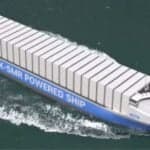


Korea Atomic Energy Research Institute (KAERI) recently announced that its concept design of a 15,000 TEU container ship having a molten reactor, which was jointly developed along with the Korea Research Institute of Ships and Ocean Engineering (KRISO) and Samsung Heavy Industries, has received approval in principle (AiP) from the American Bureau of Shipping (ABS).
The container ship will be powered by two molten salt reactors, which will be accommodated by optimising the power system, the hull form and layout design.
KAERI developed the reactors, called MARINA, while KRISO and Samsung Heavy Industries handled the hull and layout design of the reactor and onboard systems along with power operations and vital control tech.
The companies said that the systems would improve the safety, performance and efficiency of the container vessel.
Small modular reactors (SMRs) are said to be suitable for ships since they are smaller than traditional reactors, which are massive.
A molten salt reactor is a kind of small modular reactor which utilises molten salt, which mixes nuclear fuel and coolant as a liquid nuclear fuel.
This reactor technology is ideal for ocean-going vessels, travelling long distances with dangerous cargoes.
Cho Jin-young, head of the Advanced Reactor Research Institute, said, “This achievement will serve as a foundation for leading the next-generation zero-carbon ship market, based on world-class nuclear technology and the competitiveness of the shipbuilding industry.”
Hong Ki-yong, head of the Korea Research Institute of Ships and Ocean Engineering (KRISO), said, “The nuclear-powered ship promoted by the Korea Research Institute of Ships and Ocean Engineering (KRISO) is a next-generation technology that will determine the competitiveness of the future shipping industry, and securing design technology suitable for the marine environment is more important than anything else.”
Want to read more?
Check out the full article on the original site