US Marines Board Oil Tanker In Gulf Of Oman As Naval Blockade Against Iran Intensifies (Images)
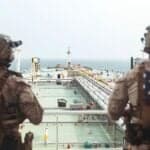


U.S. Marines boarded a commercial tanker in the Gulf of Oman on July 16 as part of Washington’s enforcement of its renewed naval blockade on ships trading with Iran, U.S. Central Command (CENTCOM) said.
U.S. forces have redirected three commercial vessels and disabled another that did not comply with the blockade, CENTCOM said.
In a post on X, CENTCOM said Marines from the 11th Marine Expeditionary Unit carried out a verification boarding of the tanker M/T Wen Yao in the Gulf of Oman.
“As of today, American forces have redirected three commercial vessels trying to run the blockade, disabled one that didn’t comply, and boarded one to ensure full compliance with the ongoing U.S. naval blockade against Iran,” CENTCOM said.
It added that the Strait of Hormuz and nearby waters remain open for commercial traffic except for vessels attempting to violate what it called America’s “steel wall blockade.”
The Gulf of Oman lies just southeast of the Strait of Hormuz, through which a significant share of the world’s seaborne oil trade passes, making military activity in the area closely watched by the shipping and energy industries.
According to maritime reports, the boarded vessel was the 300,000-deadweight-tonne very large crude carrier (VLCC) Wen Yao. U.S. Marines reached the tanker by helicopter during what CENTCOM described as a flag verification boarding.
Maritime intelligence firm TankerTrackers.com said the tanker was carrying Iranian fuel oil and changed its name and flag several times on July 16 while being pursued by U.S. forces. By the time it was boarded, the vessel was reportedly operating under the name Azhin and flying an Iranian flag.
Equasis records cited in the report showed the vessel was listed under a San Marino flag but owned and operated from Dubai.
The boarding follows several enforcement actions since the blockade was reimposed earlier this week. CENTCOM said three commercial vessels had been redirected, one vessel had been disabled after failing to comply, and one had now been boarded.
U.S. Marines from the 11th Marine Expeditionary Unit conduct a verification boarding aboard M/T Wen Yao in the Gulf of Oman, July 16.
As of today, American forces have redirected 3 commercial vessels trying to run the blockade, disabled 1 that didn’t comply, and boarded 1 to… pic.twitter.com/vbjArHuLaO
— U.S. Central Command (@CENTCOM) July 16, 2026
Maritime reports said the disabled vessel was an unladen oil tanker that was struck by Hellfire missiles after attempting to breach the blockade.
The White House said on Thursday that the blockade applies only to ships entering or leaving Iranian ports and does not restrict other commercial traffic using the Strait of Hormuz.
“We know that there is a blockade of ships directed by the President for ships entering and departing Iranian ports only. This has been fully implemented and is in full force,” White House Press Secretary Karoline Leavitt said during a briefing.
She said the operation is being supported by more than 10,000 U.S. sailors, Marines and airmen, along with two aircraft carriers, more than 20 warships and dozens of aircraft.
CENTCOM said it had struck military logistics infrastructure. Iranian state media reported strikes around Tehran, Semnan, Hormozgan, Khuzestan, Lorestan, Markazi, Hamedan, Sistan and Baluchistan, as well as Qeshm Island near the Strait of Hormuz.
Iranian media also reported strikes around Bandar Abbas, including residential areas, a railway junction west of the port city and two road bridges linking Bandar Abbas with inland areas. It reported casualties but provided no independent verification.
Regional tensions also remained high.
Early Friday, Kuwait said it was responding to missile and drone attacks. Explosions were heard in Doha after Qatari authorities warned of a heightened security threat, while Bahrain urged residents to take shelter.
Iranian state media said Iranian forces were targeting U.S. helicopters and aircraft at an American airbase in Bahrain in response to U.S. attacks on Iranian infrastructure.
Iran’s Armed Forces spokesperson Brigadier General Abolfazl Shekarchi also warned that Tehran could target U.S. infrastructure across West Asia if Iranian infrastructure came under attack.
Speaking to Iranian state broadcaster IRIB, Shekarchi said the U.S. military presence was responsible for rising tensions around the Strait of Hormuz.
“The Islamic Republic’s sovereignty over the Strait of Hormuz is a factor of security for the entire region, not insecurity,” he said. “The reason the Strait of Hormuz is becoming insecure is the presence of the Americans.”
Iran has also asked the Houthis in Yemen to be prepared to close the Red Sea oil route if the United States targets Iranian energy infrastructure, Reuters reported.
Houthi leader Abdul Malik al-Houthi also warned that Saudi oil and other strategic facilities could become targets if Saudi Arabia intervenes in Yemen.
According to Lloyd’s List Intelligence, cargo shipments through the waterway fell by nearly a quarter at the beginning of the month.
The firm also said some tankers have switched off their tracking systems while passing through the strait, while others have delayed voyages because of security concerns.
Pakistan’s foreign ministry said efforts to bring Washington and Tehran back to the negotiating table were continuing, but acknowledged that the talks were becoming more difficult.
Separately, U.S. President Donald Trump said Iran had released an American citizen detained since 2024. Human rights lawyer Jared Genser identified the individual as his client, Dena Karari, a U.S.-Iranian citizen. Iran’s judiciary, however, denied that any American prisoner had been released or exchanged.
References: US Centcom, The Guardian
Want to read more?
Check out the full article on the original site