Piracy Incidents Rise To 137 In 2025 As Malacca Strait Records 80 Attacks
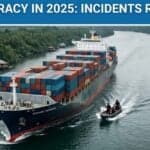


A new global survey of leaders in the shipping industry cites data from the International Maritime Bureau showing that there were 137 piracy and armed robbery incidents against ships in 2025, up from 116 the previous year.
Most of these events are opportunistic, not sophisticated in execution. Even when they do not escalate further, they still present a direct risk to crew safety and operational continuity and still involve vessel boardings, attempted hijackings and armed confrontations.
Most of the 137 incidents recorded in 2025 occurred in the Straits of Malacca and Singapore, accounting for 80 of the total. This has been the status of the corridor for years and only reinforces its place as a persistent hotspot for opportunistic boarding and theft, not a passing trend.
The geography itself dictates the crime: narrow, congested shipping lanes require massive container ships and tankers to reduce speed, making them soft targets for local, boat-bound thieves.
There has also been a resurgence in pirate activity off Somalia and Yemen in recent months. In late 2025 and early 2026, hijacking attempts returned to waters that had enjoyed a relative lull.
Security analysts point to a direct cause-and-effect: international naval forces have been heavily redeployed to the Red Sea to counter Houthi missile and drone threats. This shift has created a security vacuum off the Horn of Africa, which Somali pirates have exploited to target smaller commercial vessels, fishing dhows, and deep-water tankers.
Currently, malicious physical attacks, including piracy, are seventh out of 12 risk categories tracked in the survey, or a mid-table risk.

Confidence in the industry in managing this risk is even lower, ranking among the five lowest of all categories assessed, although confidence has improved slightly on the previous year.
Beyond these regional patterns, the survey indicates a broader structural shift: an increasing overlap between geopolitical tensions and direct threats to commercial shipping.
Developments witnessed in the Red Sea region and wider Middle East corridor through late 2025 and early 2026 highlight the increasing interplay of state tensions, proxy conflict and non-state actor activity in raising risk, not only to vessel operations but also to the seafarers transiting the affected areas.
It is worth noting that most survey responses were submitted before the escalation of the conflict in the Middle East, meaning the full impact of that escalation on industry sentiment is not yet captured.
Geopolitical risk is adding to, rather than replacing, long-established piracy hotspots, so the industry’s ability to manage physical threats to shipping may be tested more directly in the year ahead than current figures suggest.
The results come from the ICS Maritime Barometer Report 2025-2026, which surveyed senior shipping leaders on risk and confidence across the sector.
While East Asia handles the highest volume of attacks, West Africa’s Gulf of Guinea remains the most violent zone for seafarers. The region recorded 21 incidents in 2025. Though local authorities have successfully restricted the overall frequency of pirate operations compared to peak historical levels, the stakes remain incredibly high.
The Gulf of Guinea uniquely focuses on high-risk crew kidnappings for ransom rather than simple cargo or ship-store theft, making it a critical focus area for international maritime security.

The Human Element: Weapons and Psychological Warfare
Behind the statistics are the seafarers themselves. In 2025, a total of 88 seafarers were directly affected by maritime violence, enduring hostage-taking, assault, or abduction.
The IMB highlighted a fierce escalation in the threat level: the reported use of firearms rose to 42 incidents globally, up from 26 the previous year. In the Singapore Straits alone, gun carriage by criminals more than tripled, jumping from 8 to 27 reported cases.
Beyond the physical danger of being held hostage or kidnapped, the psychological toll on crews transiting these waters is immense.
The constant vigilance required during long watchkeeping hours has exacerbated an industry-wide crew retention crisis. When boardings occur, crews are increasingly forced to retreat into heavily reinforced “citadels”, secure internal safe rooms, waiting in total isolation for international navies to respond.
To manage a 91% successful boarding rate when intruders approach, the shipping industry is aggressively leaning on layered defence strategies.
Ships are using razor wire along low freeboards, high-pressure water cannons, and electronic motion sensors to detect early nighttime approaches.
The use of Private Armed Security Teams (PAST) has seen a renewed uptick, particularly for transit routes looping around Africa and nearing the Western Indian Ocean.
Joint regional initiatives such as the Indonesian Marine Police interventions that successfully dismantled two major pirate gangs prove that local law enforcement remains the most effective bottleneck against opportunistic crime.
You might also like to read-
- Biggest Ship Seizure in the History of Maritime Piracy
- What Are The Causes of Maritime Piracy in Somalia Waters?
- Enforcing the Law: An Economic Approach to Maritime Piracy and its Control
- The Menace of Maritime Piracy and Somali Pirates – Is There a Solution?
- 10 Maritime Piracy Affected Areas around the World
Want to read more?
Check out the full article on the original site