US Coast Guard Tracks First Chinese Arctic-Bound Research Ships Through US EEZ In 2026
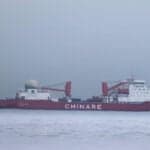


The U.S. Coast Guard has monitored two Chinese research vessels as they transited through the U.S. exclusive economic zone (EEZ) and over the U.S. extended continental shelf in the Bering Sea on their way to the Arctic, marking the first time Chinese ships have been tracked in the area this year.
The Coast Guard said it launched Operation Frontier Sentinel and deployed the national security cutter USCGC Munro (WMSL 755) to monitor the vessels during their northbound transit.
According to the Coast Guard, the Chinese research icebreaker Xue Long sailed through the U.S. EEZ and over the extended continental shelf in the Bering Sea with the Arctic as its declared destination. Another China-flagged research vessel, Xue Long 2, also headed to the Arctic.
The Coast Guard said the operation was intended to protect U.S. sovereign rights, ensure activities remain consistent with international law and allow it to respond quickly if any malign activity is detected.
An official Coast Guard photograph showed Xue Long in the Bering Sea on July 12. The Coast Guard did not reveal the exact locations of the vessels and said there was no indication that either ship had carried out scientific research in waters under U.S. jurisdiction.
Under international law, foreign vessels are allowed to operate within the U.S. EEZ and over the U.S. extended continental shelf.
However, the Coast Guard said any marine scientific research in these areas requires advance permission from the United States and the sharing of any information collected.
Rear Adm. Bob Little, commander of the U.S. Coast Guard Arctic District, said the Coast Guard, together with the Department of War, the Department of State and international partners, is actively responding to competitor activities in what he described as an increasingly contested Arctic.
The latest monitoring operation follows a similar mission in July 2025, when a U.S. Coast Guard C-130J Hercules aircraft tracked Xue Long 2 about 290 nautical miles north of Utqiagvik, Alaska. The vessel was then about 130 nautical miles inside the boundary of the U.S.-claimed extended continental shelf.
The ships are part of China’s 16th Arctic Ocean scientific expedition, which left Dalian on July 3. Along with Xue Long and Xue Long 2, the research icebreaker Jidi is taking part in the expedition, while the research vessel Tansuo-3 is expected to join later.
The expedition is scheduled to continue until early October and includes studies on sea ice, hydrology, biology, ecology, atmospheric conditions, the Gakkel Ridge and the evolution of the Arctic Ocean’s crust. Scientists from China, Russia, Germany and other countries are expected to participate.
The Polar Research Institute of China, a public institution under China’s Ministry of Natural Resources, operates Xue Long and Xue Long 2 and is responsible for the country’s national polar research programmes and expeditions.
The U.S. Coast Guard said it has seen increased activity in the U.S. Arctic in recent years and expects the region to remain busy this summer as it continues monitoring foreign vessels operating near U.S. waters.
References: shippingtelegraph, USCG
Want to read more?
Check out the full article on the original site