Ship Catches Fire Near Omani Coastline In Strait Of Hormuz
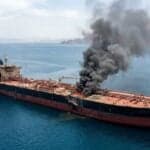


The United Kingdom Maritime Trade Operations (UKMTO) said it received a report of an incident about 8 nautical miles northwest of Kumzar, Oman.
Military authorities informed UKMTO that a vessel was on fire, but the cause of the blaze has not yet been confirmed.
UKMTO advised vessels transiting the area to exercise caution and report any suspicious activity while authorities investigate the incident.
The conflict between the United States and Iran entered its second week, with both sides carrying out fresh attacks across the region.
Shipping through the Strait of Hormuz has largely stalled during the fighting, while concerns over the safety of commercial vessels have continued to grow.
The US military has been encouraging ships to use a route close to Oman’s coastline while transiting the Strait of Hormuz. Iran has responded by attacking vessels using those routes, saying it should control navigation through the strategic waterway.
The Strait of Hormuz is one of the world’s busiest maritime chokepoints, carrying nearly one-fifth of global oil and natural gas trade during peacetime.
The vessel fire was reported as the United States launched another round of airstrikes on Iran early Monday. The US military said the latest operation marked the ninth straight night of strikes.
The latest US strikes followed Washington’s announcement that another American service member had been killed. The US military said the service member died in Iraq on Saturday during the “controlled detonation” of a downed Iranian drone.
Earlier, the military said it had targeted Iran’s paramilitary Revolutionary Guard in response to Friday’s attack in Jordan that killed US troops. One service member had remained missing after that attack.
On Sunday, the military said “unidentified remains” had been recovered and were being examined. The latest death brought the number of US service members killed since the conflict began to 17.
The latest fighting has also seen the United States strike bridges, electrical facilities and other sites inside Iran. Footage released by the US military on Sunday appeared to show fighter aircraft and Tomahawk cruise missiles launched from the sea hitting targets, including sites in mountainous areas where Iran’s Revolutionary Guard keeps missile bases and other military equipment.
Iran’s Atomic Energy Organisation said one of the US strikes hit the construction site of the planned Darkhovin nuclear power plant in southwestern Iran. Satellite images from Planet Labs PBC taken on July 9 showed earth-clearing work but little construction at the site.
The International Atomic Energy Agency (IAEA) later said the facility was still in the very early stages of construction and contained no nuclear material during its most recent inspection.
Iran also launched another wave of missiles and drones toward US-allied countries in the Middle East.
Jordan’s military said it intercepted several Iranian missiles without any casualties or damage. The country later summoned Iran’s chargé d’affaires in protest.
Bahrain, Jordan and Kuwait activated air defence systems against incoming Iranian drones and missiles.
Israel warned that missiles fired toward the Jordanian port city of Aqaba could reach Israeli territory. Authorities in Eilat said two interceptor missiles were launched to prevent debris from falling in populated areas. Israeli military chief Lt. Gen. Eyal Zamir said the country was “prepared to immediately resume combat.”
Kuwait said one of its power generation and water desalination plants was attacked for the second time in two days, causing fires. The Ministry of Electricity, Water and Renewable Energy said the country’s power grid remained stable. Around 90% of Kuwait’s drinking water comes from desalination plants.
The Gulf Cooperation Council (GCC) also criticised the attacks on civilian infrastructure. GCC Secretary-General Jasem Mohamed al-Budaiwi accused Iran of committing war crimes by targeting civilian facilities.
Under international humanitarian law, civilian infrastructure such as bridges, power stations and water facilities is generally protected from attack.
However, those sites may lose that protection if they are being used for military purposes. Even then, attacks must be proportionate and minimise civilian harm.
References: indiatoday, indiatvnews
Want to read more?
Check out the full article on the original site