Women Make Up Just 1% of the World’s Seafarers, Global Survey Finds
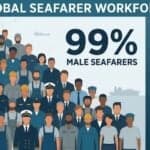


Women account for just 1% of the world’s seafarers. That figure has hardly moved in years, despite multiple promises from within the industry to diversify the workforce. A new global survey of senior shipping leaders sharpens the focus on the number and reveals just how much the sector has yet to do.
The discovery is just another piece of a bigger, long-term problem: having enough trained crew on ships in the first place. For years, the industry has been under pressure from an ageing, shrinking pool of experienced seafarers, and no sign’s going to sort itself out.
But shipping executives say they are more confident of solving this particular problem than almost any other challenge facing the industry today, including regulatory compliance, access to government funding and volatile freight markets.
That relative confidence indicates the workforce gap is seen as something that can be solved by sustained investment in training, pay and onboard conditions, not as a crisis with no clear way forward.
There are early signs of payoff on that investment. An index that closely tracks seafarer wellbeing and job satisfaction rose in the final quarter of 2023, climbing to 7.26 out of ten from 7.05. The improvement has been put down to better internet connectivity on board, better welfare provisions and more focus on mental health at sea, all long-standing gripes among the crew.
Training, too, is being radically reconfigured. New baseline frameworks are now in place to prepare seafarers for decarbonisation-related roles, from handling alternative fuels to updated onboard safety systems. The frameworks are being scaled up through Train-the-Trainer programmes to spread standardised skills training across maritime education institutions, rather than each company having to build its own from scratch.

This retraining is also an opportunity to recruit. Mentoring schemes and clearer career paths are increasingly part of the way companies try to widen their talent pool, not just retain the crew they already have. Getting more women into the industry is now talked about as part of the broader crew shortage solution, rather than as a separate initiative alongside it. Diversifying recruitment is now seen as part of the broader crew shortage solution.
None of this changes the 1% number now. Women are still almost absent from the world’s merchant fleet, and no training programme or wellbeing initiative will fill that gap alone.
But it’s a sign of an industry that’s begun to see the issues with its workforce, including the lack of women at sea on the order of almost zero, as problems to be addressed and not just something to be quietly suffered.
The industry has set itself a test according to the ICS Maritime Barometer Report 2025-2026, which surveyed senior shipping leaders across the world,
Whether that translates into visible change over the next decade will depend on whether shipping companies follow through on the commitments now taking shape.
You might also like to read
- 7 Main Reasons There Are Fewer Women Seafarers In The Maritime Industry
- 8 Career Options For Women Seafarers After Sailing At Sea
- The Brave Journey of Women Seafarers
Want to read more?
Check out the full article on the original site